Topic: Transcription

15 chapters across the catalog

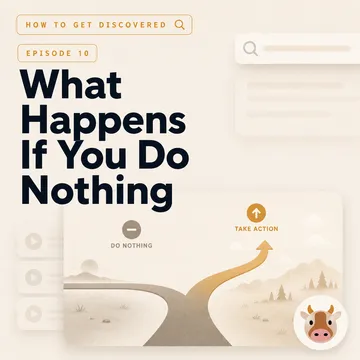
What Happens If You Do Nothing
Episode 10 0:00 - 2:19

10: What Happens If You Do Nothing

Podcast Discoverability, Show A vs Show B Thought Experiment

Maya and Tom introduce the season finale of How to Get Discovered by presenting a thought experiment involving two identical podcasts. Show A invests in discoverability through proper transcripts, custom domains, and optimized show notes, while Show B continues with audio-only distribution. The experiment tracks the divergent paths of these shows over a twelve-month period to illustrate the long-term impact of technical SEO.
What Happens If You Do Nothing
Episode 10 9:01 - 11:39

10: What Happens If You Do Nothing

Tom's Self-Correction, Loyalty vs Acquisition and SEO Skepticism

Tom reflects on his past dismissiveness toward podcast SEO, admitting his eye-rolling was a defensive mechanism to avoid additional work. He clarifies his stance on listener loyalty, noting that while it is vital, it is not opposed to acquisition since every loyal listener begins as a stranger. He also acknowledges that his initial rejection of transcripts was based on outdated, poor-quality versions of the technology.

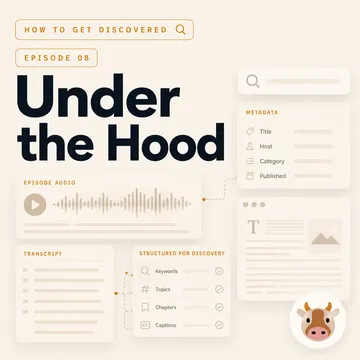
Under the Hood
Episode 8 5:50 - 9:04

8: Under the Hood

Transcript Structure and Addressable Moments via Timestamps

A raw wall of text from a machine transcription service lacks the headings and paragraph breaks necessary for effective search indexing. By breaking a transcript into sections with specific headings and timestamps, each segment receives its own unique URL or "addressable moment." This allows a user searching for a specific topic, such as freelance rate negotiation, to land directly on the relevant audio segment rather than a generic homepage.

The Question Behind the Query
Episode 7 5:51 - 9:22

7: The Question Behind the Query

Podcast Infrastructure, Building Authority and Citeability for Researchers

Technical infrastructure elements like transcripts, structured pages, and custom domains serve as surfaces that allow a podcast to present itself as an authority. Shows that become "canonical" on specific topics are often referenced by journalists, researchers, and authors because they are findable through search during the research process.

Stop Writing Bad Show Notes
Episode 6 12:22 - 13:49

6: Stop Writing Bad Show Notes

Multilingual Transcripts and AI Chatbot Discovery

The conversation explores the future of podcast discovery through multilingual transcripts and AI chatbots like ChatGPT. By providing translated transcripts, English-language podcasts can surface in foreign-language search queries and chatbot responses globally. The host mentions PodHerd as a service that automates this process, predicting that translated content will become a standard industry practice within three years.

The Episode That Won't Die
Episode 5 5:47 - 8:05

5: The Episode That Won't Die

PodHerd Implementation, Back Catalogue Indexing Results

The back catalogue was processed through PodHerd to transcribe, structure, and index every episode into sectioned pages with timestamps. After three months, episodes that previously received zero search traffic began seeing consistent weekly listens. One forgotten interview about switching from agency to in-house work emerged as a major driver of new listeners, proving that existing audio holds untapped value if it is made findable.

The Loyalty Trap
Episode 4 9:24 - 11:50

4: The Loyalty Trap

Infrastructure for Word-of-Mouth, Shareable Moments

Word-of-mouth recommendations in 2026 are described as requiring infrastructure beyond a simple MP3 feed to be effective. Listeners prefer sharing specific moments or exchanges via clips in group chats rather than assigning "homework" by sending full episode links with timestamps. Effective clip generation allows a listener to highlight a transcript passage and share a video clip with audio and attribution, making the recording portable.

When ChatGPT Recommends Your Show
Episode 3 5:23 - 8:53

3: When ChatGPT Recommends Your Show

Text-Based Discovery and the Open Web

AI chatbots currently rely on text-based data including articles, Reddit threads, and transcripts rather than directly ingesting audio files. For a podcast to exist within a chatbot's recommendation pool, it must have a presence on the open web through structured text. Unlike traditional search engines where a show might rank on a second page, being absent from a chatbot's concise answer results in total invisibility for the creator.

When ChatGPT Recommends Your Show
Episode 3 8:53 - 11:19

3: When ChatGPT Recommends Your Show

Evolution of Machine Transcripts and Structured Data

The quality of text provided to AI models is identified as a critical factor, as simple "walls of text" from raw machine transcripts are often ineffective. Modern transcription technology has improved significantly in areas like speaker separation, punctuation, and paragraph breaks, making the output more readable for both humans and AI. High-quality, structured text is presented as a necessity for moving beyond the "slab" of data that characterized early automated transcription efforts.

Whose House Are You Building
Episode 2 0:00 - 0:51

2: Whose House Are You Building

How to Get Discovered, Podcast Growth and URL Strategy Introduction

Hosts Maya and Tom introduce the episode "Whose House Are You Building?" for the podcast How to Get Discovered. The discussion focuses on the unglamorous mechanics of podcast searchability and why the specific URL where transcripts are hosted is a critical factor for long-term discoverability.

Whose House Are You Building
Episode 2 3:39 - 5:13

2: Whose House Are You Building

Domain Authority and Search Engine Trust Scores

Search engines like Google assign trust scores, formerly known as domain authority, to websites based on age, reputable links, and consistent content. When transcripts are hosted on a platform's subdomain, the SEO benefits are diluted across thousands of other shows. Hosting transcripts on a personal domain allows every share and link to accrue lasting authority and ranking power for the creator's own property.

Whose House Are You Building
Episode 2 5:13 - 7:39

2: Whose House Are You Building

PodHerd and Automated RSS Feed Transcription Services

Modern tools have simplified the process of building searchable transcript pages, which previously required significant development time. Services like PodHerd can now ingest an RSS feed to automatically transcribe and structure episodes into searchable web pages. While these pages default to the service's domain, they provide immediate benefits for listener accessibility and indexing.

Invisible Shows
Episode 1 7:57 - 10:24

1: Invisible Shows

Structured Transcripts and PodHerd for Search Traffic

Standard podcast transcripts are often published as unstructured "blobs" of text that search engines cannot effectively parse or understand. By using tools like PodHerd to index and structure episodes with specific URLs and timestamps, creators can surface specific moments for search traffic. Data from an eight-month trial showed that properly indexed old episodes began receiving steady traffic and new subscribers years after their original release.

Invisible Shows
Episode 1 13:21 - 14:11

1: Invisible Shows

Domain Authority and CNAME Technical Preview

The premiere episode concludes with a preview of next week's topic regarding where to publish podcast transcripts. The upcoming discussion will cover the trade-offs between domain authority and platform authority, specifically focusing on whether creators should host content on their own URLs. The hosts also tease a technical debate regarding the use of CNAME records for podcast SEO.