
Topic: Indexing

9 chapters across the catalog

What Happens If You Do Nothing
Episode 10 2:19 - 4:37

10: What Happens If You Do Nothing

Search Engine Indexing, Back Catalog Growth Timeline

The timeline for podcast discoverability shows that significant changes often take months to manifest in search engine results. By month three, Show A begins appearing in specific search queries for its back catalog, while Show B remains stagnant. By month six, the gap widens as older episodes from Show A generate a steady trickle of new subscribers through organic search discovery.
Under the Hood
Episode 8 0:00 - 1:47

8: Under the Hood

Technical Vocabulary Rules for Podcast Discoverability Discussion

Maya and Tom introduce a technical episode of How to Get Discovered focused on transcript indexing and search engine behavior. Maya establishes a ground rule requiring Tom to define every technical term or three-letter acronym used, such as structured data, to ensure the conversation remains accessible to listeners. Tom hints at a personal admission regarding his own podcast setup to be revealed later in the episode.

Under the Hood
Episode 8 1:47 - 4:06

8: Under the Hood

Search Engine Perception of Structured Podcast Pages

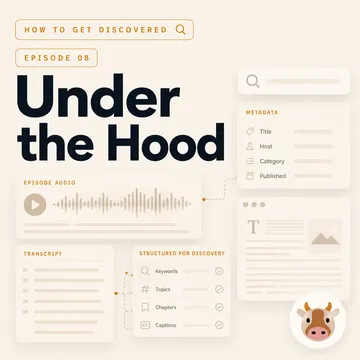
Search engines like Google and Bing interpret webpages as structured documents rather than visual layouts. While humans see headings and players, search engines read invisible metadata and tags that define whether a page is a recipe, product, or podcast episode. Properly identifying a page as a podcast episode allows search engines to surface specific moments in carousels and specialized search panels.

Under the Hood
Episode 8 5:50 - 9:04

8: Under the Hood

Transcript Structure and Addressable Moments via Timestamps

A raw wall of text from a machine transcription service lacks the headings and paragraph breaks necessary for effective search indexing. By breaking a transcript into sections with specific headings and timestamps, each segment receives its own unique URL or "addressable moment." This allows a user searching for a specific topic, such as freelance rate negotiation, to land directly on the relevant audio segment rather than a generic homepage.

Under the Hood
Episode 8 9:04 - 11:24

8: Under the Hood

Mechanics of Web Crawling and Search Indexing

The process of appearing in search results involves three distinct steps: discovery, crawling, and ranking. Google uses programs to visit pages and feed them into a giant database index based on sitemaps and domain history. Final ranking depends on a combination of metadata, transcript quality, page speed, and external links, most of which remain invisible to the end listener.

The Episode That Won't Die
Episode 5 5:47 - 8:05

5: The Episode That Won't Die

PodHerd Implementation, Back Catalogue Indexing Results

The back catalogue was processed through PodHerd to transcribe, structure, and index every episode into sectioned pages with timestamps. After three months, episodes that previously received zero search traffic began seeing consistent weekly listens. One forgotten interview about switching from agency to in-house work emerged as a major driver of new listeners, proving that existing audio holds untapped value if it is made findable.

Whose House Are You Building
Episode 2 7:54 - 10:04

2: Whose House Are You Building

CNAME Records and Subdomain Authority for Podcasts

Using a CNAME record allows podcasters to point their own URL to a third-party service's infrastructure, ensuring that Google treats the content as part of the creator's site. This technical setup ensures that compounding SEO equity stays with the creator's domain rather than the service provider. Establishing a subdomain, such as archive.yourshowname.com, can serve as a high-authority foundation for an entire podcast website.

Invisible Shows
Episode 1 7:57 - 10:24

1: Invisible Shows

Structured Transcripts and PodHerd for Search Traffic

Standard podcast transcripts are often published as unstructured "blobs" of text that search engines cannot effectively parse or understand. By using tools like PodHerd to index and structure episodes with specific URLs and timestamps, creators can surface specific moments for search traffic. Data from an eight-month trial showed that properly indexed old episodes began receiving steady traffic and new subscribers years after their original release.