Topic: Podcasting

41 chapters across the catalog

What Happens If You Do Nothing
Episode 10 0:00 - 2:19

10: What Happens If You Do Nothing

Podcast Discoverability, Show A vs Show B Thought Experiment

Maya and Tom introduce the season finale of How to Get Discovered by presenting a thought experiment involving two identical podcasts. Show A invests in discoverability through proper transcripts, custom domains, and optimized show notes, while Show B continues with audio-only distribution. The experiment tracks the divergent paths of these shows over a twelve-month period to illustrate the long-term impact of technical SEO.

What Happens If You Do Nothing
Episode 10 4:38 - 6:57

10: What Happens If You Do Nothing

Opportunity Cost, Invisible Risks of Stagnation

The cost of ignoring discoverability is framed as an invisible opportunity cost rather than a direct loss. While Show B maintains a stable audience, it fails to capture the potential growth that Show A achieves by making its archive searchable. This quiet cost is described as dangerous because the lack of immediate negative feedback prevents podcasters from realizing they are missing out on new listeners.

What Happens If You Do Nothing
Episode 10 7:01 - 9:00

10: What Happens If You Do Nothing

Maya's Self-Correction, AI Chatbots and Voice vs SEO

Maya admits to three specific errors made during the season, including underestimating the energy required for discoverability work. She acknowledges being overly confident about how AI chatbots cite sources and admits that her focus on search-friendly titles occasionally stripped the show of its unique voice. These concessions address the tension between writing for algorithms and writing for human listeners.

What Happens If You Do Nothing
Episode 10 9:01 - 11:39

10: What Happens If You Do Nothing

Tom's Self-Correction, Loyalty vs Acquisition and SEO Skepticism

Tom reflects on his past dismissiveness toward podcast SEO, admitting his eye-rolling was a defensive mechanism to avoid additional work. He clarifies his stance on listener loyalty, noting that while it is vital, it is not opposed to acquisition since every loyal listener begins as a stranger. He also acknowledges that his initial rejection of transcripts was based on outdated, poor-quality versions of the technology.

What Happens If You Do Nothing
Episode 10 11:39 - 13:10

10: What Happens If You Do Nothing

Back Catalog Assets, Making Invisible Work Findable

The core argument of the season is that a podcast's back catalog should be treated as a valuable asset rather than a dead archive. Most podcasters underrate their past work, leaving high-quality conversations invisible to potential new listeners. The responsibility for making this content findable rests solely with the creator, moving beyond simple reliance on platforms or word-of-mouth.

What Happens If You Do Nothing
Episode 10 13:10 - 15:29

10: What Happens If You Do Nothing

PodHerd Tool, Ownership and Domain Strategy

Tom reveals he has signed up for the PodHerd tool on a paid tier to integrate Search Console and manage his own domain via CNAME. He explains this shift as a move toward "building his own house" rather than relying on third-party platforms for his digital presence. This transition marks a change in his philosophy from skepticism to active implementation of discoverability infrastructure.

What Happens If You Do Nothing
Episode 10 15:29 - 17:07

10: What Happens If You Do Nothing

Season One Outro, Future Feedback and Sign-off

Maya and Tom conclude the first season of How to Get Discovered by encouraging listeners to view their back catalogs as earning assets. They thank the audience for following the ten-episode arc and invite feedback or topic suggestions through their website. The hosts announce an indefinite break before any potential future episodes, emphasizing the importance of hosting content on one's own domain.

Compounding
Episode 9 0:00 - 2:45

9: Compounding

Maya and Tom, Podcast Back Catalog Compounding Experiment

Maya and Tom introduce the concept of compounding data in podcasting, focusing on how back catalogs perform over long horizons. Maya reports on her three-week experiment with a new podcast feed, noting that while pages are being indexed by Google, the initial traffic numbers remain small. Tom argues that three weeks is insufficient for a dataset and prepares to explain why the growth curve of a podcast differs from typical expectations.

Compounding
Episode 9 2:46 - 5:35

9: Compounding

Podcast Growth Curves, Front-Loaded vs Back-Loaded Listen Patterns

The standard podcast model is front-loaded, where the majority of listens occur within the first 30 days of an episode's release. In contrast, search-driven discovery creates a back-loaded curve where episodes accumulate listens slowly over years, often surpassing their launch month totals by year three. This discrepancy suggests that traditional industry measurements, which focus on the first 90 days, fail to capture the true value of a show's back catalog as a long-term asset.

Compounding
Episode 9 5:35 - 9:46

9: Compounding

Cohort Analysis, Measuring Long-Tail Podcast Performance

Cohort analysis allows podcasters to evaluate performance by grouping episodes by their release date rather than looking at total monthly show traffic. For shows invested in discoverability, older cohorts continue to earn listens and ad impressions at a non-zero rate, changing the ROI calculation for the time spent producing each episode. This framing reveals "dormant value" in older content that traditional hosting platforms often ignore.

Compounding
Episode 9 12:18 - 13:56

9: Compounding

Listener-Driven Clips, Resilient Distribution via Private Sharing

Clip-driven discovery operates on a different timescale than search because the trigger is a person rather than a query. A clip from an older episode can resurface in a private group chat years later if the content remains funny or surprising. This form of distribution is more resilient than search because it is not mediated by Google or AI assistant algorithms, relying instead on direct human-to-human recommendation.

Compounding
Episode 9 15:51 - 17:20

9: Compounding

How to Get Discovered Finale, Maya Upgrading to Search Console

Maya admits she is considering upgrading her PodHerd tier to access the Google Search Console integration to better monitor her experiment's data. The hosts announce that the next episode will be the season finale, featuring a "closing argument" on podcast discoverability. They plan to compare two hypothetical shows—one that invested in search and one that did not—to conclude the series.

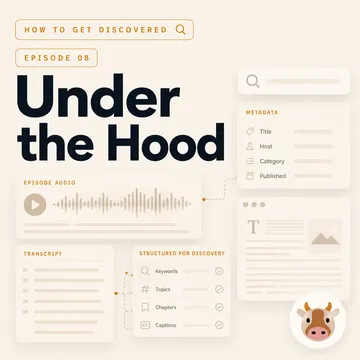
Under the Hood
Episode 8 0:00 - 1:47

8: Under the Hood

Technical Vocabulary Rules for Podcast Discoverability Discussion

Maya and Tom introduce a technical episode of How to Get Discovered focused on transcript indexing and search engine behavior. Maya establishes a ground rule requiring Tom to define every technical term or three-letter acronym used, such as structured data, to ensure the conversation remains accessible to listeners. Tom hints at a personal admission regarding his own podcast setup to be revealed later in the episode.

Under the Hood
Episode 8 1:47 - 4:06

8: Under the Hood

Search Engine Perception of Structured Podcast Pages

Search engines like Google and Bing interpret webpages as structured documents rather than visual layouts. While humans see headings and players, search engines read invisible metadata and tags that define whether a page is a recipe, product, or podcast episode. Properly identifying a page as a podcast episode allows search engines to surface specific moments in carousels and specialized search panels.

Under the Hood
Episode 8 15:36 - 18:09

8: Under the Hood

Tom's PodHerd Experiment and Show Outro

Tom admits to starting a three-month experiment by setting up a feed on the PodHerd starter tier to test the discoverability theories discussed throughout the season. While he is currently using the podherd.com domain rather than a custom CNAME, he intends to use the resulting data to validate Maya's claims about search performance. The hosts conclude the episode by previewing next week's discussion on data compounding.

The Question Behind the Query
Episode 7 0:00 - 1:14

7: The Question Behind the Query

How to Get Discovered, The Question Behind The Query

Hosts Maya and Tom introduce the "The Question Behind The Query" episode of the How to Get Discovered podcast. The discussion focuses on three core pillars: long-tail search intent, becoming a cited resource for journalists and researchers, and the relationship between listener loyalty and acquisition.

The Question Behind the Query
Episode 7 2:47 - 5:50

7: The Question Behind the Query

Listener Personas, One-Clip versus Relationship and Authority Listeners

Podcast listeners are categorized into three types based on their search behavior: the one-clip listener seeking a quick tip, the relationship listener looking for a new show rotation, and the authority listener seeking a trusted expert. Most podcasts fail to capture these diverse audiences because they only present themselves as a standard episode feed rather than providing clippable or authoritative surfaces.

The Question Behind the Query
Episode 7 5:51 - 9:22

7: The Question Behind the Query

Podcast Infrastructure, Building Authority and Citeability for Researchers

Technical infrastructure elements like transcripts, structured pages, and custom domains serve as surfaces that allow a podcast to present itself as an authority. Shows that become "canonical" on specific topics are often referenced by journalists, researchers, and authors because they are findable through search during the research process.

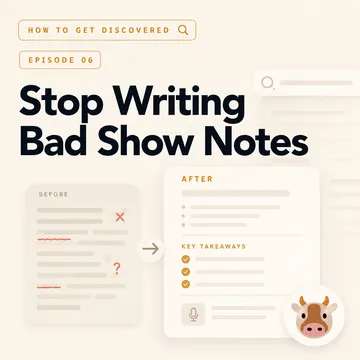
Stop Writing Bad Show Notes
Episode 6

6: Stop Writing Bad Show Notes

Podcast Show Notes as Pitches Not Labels

Maya and Tom introduce the concept of "easy wins" for podcast discoverability, focusing on the critical role of show notes. Tom confesses to writing poor, one-sentence show notes for three years before realizing they serve as a pitch to potential listeners rather than just a receipt or label. The discussion emphasizes that show notes are the second thing a stranger sees after the title, directly influencing whether they hit play.