Topic: Seo

Seo comes up in 6 chapters across 5 episodes of How to Get Discovered, from August 2026 to September 2026.

Related topics

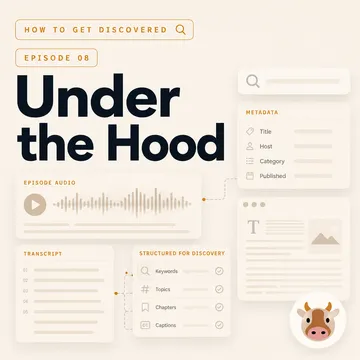
Under the Hood
Episode 8 • • 14:50 - 16:20

8: Under the Hood

Realistic SEO Growth and Next Week Preview

Maya challenges Tom to demonstrate the realistic, often "dull" first month of SEO results for an ordinary podcast rather than focusing on outlier success stories. They agree to a case study for the following week that will examine compounding growth and why some episodes provide long-term value while others fade quickly. The episode concludes with a preview of the "compounding" topic and a final jargon count.
seo growthcompoundingpodcast marketingcase studyanalytics
The Question Behind the Query
Episode 7 • • 13:04 - 13:48

7: The Question Behind the Query

Preview of Technical Metadata and Jargon-Free Search SEO

The hosts conclude the episode by previewing next week's technical deep dive into what search engines see when crawling a podcast page. Maya plans to explain metadata, structured transcripts, and domains while adhering to a "no jargon" rule enforced by Tom. The episode ends with a reminder to check listener feedback folders and a sign-off.

metadatastructured transcriptsseopodcastingjargon
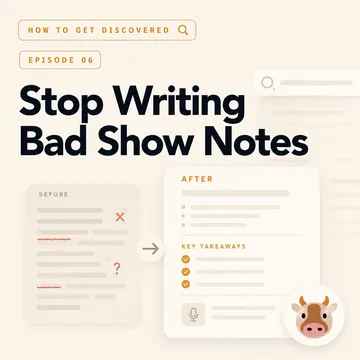
Stop Writing Bad Show Notes
Episode 6 • • 2:01 - 5:39

6: Stop Writing Bad Show Notes

Three-Part Structure for High-Converting Show Notes

A specific three-part framework for show notes is proposed to replace generic descriptions. The structure includes a "hook" paragraph framed for strangers, a "substance" section detailing three or four specific topics covered, and a "takeaways" section highlighting the guest's expertise. This approach prioritizes search-friendly phrases and concrete value over internal references, aiming to turn the show notes into a "better shop window" for the audio content.

copywritingseosearch intentpodcast marketingcontent structure
Stop Writing Bad Show Notes
Episode 6 • • 5:39 - 7:51

6: Stop Writing Bad Show Notes

Three Common Podcast Title Failures and the Descriptive Alternative

Episode titles are categorized into three failing groups: "cute" inside jokes, "lazy" episode numbers, and "stuffed" keyword-heavy strings. Tom explains that Apple Podcasts provides a dedicated field for episode numbers, making them redundant in titles. A fourth alternative is suggested: descriptive titles that lead with a strong point of view or a human-centric summary of the episode's value to attract new listeners.

podcast titlesapple podcastsseouser experiencebranding
Whose House Are You Building
Episode 2 • • 2:00 - 4:51

2: Whose House Are You Building

Domain Authority and Long-Term SEO Credit

Search engines like Google build trust in established websites over time, a concept historically referred to as domain authority. When podcasters host episode pages on a hosting provider's subdomain, the SEO credit benefits the host rather than the creator. Maintaining a personal domain ensures that links, rankings, and bookmarks remain portable even if the creator changes hosting networks or services.

seodomain authoritygoogle searchbacklinkssubdomains
Invisible Shows
Episode 1 • • 6:21 - 7:50

1: Invisible Shows

Evolution of Podcast Transcripts and Search Engines

The effectiveness of podcast transcripts has evolved from simple walls of text to structured data that search engines like Google can index more effectively. Older methods of posting unformatted transcripts often failed to drive traffic because they lacked the headings and timestamps necessary for search engines to categorize specific topics within an audio file.