

Episode 3 · Tuesday, 24 March 2026

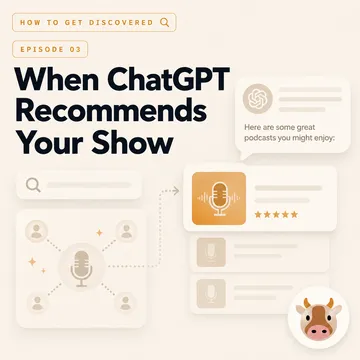
When ChatGPT Recommends Your Show

The transition from Google search boxes to conversational AI chatbots creates a new era of invisibility for podcasts lacking high-quality structured text and transcripts.

By How to Get Discovered | 15m listen | 7 chapters
When ChatGPT Recommends Your Show cover
How to Get Discovered · No. 3

About this episode

OpenAI's ChatGPT and competitors like Perplexity and Gemini are fundamentally altering how audiences find audio content by replacing traditional search boxes with conversational queries. This permanent shift in listener behavior forces creators to move beyond legacy SEO to capture 'soft' recommendations for niche topics like beekeeping. While word-of-mouth remains a primary driver, the rapid adoption of AI search among tech-adjacent demographics creates a new gatekeeper for the podcasting industry.

AI chatbots currently prioritize text-based data from Reddit threads and structured transcripts over raw audio files. PodHerd now offers a solution by converting MP3s into searchable articles with extracted topics and functional timestamps, preventing the 'invisibility' that occurs when shows lack a text presence on the open web. Modern transcription technology has evolved past the unreadable 'slab' of early machine output, now providing the speaker separation and punctuation necessary for LLM ingestion. These structured pages ensure that shows appear in concise chatbot answers rather than being buried on the second page of Google.

Concerns regarding the 'summarization trap' suggest that AI middlemen might satisfy curiosity without listeners ever pressing play on an episode. Maya and Tom argue that personality-driven content remains the only defense against this automated extraction of value. The program concludes with a preview of 'The Loyalty Trap,' a future segment challenging the industry obsession with search-based growth in favor of deep audience retention.


CHAPTER 01 / 7 Discussion

AI Chatbots and the Future of Podcast Discovery

Maya and Tom discuss the shifting landscape of how audiences find content, specifically focusing on the transition from traditional search boxes to AI chatbots. While the interfaces of tools like ChatGPT, Perplexity, and Gemini are expected to evolve significantly over the next three years, the underlying behavioral shift toward conversational queries appears permanent. This change specifically impacts "soft" recommendation questions, such as users seeking specific podcast topics like beekeeping.

chatgpt· podcast discovery· search engines· artificial intelligence· user behavior

00:00 Welcome back to How to Get Discovered. I'm Maya And I'm Tom. HTGD is the show where we argue about how podcasts get found. Last week, we did the case for owning the URL your transcripts live on. Tom grudgingly conceded one specific feature was interesting — which I am still counting as a win. It's not a win. Today's episode is called, When Chat GPT Recommends Your Show. It's about what happens to podcast discovery when people stop typing into search boxes and start asking chatbots... Which is a thing that IS happening! ...which is a thing that IS happening. And I'm going to argue it matters for podcasters. Tom will argue we don't really know what it means yet and should be careful about what we build for it. That's roughly my position… Let's get into it.

00:54 Last week, you said you were going to come into this episode arguing that what we call AI search today is gonna look quaint in three years. I am gonna argue that! So before we even start...I want to agree with you on that and then disagree with the conclusion you're drawing from it That's a sneaky opening. It's a fair opening, because I think you're right! The way AI assistants work today — the way chat GPT and perplexity and Gemini work when you ask them a question — is going to look primitive in three years. The interfaces will be different. The models will be different. The whole vocabulary will have moved on. Right… But...

01:37 Here it comes. But the underlying shift? That people are increasingly asking a chatbot what they used to ask a search box? That's not going to reverse! THAT part is the thing that's permanent, The form will change...the behavior won't. Okay I want to push back on that but only after I make sure I understand what you're actually claiming. Spell it out. Sure The claim is, for a growing number of people the first thing they do when they want to know something is open a chatbot not a search engine. Especially for soft questions recommendation questions What should I watch tonight? What podcast should I listen to about beekeeping? Questions where they want an answer not a list of links And...

CHAPTER 02 / 7 Discussion

Stability and Adoption of AI Search Recommendations

The discussion addresses the current scale of AI search, noting that while traditional Google searches and word-of-mouth still dominate podcast discovery, AI adoption is growing fastest among tech-adjacent audiences. Concerns are raised regarding the instability of chatbot answers, which can vary by day or prompt. The argument is made that podcasters should focus on being "discoverable" by these models rather than trying to optimize for specific, fluctuating queries.

google· technology adoption· search trends· podcasting· market share

02:25 And those people are getting answers. The chatbot says, here's a show you should listen to... Here's why… Here's where to find it… and the question for us as podcasters is when that conversation happens does your show ever come up? Right! Okay that's the claim let me push on it So my pushback is this. I think you're overestimating how much of search is going through chatbots right now, and I think you're underestimating how unstable the answers chatbot's give actually are Which means anything you do to optimize for them might be optimizing for something that doesn't exist in 18 months. Both of those are real points Let me take them in order First, most search is still search Most people still type things into Google Most podcast discovery still happens through podcast apps Through word-of-mouth Through other podcasts The chatbot thing IS real but it's a slice And the slice is loudest among people who work in tech

03:25 Podcasting is a podcast that's loudest among the people writing about podcasting, which means it sounds bigger than it is. I'm with you so far. Second, chatbot answers are unstable. Ask the same question to the same model twice and you can get different recommendations. Ask it on different days, different versions of the model, different prompts... You get different shows! So the idea that you can build something durable on we want ChatGPT to recommend us feels like building on sand. Those are both fair points Let me concede the first one completely, because I think you're right about the proportion. Most search is still search. I'm not arguing that chatbots have replaced search engines—I am arguing that they will increasingly coexist and that the slice you are describing—the loud tech-adjacent slice—is the slice that grows fastest. We both know how technology adoption works. The thing that's a slice today is the default in five years.

04:24 Often. Often, not always...okay But the second point is the more interesting one. Because you're right that chatbot answers are unstable, I want to take that one seriously. Please do! I think you're right that you can't build anything on we-want-to be-the answer-to this specific question—that's chasing noise. The recommendation moves, the model changes… The query changes... If you optimize for being recommended, you'll go mad. Right. But that's not what I'm arguing for What I'm arguing for is, be the kind of thing a chatbot can find when it goes looking. Be discoverable, be readable, be structured—be on the open web! Don't try to be the answer—try to be in the pool of things that could be the answer. Because the pool of things a chatbot will pull from is a much more stable set than which specific thing it picks on a given Tuesday.

CHAPTER 03 / 7 Discussion

Text-Based Discovery and the Open Web

AI chatbots currently rely on text-based data including articles, Reddit threads, and transcripts rather than directly ingesting audio files. For a podcast to exist within a chatbot's recommendation pool, it must have a presence on the open web through structured text. Unlike traditional search engines where a show might rank on a second page, being absent from a chatbot's concise answer results in total invisibility for the creator.

perplexity· gemini· transcripts· show notes· seo

05:23 Okay, that's a more defensible position than I expected. Thank you! I'm still suspicious of it but...it's more defensible? I'll take more defensible So this gets to the bit I really wanted to talk about today which is what is in the pool a chatbot pulls from What can it actually see And I think most podcasters have not thought about this for 30 seconds. Most podcasters have not thought about this for 3 seconds! Right, so let's do it… When you ask ChatGPT or Perplexity or Gemini or any of them to recommend a podcast about beekeeping for beginners

06:08 What is it doing? Hand wave it for me. It's broadly looking at the text it was trained on, plus in most cases now the live web. It's looking at what has been written about beekeeping podcasts – articles, reviews, Reddit threads, listener comments, show notes pages and increasingly transcripts. It's looking at texts everywhere. Text not audio. Not audio. This is the thing I think is the most important sentence in the episode so far. Chatbots, for now and for the foreseeable future read text they do not listen to podcasts They cannot ingest your audio They cannot tell what your show was about from the mp3 They can only tell what your show was about from text that exists about your show Right So when somebody asks Perplexity for beekeeping podcast

07:05 Perplexity is not listening to your show. It's reading what has been written about your show, and if nothing has been written—if there are no transcripts, no detailed show notes, no rich text descriptions, no reviews...nothing—then your show might as well not exist…to the chatbot! Even if it's the best beekeeping podcast on earth? Even if it's the best beekeeping podcast on earth. The chatbot doesn't know that, It can't know that! It can only know what is written down Okay so your argument is and tell me if I'm getting this right Your argument is That way to be findable by chatbots Is to have a lot of good text about your show On the open web That is exactly my argument

07:50 That's the same argument as the SEO argument. Yes? That's the same argument as the transcripts argument. Yes? So, the AI thing isn't really a new argument it's the same argument with a different scary word on the front I would phrase it differently but yes functionally what makes you findable by a search engine is roughly the same set of things that make you findable by a chatbot Indexed, structured, readable text on the open web. Ideally on a domain that has some authority to it. So why are we doing a whole episode about it? Because the stakes are different. With Google, if you don't rank you're on page 2 and some people scroll to page two with a chatbot If you're not in the answer You don't exist There's no page 2 The chat bot says here are three shows and the listener doesn't say give me three more That's true So the cost of being invisible is higher The thing that was attacks in the old world is more like a barrier in the new one Hmm okay I'll grant you that

CHAPTER 04 / 7 Discussion

Evolution of Machine Transcripts and Structured Data

The quality of text provided to AI models is identified as a critical factor, as simple "walls of text" from raw machine transcripts are often ineffective. Modern transcription technology has improved significantly in areas like speaker separation, punctuation, and paragraph breaks, making the output more readable for both humans and AI. High-quality, structured text is presented as a necessity for moving beyond the "slab" of data that characterized early automated transcription efforts.

machine transcription· speaker separation· formatting· user experience· data quality

08:53 The cost of invisibility is higher in the chatbot world. That changes the maths! Now, I want to make a point that goes the other direction... Because if we're going to argue that text is the whole game for AI discovery then I want to talk about the quality of the text because there is a temptation and I have seen podcasters do this to dump a machine transcript onto a page and call it done Yes. And the machine transcript is... it's serviceable, it gets the words mostly right but has no paragraphs, no structure or headings It has the speaker's name attached but doesn't know which lines are important and throwaway, what the episode is about — just a wall of words Right

09:43 And I have a sneaking suspicion that the chatbot, when it goes looking for something to recommend, prefers structured text. Articles — things with headings, things with paragraphs — things that look like the documents it was trained on not a wall of unbroken speech transcription That is broadly correct The chatbot does prefer structured text and here's the bit where I have to admit something Oh The first time I put my show through transcription, years before PodHerd. I did exactly what you just described. I had a machine transcript. I pasted it onto a page... wall of text! No paragraphs, no structure, no timestamps that did anything useful. Just…a slab. How long did you keep it like that? Embarrassingly long Did it do anything for you?

10:38 Almost nothing. And I think I was actually annoyed at the concept of transcripts for a long time, because I'd tried it and it hadn't worked and I concluded transcripts didn't work when in fact what hadn't worked was bad transcripts. Okay so what changed? A few things. Speaker separation got much better. Modern transcription can actually attribute lines properly, even when people interrupt each other—which they do constantly on podcasts! Yes they do. Punctuation got much better. Paragraph breaks got much better. The text starts to look like something a person wrote not like something a machine vomited

CHAPTER 05 / 7 Discussion

PodHerd and the Benefits of Rich Text Pages

PodHerd is highlighted as a service that transforms podcast audio into structured transcript pages featuring extracted topics, key moments, and functional timestamps. This approach turns a podcast page into a searchable article with an integrated player, enhancing discoverability for both search engines and AI chatbots. Proper implementation of these tools is framed as essential, as incomplete or poorly formatted transcripts may provide a false sense of progress.

podherd· timestamps· content extraction· summaries· search engine optimization

11:20 Okay. And then, and this is the bit that I think is genuinely the leap... You can take the structured transcript and you can do more with it! You can extract topics, you can extract key moments, you can generate summaries…you can attach timestamps to specific phrases so listeners can land on the exact moment somebody said the thing—all of which is rich text that a chatbot or search engine can read and understand. So the page goes from being a wall of text to being something more like an article with a player attached. More like an article with a player attached, right! And that's the version that works — not just for chatbots...for everything… For Google? For listeners landing on the page from search? Or somebody sharing a moment? This is the bit where you mention PodHerd I was going to try not too You can mention it It's relevant

12:18 This is what PodHerd does, among other things. The structured transcript page... the extracted moments… the timestamps that work I'm not going to pretend it's the only service that does this but its' the one I use and its' the one that changed my mind about whether transcripts were worth the bother Right And the broader point is if you're going to do transcripts at all Do them properly The half version is worse than nothing in a way, because it makes you think you've done the work when you haven't. This is I think the thing where we agree most this episode. I think so too...I want to close the episode with a worry though

CHAPTER 06 / 7 Discussion

AI Summarization and the Threat to Listener Engagement

A concern is raised regarding chatbots acting as middlemen that summarize podcast content, potentially satisfying a listener's curiosity without them ever hitting play. This scenario poses a threat to traditional audience growth and fan loyalty. The suggested defense against this "summarization trap" is to create personality-driven shows where the value lies in the host's voice and the nuances of the conversation, which AI cannot easily replicate.

middleman· content summarization· audience retention· host personality· future of media

13:00 My worry is that we're heading into a world where the chatbot is the middleman between the listener and the show. And the listener never actually sees the show page, they never sign up, they never become a fan... They just ask the chatbot a question, the chatbot reads three transcripts, summarizes an answer…and the listener moves on without ever hitting play! That's a real worry. That's the version of AI discovery that I find genuinely scary Not because chatbots can't find us, but because they can find us, summarize us and then the listener doesn't need us anymore. I think that's a worry we have to take seriously and I don't have a clean answer to it

13:44 I think part of the answer is, the kinds of shows that survive that version of the world are ones the chatbot can't summarize. The ones where value is the host—the voice—the way conversation moves... The one's where reading three transcripts doesn't give you the thing. Which is most of the best shows? Which is… hopefully most of the best shows I'm not entirely reassured. I think the future is genuinely uncertain, but I think the thing to do right now is be findable—be in the pool—be the show that Chatbot can recommend if it wants to… and then trust that what makes your show good is the bit that Chatbot can't replicate. That's a more measured place to land than I expected from this episode...

CHAPTER 07 / 7 Discussion

The Loyalty Trap and Future Episode Preview

The hosts conclude the episode by previewing a future discussion titled "The Loyalty Trap," which will challenge the industry's obsession with search-based discoverability. The upcoming segment intends to argue that focusing on existing loyal listeners is more valuable than chasing new ones through search optimization. The episode ends with a standard sign-off for the How to Get Discovered program.

loyalty trap· listener retention· discoverability· podcasting strategy· sign-off

14:38 Next week is the one I have been looking forward to. This is the one we're calling The Loyalty Trap. This is the episode where I get to make the case that chasing new listeners through search is mostly a distraction from making a show that loyal listeners actually love, and that the obsession with discoverability has done more damage to podcasting than it's done good And it's the episode where I come prepared. Embracing! You should be... I am!!! Thanks for listening to How to Get Discovered, we'll see you next week See ya next week