

Episode 6 · Tuesday, 14 April 2026

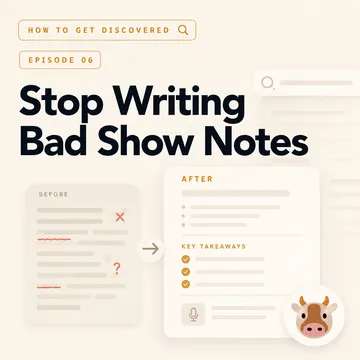
Stop Writing Bad Show Notes

A new three-paragraph framework for episode descriptions transforms show notes from simple labels into high-conversion pitches that capture search traffic and new listeners.

By How to Get Discovered | 14m listen | 7 chapters
Stop Writing Bad Show Notes cover
How to Get Discovered · No. 6

About this episode

Tom and Maya reveal a three-paragraph framework for podcast show notes designed to convert strangers into listeners. This strategic shift moves away from one-sentence labels toward a structured pitch that prioritizes the hook, substance, and guest credibility to drive measurable growth in listener analytics.

Podcast titles now fall into four distinct categories ranging from keyword-stuffed to human-centric descriptive formats. Strategic metadata optimization involves selecting niche subcategories like investing or careers on Apple Podcasts and Spotify to bypass broad competition in the business charts. PodHerd and other automation tools now facilitate multilingual transcripts, allowing English-language shows to surface in global ChatGPT queries and foreign-language search results. Feed descriptions in hosting platforms remain a critical discovery tool that many creators neglect by leaving fields blank or using minimal one-liners.

Tom admits to three years of writing poor descriptions before adopting this 15-minute process for the marginal gains stack. The episode concludes with a preview of long-tail search intent and the specific ways journalists reference audio content in digital reporting.


CHAPTER 01 / 7 Discussion

Podcast Show Notes as Pitches Not Labels

Maya and Tom introduce the concept of "easy wins" for podcast discoverability, focusing on the critical role of show notes. Tom confesses to writing poor, one-sentence show notes for three years before realizing they serve as a pitch to potential listeners rather than just a receipt or label. The discussion emphasizes that show notes are the second thing a stranger sees after the title, directly influencing whether they hit play.

show notes· podcast discovery· listener retention· episode titles· conversion

00:00 Welcome back to How to Get Discovered. I'm Maya And I'm Tom. HTGD is the show where we argue about how podcasts get found. Last week, I told a story about an episode that wouldn't die and Tom admitted—for the first time—that he might actually go and do something which I have not let him forget She has not let me forget Today's episode is the one we've both been looking forward to. It's the easy wins one, stop writing bad show notes! The things you can do this afternoon without rebuilding anything that will make your show more findable. This is my territory. This is Tom's territory he's gonna be slightly unleashed for the next half hour I'm going to interject occasionally to keep him honest She's going to interject more than occasionally

00:50 I'm going to interject more than occasionally. Let's get into it! I want to start with a confession. Oh good For the first three years of making podcasts, I wrote my own show notes and they were terrible They were terrible in a specific way They were terrible in the way that almost every show notes I read are terrible They were one sentence long The sentence was usually This week I talked to Brian about freelancing That was the whole show notes for three years For three years. And the reason I wrote them like that, and I think this is the reason most podcasters write them like that... ...is that I thought of show notes as a kind of receipt—a label—a thing that tells you which episode this is so you can scroll past it in the feed. I did not think of them as a piece of writing that anybody was going to read

01:44 And then? And then I had a conversation with, actually with the person who got me thinking about any of this stuff. Who pointed out that the show notes are the second thing every potential new listener sees The first thing is the title The second thing is the show notes and if both of those are useless... ...the listener doesn't hit play They scroll past Which is sometimes 100% of what determines whether your work gets heard A hundred percent The episode could be the best episode you've ever made. If the title is Episode 47 and the show notes are, This week I talked to Brian about freelancing then the only person hitting play is somebody who was already going to. This is your whole argument for this episode isn't it? This is my whole argument for this episode Most show notes are written as labels they should be written as pitches Ok let's get practical What does a good show note look like

CHAPTER 02 / 7 Discussion

Three-Paragraph Structure for Effective Podcast Show Notes

A specific three-paragraph framework is proposed to improve podcast show notes and measurable listener growth. The structure includes a "hook" paragraph framed for strangers, a "substance" paragraph detailing specific topics for SEO, and a "credibility" paragraph explaining the guest's expertise. Implementing this 15-minute process has resulted in a measurable increase in new listeners according to the show's analytics.

copywriting· hook· seo· guest credibility· analytics

02:40 I'll give you my structure. This is what i do now, it took me an embarrassingly long time to land on so don't roast me for how obvious it is. I won't roast you... First paragraph The hook What's the episode about? Framed as something a stranger would care about Not-I talked to Brian about freelancing Something more like… Brian whoever spent 10 years freelancing before incorporating and he walked us through every decision that made him glad he waited That's a sentence somebody might actually read. Right… Second paragraph, the substance—what do we actually talk about? Three or four specific things—not a list, a paragraph because if a person is on the fence, the substance paragraph is what tips them. They want to know whether the episode addresses the thing they care about so you tell them! Concretely. Concretely. Concretely

03:34 We talk about when to incorporate, why his accountant pushed back how the tax maths actually works in year one and the one piece of paperwork he wishes he'd known about. That's a paragraph that tells you whether this episode is for you. I like that, because it's also the thing a search engine reads—those specific phrases are the things people Google. That is where my practical instincts and your SEO instincts converge. They converge constantly… You just don't like admitting it. I don't like admitting it... Third paragraph Who's the guest? Why should anyone care? Their actual credibility not their job title

04:14 Not, Brian is a freelance consultant. More like, Brian's been freelancing since 2012 has worked with clients across X and Y and writes a newsletter that whatever specific verifiable the thing that tells a stranger why this person's opinion is worth 30 minutes are you doing this for every episode I am now it takes me Honestly, about 15 minutes per episode. Which given how much time I spend on the audio is nothing and the difference it makes is...I have actually checked measurable. Define measurable? I can see in the show's analytics that episodes with better show notes get more new listeners per week than ones with older bad show notes

CHAPTER 03 / 7 Discussion

Four Categories of Podcast Episode Titles

Podcast titles are categorized into four types: cute/in-joke titles, lazy numbered titles, keyword-stuffed titles, and human-centric descriptive titles. The hosts argue for a structure that leads with a descriptive phrase followed by a guest name or "voice" hook to satisfy both search engines and human readers. They conclude that creators should "write for the stranger" while trusting regular listeners to tolerate less creative, more functional titles.

episode titles· keyword stuffing· descriptive titles· user experience· search intent

05:07 The difference isn't enormous, but it's there. And the only thing that changed between the bad show notes and the good show notes is the show notes! This is the bit where I have to ask the slightly annoying question... Go Where do those show notes live? Because I know the answer is going to make me happy. I know what you're doing. The answer is on my own domain Yesssssssssssssssssssssssssssssssssssssssssssssssssssssssssssssssssssssssssssssssssssssssssssssssssssssssssssssssssssssssssssssssssssssssssssssssssssssssssssssssssssssssssssssssssssssssssssssssssssssssssssssssssssssssssssssssssssssssssssssssssssssssssssssssssssssssssss I'm just noting it for the record. It is noted! Right, titles…I want to come back to titles because we touched on them in episode 2 and i think there's more to say There's a lot more to say Go Most podcast episode titles fall into one of three categories Category 1 – The Cute Title Brian's Big Day The One About the Thing

06:03 In-jokes, wordplay. Things that mean something to the host and nothing to anyone else. Category 2. Category 2 – The Lazy Title Episode 47 Episode 47 – Brian A number, a name…nothing else. Category 3. Category 3 – The Keyword Stuff title How to negotiate your freelance rate. Freelance tips, freelance advice, freelance negotiation with Brian. Which is what happens when somebody reads one article about SEO and decides to apply it. I have seen episodes titled that way We have all seen episodes titled that way They are worse than the cute titles They're not for humans, they're for a search engine that doesn't actually work the way the host thinks it does Right So my whole pitch is there's a fourth category

06:57 Which is a title that tells a human what the episode is about, in human words. With the descriptive part doing the lifting and a bit of voice on the edges Give me the structure Sure The structure I use is Descriptive Bit then either a guest name or a voice bit How to negotiate a freelance rate with Brian whoever When to incorporate your freelance business? Brian Whoever explains the maths Sometimes I'll lead with a voice bit if the episode has a strong angle. Don't incorporate yet! Brian whoever on the tax trap nobody warns you about, that one is doing double work—it's descriptive and it's got a hook. I want to push back gently here because I think there's a tension between writing for the regular listener and writing for the stranger

07:48 The regular listener doesn't need how to negotiate a freelance rate. They know your show, they know the episode is going to be a conversation For them the descriptive bit is a tax The voice bit is what makes them want to listen I'll partially concede that But I think the descriptive bit is a tax the regular listener happily pays Because they're scrolling their feed They wanna know what each episode is about The descriptive bit helps them too. Fair And this is the bit I keep coming back to... The regular listener will hit play whatever you call the episode They might prefer the cute title, but they're not the constraint. The constraint is the stranger. The stranger needs the descriptive bit So you write for the stranger and let the regular listener tolerate a slightly less cute title That's a good way to put it Write for the stranger

CHAPTER 04 / 7 Discussion

Metadata Optimization and Strategic Category Selection

The discussion shifts to the technical metadata fields in hosting platforms, such as show descriptions and category tags, which dictate how apps like Apple Podcasts and Spotify render a show. Tom explains the strategic advantage of choosing specific subcategories like "investing" or "careers" over broad categories like "business" to reduce competition and increase chart visibility. While category browsing is a marginal gain, it contributes to the overall "marginal gains stack" for discovery.

metadata· apple podcasts· spotify· podcast categories· chart rankings

08:42 Trust the regular listener to tolerate it. Write for the stranger, trust the regular listener Okay, now I want to do the bit that nobody enjoys but which matters. Metadata. Metadata... Specifically the bits of your podcast feed that you set once and then never look at again? Yes… The show description, the category, the episode description, the author, the artwork title, the episode tags—all the boring fields in your hosting platform. The fields nobody fills in properly

09:18 The fields nobody fills in properly. And the point is, these fields are what every podcast app uses to render your show—they're what Apple uses to categorize you—they're what Spotify shows in the description… they're what directories pull... They are doing more work for your show than most podcasters realize. I want to give a specific example of this, because I had a thing happen to me with category selection that I wish I'd known about earlier… Go! When you set up a show, you pick a category – Apple has a primary category and secondary category – and most podcasters pick the category that sounds most like their show so

09:56 So, if you make a show about money you pick business or investing and then move on. But what most podcasters don't think about is the category determines who you're competing with for the chart and in big general categories you're competing with shows that have 100 times your budget You will never chart in business Nobody's finding through the Business category It's a chart populated by shows that already have audiences Whereas a more specific subcategory, investing might be too big. But something more like non-profit or careers has a much smaller pool, much less competition and is the actual category your audience is browsing if they're browsing by category at all

10:43 You're better off being visible in a small category than invisible in a big one. This is the bit where I want to remind people that very few new listeners find a show by browsing categories. Few do, some do—enough to matter for the kind of marginal gains we're talking about this episode. Fair. Marginal Gains Stack. The other thing I want to mention briefly is the episode description in the feed, which is—and I keep harping on this—the field that every podcast app pulls from to show your show notes. And it's the thing every podcaster writes once in their hosting platform's editor and never updates. It's often blank or it's a cute one-liner…or it's the lazy, This week I talked to Brian. Right?

CHAPTER 05 / 7 Discussion

Importance of Feed Descriptions in Podcast Apps

A distinction is made between show notes on a website and the episode description field within a podcast feed. Many creators neglect the feed description, leaving it blank or using a one-liner, which prevents mobile app users from seeing the detailed pitch. The hosts stress that copying website show notes into the hosting platform's description field is a vital, free task that takes only 30 seconds.

rss feed· podcast apps· episode description· user interface· hosting platforms

11:31 That field is the entire reason most listeners decide whether to hit play in their podcast app. And if you put a single boring sentence in it, you've thrown away the work you did on show notes on your website because the listener in the podcast app doesn't see your website's show notes — they see the feed description so you have to do the work twice or at least copy across This is a deeply boring practical tip, and it's also probably the most useful thing in the episode. It's deeply boring! It's also the thing that's free and that takes 30 seconds per episode I want to take a small detour because while we're talking about who can read your stuff and find your show... ...I want to mention something I think is going to matter more over the next few years which is multilingual transcripts Go on

CHAPTER 06 / 7 Discussion

Multilingual Transcripts and AI Chatbot Discovery

The conversation explores the future of podcast discovery through multilingual transcripts and AI chatbots like ChatGPT. By providing translated transcripts, English-language podcasts can surface in foreign-language search queries and chatbot responses globally. The host mentions PodHerd as a service that automates this process, predicting that translated content will become a standard industry practice within three years.

multilingual transcripts· chatbots· podherd· translation· global audience

12:22 Most podcasts are in one language. The transcript is in that language, the show notes are in that language, the metadata is in that language... which means the entire audience for the show is people who speak that language and are searching in that language. Right But chatbots increasingly bridge languages Somebody asking ChatGPT in German about freelance taxation in the UK? The chatbot might surface an English-language podcast if it can read the transcript Somebody googling in Spanish about beekeeping might end up on an English-language episode if the transcript is well structured enough that translation surfaces the content. Hmm...

13:02 And some services will transcribe your show into multiple languages automatically, which sounds like overkill until you realize that the global audience for almost every English-language podcast is significantly larger than the domestic one and that translated transcripts are the cheapest way to access that audience that has ever existed. Is this a PodHerd pitch? PodHerd does it. I'm trying not to make every episode about PodHerd, but it does and I think this is the kind of thing that three years from now every show will do as a matter of course and the shows that started doing it early will have a head start That's hard to catch up with. I'll allow that! I don't have strong opinions about it because I haven't done it But I can see the argument That's enough of a concession for me

CHAPTER 07 / 7 Discussion

Long-Tail Search Intent Preview and Outro

Maya and Tom conclude the episode by previewing next week's topic, "The Question Behind the Query," which will cover long-tail search intent and how journalists reference podcasts. They sign off after promising a list of bad search queries to analyze.

search intent· long-tail keywords· journalism· research· podcasting

13:49 So, next week… Next week. …next week is The Question Behind the Query which is long-tail search intent in depth how people actually phrase their searches what those phrasings tell you about what they want and what it means to be the show that journalists and researchers reference I'm bringing a list of bad query phrasing's to mock Please do! I will Thanks for listening to How To Get Discovered We'll see ya next week See ya next week