Topic: Podcast Growth

8 chapters across the catalog

What Happens If You Do Nothing
Episode 10 4:38 - 6:57

10: What Happens If You Do Nothing

Opportunity Cost, Invisible Risks of Stagnation

The cost of ignoring discoverability is framed as an invisible opportunity cost rather than a direct loss. While Show B maintains a stable audience, it fails to capture the potential growth that Show A achieves by making its archive searchable. This quiet cost is described as dangerous because the lack of immediate negative feedback prevents podcasters from realizing they are missing out on new listeners.

What Happens If You Do Nothing
Episode 10 9:01 - 11:39

10: What Happens If You Do Nothing

Tom's Self-Correction, Loyalty vs Acquisition and SEO Skepticism

Tom reflects on his past dismissiveness toward podcast SEO, admitting his eye-rolling was a defensive mechanism to avoid additional work. He clarifies his stance on listener loyalty, noting that while it is vital, it is not opposed to acquisition since every loyal listener begins as a stranger. He also acknowledges that his initial rejection of transcripts was based on outdated, poor-quality versions of the technology.

What Happens If You Do Nothing
Episode 10 15:29 - 17:07

10: What Happens If You Do Nothing

Season One Outro, Future Feedback and Sign-off

Maya and Tom conclude the first season of How to Get Discovered by encouraging listeners to view their back catalogs as earning assets. They thank the audience for following the ten-episode arc and invite feedback or topic suggestions through their website. The hosts announce an indefinite break before any potential future episodes, emphasizing the importance of hosting content on one's own domain.

Compounding
Episode 9 2:46 - 5:35

9: Compounding

Podcast Growth Curves, Front-Loaded vs Back-Loaded Listen Patterns

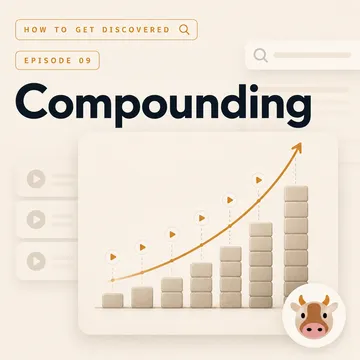
The standard podcast model is front-loaded, where the majority of listens occur within the first 30 days of an episode's release. In contrast, search-driven discovery creates a back-loaded curve where episodes accumulate listens slowly over years, often surpassing their launch month totals by year three. This discrepancy suggests that traditional industry measurements, which focus on the first 90 days, fail to capture the true value of a show's back catalog as a long-term asset.

The Episode That Won't Die
Episode 5 4:09 - 5:47

5: The Episode That Won't Die

Durable Questions vs. News Cycle Content

Analysis of a 140-episode back catalogue reveals a pattern where episodes tied to specific news cycles or temporary celebrities lose value quickly. In contrast, content addressing persistent problems maintains its audience over time. This realization suggests that chasing "hot" guests may be less effective for long-term growth than creating resources that answer timeless questions.

The Loyalty Trap
Episode 4 0:00 - 2:28

4: The Loyalty Trap

The Loyalty Trap, Case Against Growth Tactics

A discussion titled The Loyalty Trap posits that chasing new listeners through search and discoverability is a distraction from creating content for loyal audiences. The argument suggests that podcasters often optimize their way into mediocrity by prioritizing titles, thumbnails, and SEO over deep preparation and high-quality questioning. This focus on infrastructure and growth tactics is claimed to drain the energy required to make a show that listeners truly love.

Whose House Are You Building
Episode 2 0:00 - 0:51

2: Whose House Are You Building

How to Get Discovered, Podcast Growth and URL Strategy Introduction

Hosts Maya and Tom introduce the episode "Whose House Are You Building?" for the podcast How to Get Discovered. The discussion focuses on the unglamorous mechanics of podcast searchability and why the specific URL where transcripts are hosted is a critical factor for long-term discoverability.

Invisible Shows
Episode 1 0:00 - 1:40

1: Invisible Shows

How to Get Discovered Podcast Premiere and Host Introductions

Maya and Tom introduce their new weekly series, How to Get Discovered, which focuses on the mechanics of podcast growth and searchability. Maya brings a background in content marketing and asset compounding, while Tom provides a skeptical perspective based on ten years of podcasting experience. The hosts outline a ten-episode format where they will debate whether discoverability tactics or show quality are the primary drivers of success.