Topic: Health

239 chapters across the catalog

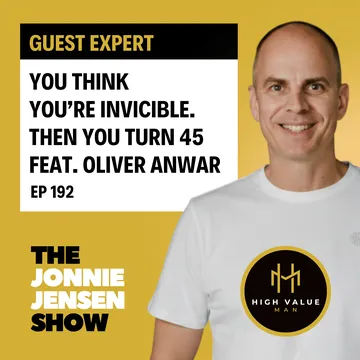
You Think You're Invincible. Then You Turn 45 feat. Oliver Anwar
Episode 192

192: You Think You're Invincible. Then You Turn 45 feat. Oliver Anwar

Oliver Anwar, Chief Health Officer for Global Executives

Jonnie Jensen introduces Oliver Anwar, a 31-year-old fitness and mindset expert based in Dubai who serves as Chief Health Officer to global executives. Jensen highlights Anwar's consistent presence on LinkedIn and notes their shared alignment in helping successful men improve their physical health and mental clarity. The discussion sets the stage for exploring how high-performing men can avoid the mid-life health crisis often seen in their 40s and 50s.

You Think You're Invincible. Then You Turn 45 feat. Oliver Anwar
Episode 192 7:10 - 12:31

192: You Think You're Invincible. Then You Turn 45 feat. Oliver Anwar

Mid-Life Health Crisis, Prioritizing Fitness for High-Performing Men

Men aged 40 to 65 often deprioritize their health in favor of career and family obligations until a medical crisis occurs. This neglect is frequently driven by societal expectations that men must carry all burdens without complaint, leading to a "toxic" stigma around self-improvement. Anwar argues that prioritizing one's own health is actually the most selfless act a man can perform, as it provides the energy and presence required to support others.

You Think You're Invincible. Then You Turn 45 feat. Oliver Anwar
Episode 192 22:59 - 25:32

192: You Think You're Invincible. Then You Turn 45 feat. Oliver Anwar

Executive Health Coaching, Data-Driven Blood Work Analysis

Oliver Anwar explains his coaching methodology, which utilizes comprehensive blood work and data to quantify health improvements for entrepreneurs and executives. His company, Fitness for Entrepreneurs, focuses on sustainable systems for busy professionals who travel frequently. By tracking specific biomarkers rather than just scale weight, clients can see objective evidence of their internal health progress.

You Think You're Invincible. Then You Turn 45 feat. Oliver Anwar
Episode 192 25:32 - 28:58

192: You Think You're Invincible. Then You Turn 45 feat. Oliver Anwar

Biomarkers and Longevity, Identifying Hidden Heart Disease Risks

Standard GP blood tests often fail to measure critical markers like Lipoprotein(a), which can indicate a high risk for heart disease even in seemingly fit individuals. Anwar shares a personal anecdote about discovering his own high Lipoprotein(a) levels, which prompted him to change habits like smoking cigars and shisha. Monitoring hormones, fasted insulin, and stress markers like cortisol is essential for men in their 40s and 50s to ensure longevity.

You Think You're Invincible. Then You Turn 45 feat. Oliver Anwar
Episode 192 28:59 - 32:17

192: You Think You're Invincible. Then You Turn 45 feat. Oliver Anwar

Sustainable Systems, Overcoming the Time Excuse for Sleep

The common excuse of "not having enough time" for fitness is challenged by comparing busy executives who successfully maintain their health. Anwar advocates for building sustainable systems, such as 90 minutes of exercise per week, rather than extreme two-hour daily workouts. Sleep is identified as the primary foundation of health; poor sleep leads to a downward spiral of bad nutritional choices and skipped training sessions.

You Think You're Invincible. Then You Turn 45 feat. Oliver Anwar
Episode 192 50:47 - 52:26

192: You Think You're Invincible. Then You Turn 45 feat. Oliver Anwar

Social Circles, The Importance of Peer Support for Men

Maintaining long-term friendships with people who are also committed to self-improvement provides a crucial support system for men. Anwar notes that his childhood friends from Bristol have all pursued their own forms of growth, which allows for honest conversations about stress and problems. Surrounding oneself with other men on a similar path is often more conducive to progress than isolated therapy.

Your Marriage Isn't Broken, It's Paused feat. Dr Lee Baucom
Episode 191 35:34 - 37:49

191: Your Marriage Isn't Broken, It's Paused feat. Dr Lee Baucom

Human Need for Mattering, Rejection in Marriage

The conversation explores the deep human need to "matter" to a spouse and the psychological impact when that need is unmet. Lee Baucom explains that feeling rejected in a core relationship can lead to depression, anxiety, or seeking validation elsewhere. In a connected relationship, a partner can decline intimacy due to fatigue without the other person feeling a global sense of rejection.

Your Marriage Isn't Broken, It's Paused feat. Dr Lee Baucom
Episode 191 40:23 - 44:20

191: Your Marriage Isn't Broken, It's Paused feat. Dr Lee Baucom

Men's Competency Fears, Globalized Failure

Lee Baucom identifies three core human fears: not being good enough (competency), not having enough (resources), and not being loved enough (connection). For men, a failure in marriage often triggers a "globalized" sense of incompetence across all areas of life. Baucom shares an anecdote about a wealthy client to illustrate that these fears are often internal perceptions rather than objective realities.

Getting Divorced Is Tough. Being Divorced Should Be Great.
Episode 188

188: Getting Divorced Is Tough. Being Divorced Should Be Great.

Jonnie Jensen, High Value Man Project Introduction

Jonnie Jensen introduces the High Value Man Project, a community and coaching program designed to help modern dads navigate divorce and midlife challenges. The discussion emphasizes that divorce should be viewed as the end of a marriage rather than the end of a life. Jensen encourages men to move past being "flaky" or "burnt out" to become charismatic, thriving leaders in their families and communities.

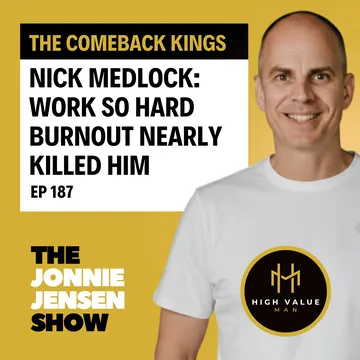
Work So Hard Burnout Nearly Killed Him feat. Nick Medlock
Episode 187 5:25 - 8:24

187: Work So Hard Burnout Nearly Killed Him feat. Nick Medlock

Childhood Reflections, Absent Fatherhood and Peer Support

Nick Medlock reflects on his childhood in a household led by a single mother with four jobs and four children. He discusses his father's move to Ireland when Medlock was approximately 13 years old and how that absence shaped his own commitment to being a present father. The conversation also covers the vital role of a solid group of friends in maintaining a teenager's mental health and preventing isolation.

Work So Hard Burnout Nearly Killed Him feat. Nick Medlock
Episode 187 14:09 - 18:36

187: Work So Hard Burnout Nearly Killed Him feat. Nick Medlock

Burnout Symptoms, COVID-19 Pressures and Physical Decline

Nick Medlock describes the onset of severe burnout in his late twenties, which was significantly exacerbated by the pressures of the COVID-19 pandemic. As a business owner responsible for 40 employees and vulnerable clients, the stress led to chronic insomnia and a dangerous decline in physical health. Despite the internal struggle, Medlock felt a societal pressure to continue working without showing weakness or stopping.

Work So Hard Burnout Nearly Killed Him feat. Nick Medlock
Episode 187 18:37 - 22:34

187: Work So Hard Burnout Nearly Killed Him feat. Nick Medlock

Health Crisis, Extreme Blood Pressure and Parenting Wake-up Call

A critical turning point occurred when Nick Medlock's young son began noticing his father's constant illness and exhaustion. Medlock reveals he was living with a daily blood pressure reading of 210, placing him at extreme risk for a stroke or heart failure, and frequently suffered from office nosebleeds. This realization prompted a shift in perspective, leading Medlock to prioritize his health and wellbeing over professional output to ensure he could remain present for his family.

Work So Hard Burnout Nearly Killed Him feat. Nick Medlock
Episode 187 36:33 - 39:26

187: Work So Hard Burnout Nearly Killed Him feat. Nick Medlock

Family Values, Guardian Angels and Fatherhood Goals

Nick Medlock discusses his commitment to his fiancée and son, whom he credits as the "guardian angels" who saved his mental health. He expresses a deep dedication to providing them with the best possible life, noting that his son's unplanned arrival provided him with a necessary focus and purpose. Medlock's current life is structured around supporting his family and fostering his son's independence.

Man Up: The Three-Step Process to Finding Your Purpose
Episode 186 5:28 - 10:15

186: Man Up: The Three-Step Process to Finding Your Purpose

Purpose Crisis, Mental Health, Modern Men and Midlife Struggles

Modern men often face a purpose crisis, feeling stuck or emasculated despite professional success. This lack of direction contributes to a mental health epidemic characterized by loneliness, depression, and obesity. The transition from university or into midlife often leaves men feeling miserable and disconnected, requiring a shift in internal responsibility to overcome these challenges.

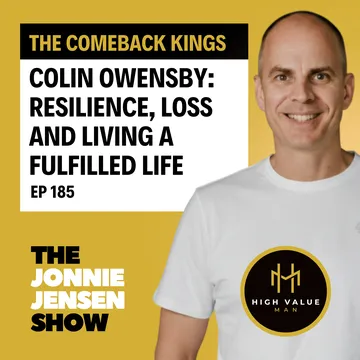
You'll Never Walk Again: Colin Owensby on Resilience, Loss and a Fulfilled Life
Episode 185 4:12 - 7:18

185: You'll Never Walk Again: Colin Owensby on Resilience, Loss and a Fulfilled Life

Resilience and Adaptability, Navigating Life Crises Without Substance Abuse

Colin Owensby discusses the importance of adaptability as the core of resilience, noting that life consists of multiple chapters rather than a single experience. He reflects on how he avoided turning to drugs or alcohol during major life tragedies, a choice he initially didn't realize was unique. The conversation focuses on developing a toolset to navigate crises in a functional, positive manner.

You'll Never Walk Again: Colin Owensby on Resilience, Loss and a Fulfilled Life
Episode 185 21:30 - 24:14

185: You'll Never Walk Again: Colin Owensby on Resilience, Loss and a Fulfilled Life

Grieving Process, Honoring Memories Without Guilt

Colin Owensby shares his perspective on grieving, describing it as a fleeting emotion that should be honored rather than becoming a permanent identity. He emphasizes the importance of focusing on positive memories and avoiding the guilt that often traps people in long-term mourning. The hosts discuss how experiencing loss early in life can change one's relationship with the concept of death.

You'll Never Walk Again: Colin Owensby on Resilience, Loss and a Fulfilled Life
Episode 185 1:05:14 - 1:07:49

185: You'll Never Walk Again: Colin Owensby on Resilience, Loss and a Fulfilled Life

Healthy Activities, Nature and Creative Outlets

The discussion continues through the pillars of resilience, focusing on healthy diet, regular exercise, and spending time in nature. Owensby advocates for getting away from urban environments to reset the mind and using creative outlets to process pain or boredom. He notes that growing up before the era of cell phones helped him develop a natural affinity for outdoor activity and imagination.

Win At Home Before You Lose It All: The 5 Step System For Midlife Men
Episode 184 4:47 - 10:10

184: Win At Home Before You Lose It All: The 5 Step System For Midlife Men

Identity Loss, The Pit Stop Analogy for Men

Men often experience a "low value death spiral" when they lose sight of their original identity and succumb to the repetitive grind of work and domestic stress. This psychological state, described as a "double bind," leaves men feeling stuck between staying in a miserable situation or leaving it. Jensen utilizes a Formula One pit stop analogy to argue that men must proactively refuel and maintain their mental health to avoid total burnout.

Ezra Vancil Addiction, Divorce and the Rebuild Nobody Saw Coming
Episode 181 13:28 - 15:51

181: Ezra Vancil Addiction, Divorce and the Rebuild Nobody Saw Coming

Fear of Failure and Music Industry Pressures

Reflecting on his youth, Ezra Vancil describes being crippled by the fear of failure while dealing with "slick" industry professionals in Los Angeles. He explains how this fear got in the way of his authentic self and contributed to a cycle of self-sabotage during his early success.

Ezra Vancil Addiction, Divorce and the Rebuild Nobody Saw Coming
Episode 181 40:27 - 45:02

181: Ezra Vancil Addiction, Divorce and the Rebuild Nobody Saw Coming

Mental Health Crisis and the Lone Wolf Persona

Ezra Vancil reflects on his history of mental health struggles, including hospitalizations and a "lone wolf" persona that romanced sadness and suicide. He connects these tendencies to the trauma of seeing his father in a state mental hospital at age 14 and his own eventual burnout and near-suicidal state.