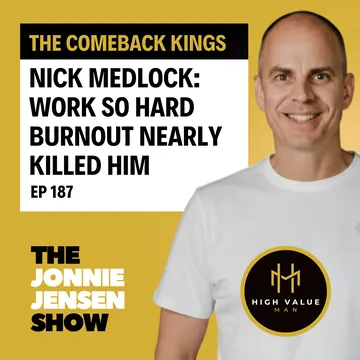
Episode 187 · Tuesday, 30 June 2026

Work So Hard Burnout Nearly Killed Him feat. Nick Medlock

A high-performance entrepreneur reveals the physical and psychological toll of scaling a family business until a near-death medical emergency forced a total life reset.

Professional BurnoutAdult Social CareCQC RatingsBlue Circle SurveyorsBusiness ExitEssex Entrepreneurship
By The Jonnie Jensen Show | 47m listen | 14 chapters
Work So Hard Burnout Nearly Killed Him feat. Nick Medlock cover
The Jonnie Jensen Show · No. 187

About this episode

Essex entrepreneur Nick Medlock suffered a life-threatening twelve-minute seizure during a client trip in Hastings, an event that saw his vital signs temporarily cease due to extreme professional burnout. Medlock, who scaled his family’s adult social care business to a multi-million pound exit, reveals how a blood pressure reading of 210/140 and chronic nosebleeds became the physical price of maintaining a six-year Outstanding rating from the Care Quality Commission.

Following the sale of the care company to secure his mother’s retirement, Medlock transitioned from the high-stakes world of learning disability support to the property sector. He partnered with chartered building surveyor Craig Medlock to launch Blue Circle Surveyors, a venture built on radical transparency and operational efficiency rather than industry-specific background. The transition highlights the shift from the relentless pressures of the COVID-19 pandemic, where Medlock managed 40 employees and dozens of vulnerable clients, to a partnership-driven model focused on large-scale projects across London and the Home Counties.

Host Johnny Jensen explores the psychological drivers behind Medlock’s work ethic, rooted in his upbringing by a single mother and a total estrangement from his father at age thirteen. Medlock reflects on the necessity of peer groups in the digital age and his commitment to raising an independent eight-year-old son who understands the value of money. The conversation captures the raw reality of a business owner who chose to walk away from a legacy to save his own life.


CHAPTER 01 / 14 Discussion

Nick Medlock Introduction and Resilience in Business

Host Johnny Jensen introduces Nick Medlock, a 33-year-old multi-business owner from Essex. Medlock is highlighted for his magnetic personality and resilience, having successfully recovered from professional burnout. The conversation aims to provide value to single dads and business-owning fathers by exploring Medlock's journey from selling his first company to launching new ventures.

nick medlock· johnny jensen· business owner· resilience· burnout· high value man project

00:00 12 minutes worth of seizure. So after two minutes, you start getting brain damage, starvation to the brain. And then what happened was my body somehow, some miracle, shocked itself back. I was extremely lucky. And the hospital said I only survived because I was so fit at the time. I went back to work the next day. That was my, my thought process is: I have to work. I have to work. That's how bad it got for me. Welcome to the Johnny Jensen Show, where modern dads discover how to create the true riches, relationships, and results they deserve.

00:42 Get your high-value man blueprint and join our community at highvalue manproject.com. Let's go. Welcome to the Johnny Jensen show. It's great to have you back here for another week. I don't know how you found me, but if you're a subscriber, then you'd have got the alert, right? And if you've actually just been sent here for the first time, then brilliant. Today's guest is Nick Medlock. I met Nick at a networking event, and I've got to tell you, by the end of the evening, there was like six people all sat around Nick listening to him talk. And for a bloke who's just 33, business owner, multiple business owner, engaged son of eight years old from a previous relationship.

01:23 I was just like, whoa, this, sorry to call him a lad, but I'm 52, right? He's 33. And I'm like, there's something about this guy that is that is magnetic. And I got him on the podcast today, really, just to chat. He's not famous. He's not really got a huge horror story to share. But what I do know about Nick is that the guy is incredibly resilient. He has recovered from burnout, now running more successful businesses after selling his first successful business. And I just really wanted to get into a conversation that I think could be a value for a lot of other dads, single dads, business owning dads. And we're just going to roll with it and see what comes up. Nick, welcome to the Johnny Jensen show.

CHAPTER 02 / 14 Discussion

Nick Medlock Upbringing and Estrangement from Father

Nick Medlock reflects on his childhood in Essex, raised by a hardworking single mother who held four jobs. He discusses his father's move to Ireland when Medlock was approximately 13 years old and their subsequent lifelong estrangement. Now a father himself, Medlock expresses a lack of desire to reconnect, citing his inability to understand walking out on a child.

essex· ireland· single mother· childhood· fatherhood· family dynamics

02:08 Thanks for having me. That's a very nice introduction. Yeah, yeah, cheers, cheers, cheers. Well, like I said, like, I'm sure you must have realized it by the event finished, and then there was like six of us still sat chatting, which basically, although it was a chat, it was you in the middle and everyone else just mesmerized, really. I don't know how fast putting it politely, but I think it overran for about an hour in the end, didn't it? Yeah, it did. It did. And obviously, you shared stuff about your business journey, right? And actually the first business and how that really involved your mum and it was really focused on adult care. And I think perhaps that really touched the heart with a lot of us. So we're going to get stuck into some of that.

02:52 But yeah, tell us a little bit about yourself. Not you don't have to go war and peace, but you know, where do you live? What are you up to? You know, I think you're Essex, 33, dad. But yeah, fill in the gaps for us. That's me predominantly. So yeah, Nick, 33 from Essex. Dad of an eight-year-old. He's my everything, business owner. Tried to put my hat in a lot of areas, trying new areas, especially at the moment for the business, which seemed to be succeeding. But above all, I just want to be a positive force for people. And I suppose that's a lot of what my message and my goal is in life. Whether that's close family, outsiders, whatever it is, I'd like to be remembered for more than just here's Nick from Essex, ran a business, if that makes sense.

03:40 Yeah, it does. I think perhaps that's what was the magnetic thing about you, right? Not every most dads go, yeah, my lads, my kids and my everything, right? It's all about them, right? But you definitely have this message about, you know, being more, more for the community, right? So where does that all come from? Like, where can you trace that back to? Suppose if I'd been super raw with it, it'd probably be for my upbringing. So for my upbringing, I had a mum who absolutely loved me. She couldn't have tried any harder. Dad's not around, but you know, that's neither here nor there to me. But a mum who couldn't have tried any harder, but we had a hard upbringing, to put it politely.

04:21 And I knew what it was like to be a kid without, or I knew what it was like, especially going to adult life and still without moving into working and caring and seeing others who are maybe in a less fortunate position than me. And I looked at my life and there's a lot of gratitude that I could take for my situation. And I just thought, anything I've gone through, learned from, I would like to stop others having to experience. And it's no skin off my back to try and be a bit positive every now and then, is it, I suppose? More people could be positive. More people could look out for other people. More people could see, you know, what's happening. Yeah, exactly, exactly. Exactly. So, what, uh, you know, how old were you when you know, was you?

05:04 I'm not 100% sure, but I would guess probably about 13, 12, 13. He moved to Ireland. Yeah. Didn't see the eye to eye with him most of my life, to be fair. So, at the time, it didn't feel like a major loss. And I was, as harsh as it sounds, happy to cut my ties. In later life, he has tried to make contact, but I've come to the decision that if when I was a kid, it wasn't good enough. Then, as I'm an adult, then the situation stays the same. So, maybe because I'm a dad now and I couldn't think of anything worse than walking out on my little, and it made me really question the morale behind moving to another country when you have children in this one.

CHAPTER 03 / 14 Discussion

Importance of Peer Groups and Childhood Friendships

The discussion shifts to the foundational importance of a solid group of friends during the teenage years to combat loneliness and isolation. Nick Medlock credits his long-term friend group for keeping him out of trouble, contrasting his experience with the fast-paced, judgmental nature of modern online social circles. He expresses concern for his eight-year-old son's ability to form similar bonds in a digital age.

mental health· isolation· football· parenting· social media· peer pressure

05:45 Each of their own, you know, he's got his own life to live on decisions to make, but that's where I stand with it. Yeah, yeah. And I think more interesting than that was really as a teenager, there you are. I mean, single, single mum. Have you got any brothers and sisters? Yeah, there's four of us. So, single mum had handful. Single mum worked very hard. She had four jobs. I suppose we helped raise each other as siblings. Very different world, I suppose, to what it is now. But yeah, there's four of us. So I've got one brother and two sisters. And what were you like? Were you always studious? Were you a good kid or were you a bit of a bit of a handful?

06:26 I would say I was in the middle. Yeah, okay. I would say that if he was to ask my mum, and she's a bias, I suppose, but she would say that I was a nice kid and I tried hard and I recognised my mum's trying hard and I wanted to help her where possible. But I probably could have pushed myself more education-wise. But I didn't like getting in too much trouble. I felt like my group of friends, they're still my group of friends now. I had a great group of friends growing up and they just weren't troublemakers. So I kept myself out of a lot of issues. But I could have probably done better with my studying. And I recognise that now that I run businesses and etc., that it could help.

07:08 Yeah, yeah. I mean, mates are so important. I mean, when I'm talking to my kids, when I'm encouraging dads I'm working with, you know, in reality, if your kids have got a solid group of mates, the rest of it, there's not, you know, you could ask them to revise more, you could ask them to do more homework, you could make sure they play a sport or a musical instrument, you can do sort of stuff like that. But really, one of the strongest foundations there is, are they lucky enough to have a strong group of mates? Because I think so much of what a teenager's mental health gets pinched on is loneliness and isolation and feeling like the odd one out. And a group of mates will always support that, really. A good group of mates. I couldn't agree more. Yeah, a good group of mates.

07:50 I couldn't agree more. So that's one of my concerns for my son growing up. Now, when I was younger, I had a good group of friends. We all loved football. We'd come play in football at the park. But now it's very online. It's very fast-natured. It's very judgmental. It's not the same. And my concern would be him growing up without a good group of friends and then the impact that has on his latter life. Now, he's a bubbly kid. He likes sports. He has friends. I just hope it spills into as he gets older. But I couldn't agree more that a solid group of friends will keep you on the right track. Yeah. Yeah. And for me, as a dad, we get to role model there. So our kids need to see us with friends.

CHAPTER 04 / 14 Discussion

Career Transition from Sainsbury's to Adult Social Care

Nick Medlock details his early career path, which began with training as a chef before moving into a full-time role at Sainsbury's. He eventually joined his mother's fledgling care company, working his way up from payroll and caregiving to deputy manager and eventually director. Medlock describes how he combined his mother's 40 years of care experience with his own business foundations to scale the company.

sainsbury's· chef· entrepreneurship· adult social care· family business· career path

08:31 You know, it's an important part of a man's balance to have his home, his business, his wife, his kids, and his social life really, really important. Yeah, I couldn't agree more. So what happened? What happened this end of school? Did you have any other jobs before you started, before you teamed up with your mum in that business? Yeah, so I initially went to college. I didn't know what I wanted to do. I suppose most teenagers don't actually know and their career falls into a certain path. I didn't know what I wanted to do, but I used to love cooking. So I trained as a chef in college. I passed my courses, but then the idea of unsociable hours did not appeal to me as I was a young teenager.

09:17 Well, going into care at this 24-7 is even worse. Initially, the idea didn't appeal to me. So I had a part-time job at Sainsbury's, went full-time. I worked my way up the ladder a little bit there. Didn't really know where I was going with my career. And then on the sidelines, my mum was setting up the care company. So she had been going for a little while. She asked me to join, but it sounds a bit rude here, but she couldn't afford for me to join because our household, I used to contribute fair bit to the household. So I had to still make sure I was bringing in a salary. But when the company was doing okay enough for me to come along, I joined, I joined in payroll. I didn't just become a a director. I joined in the payroll department, then was a carer, then deputy manager, manager, etc.

10:02 And then led into me becoming a director. So I suppose my only real job was Sainsbury's and then self-employed. Nice. It's that entrepreneurial spirit is just flipping, bursting to get out of you. I always knew I wanted to do my own thing. I didn't know the path. So I thought I was presented a major opportunity with the industry. My mum had worked in it for 40 years, so she knew it very well. Unfortunately, let's say business wasn't her strongest strength, but caring was. So the idea was I could hopefully bring in some foundations to the business and push that way.

CHAPTER 05 / 14 Discussion

High Standards in Adult Social Care and CQC Ratings

Nick Medlock discusses the challenges and rewards of supporting adults with learning disabilities and autism. He emphasizes the importance of hiring "good people" over experienced CVs, noting that some interviews lasted three hours to ensure a candidate's character fit. Under his leadership, the company maintained an "Outstanding" rating from the Care Quality Commission (CQC) for six years before its eventual sale.

cqc· autism· social care· essex· ofsted· healthcare management

10:39 And that's what ultimately pushed the business forward. And how tough is it being around adults with learning disabilities, adults with, you know, who need care? I sort of see sometimes in supermarkets or people taking people to a park or something. And, you know, there's a carer there and then there's an adult and they obviously need quite a lot of support and attention. It seems like it was a little bit isolated, like they're there trying to fit in with the everyday, with the everyday world. You know, how tough is it for to care for an adult with special needs? Very tough, but in different ways. So it's the same as being a parent. You could be a shit parent or a good parent.

11:22 You can be a bad carer or a good carer. So it all depends on the foundations of a company that push you to get to deliver the care. And do you have a good heart? So when we used to interview, I was very conscious of a CV didn't really matter to me and experience wasn't the end of the world either. Are you a good person? So some of the interviews could last three hours. I think three hours was my longest interview because we would just talk. And I used to feel if you couldn't sit and talk to me, you're going to seriously struggle to talk to someone with autism who you're going to have to carry conversation. So it can be hard. There's ups and down days. It's extremely rewarding when you can

12:04 deliver some support and change someone's life for the better. It's a feeling you can't really find in other sectors, other businesses, you know, looking at numbers, unless you're fully focused on earning money, that's satisfying in one way. But the feeling of changing your life, helping someone, you can't match it. And that's what drives the passion for it. So the things that are difficult become less difficult because you're so passionate. I hope that makes sense. To me, it did. You can look outside of the things that are difficult because you've got a goal to achieve for this person, not just yourself, not just the business. It's that person. It's their loved ones who expect from you. And that's what drives you to make sure you do a good job in the industry.

12:49 And just blow my own horn here. So the CQC, they're our regulating body. They were a bit like Ofsted at a school. And they can rate you and requires improvement. Good, outstanding. Outstanding is the top. And we were outstanding and we maintained it for, I think, six years until we sold. So the care we delivered was as high as it could be marked, shall I say? Beautiful, beautiful. And what sort of, just to put in the context of people, what sort of numbers are how many people in the community need care like this? Oh, the figures are huge. I believe now, this was two years ago. I had a meeting with someone at local authority and I believe just adult social care, so ignore NHS and all that kind of stuff, just adult social care, which is what I worked in.

13:36 I believe it costs us Essex 90 million a year. So care isn't cheap to deliver. You would think someone running and owning a care company would be very prosperous. It doesn't work like that. Very tight margins, especially if you want a good company, you're putting the money back into it. But I suppose that shows the scale of care required in that area. And you believe you think there's elderly care, there's disabilities, there's children said, there's all different types. So it's vast. And what you have to be very careful of, us as a business, which again sounds backwards, we was not focused on chasing numbers.

14:14 We actually turned away a lot of contracts all the time because we wanted to grow with our care. And so we was very keen on delivering care for a purpose, not just a wage. And so we must maintain the quality as we grow. Otherwise, what are we doing it for? And that was always the thing to the point where I felt like I couldn't do my best anymore or I fell out of love with it. I had to separate. I had to part ways. And it wasn't I fell out of love with it. It was I had some ill health burnout. I was quite unwell that ultimately I felt if I carried on rather than going to die. That's what the doctor doctor said. said, or I'm going to have to, I won't be able to give it my everything.

CHAPTER 06 / 14 Discussion

Professional Burnout and COVID-19 Pandemic Pressures

The conversation explores the physical and mental toll of running a care company during the COVID-19 pandemic. Nick Medlock describes suffering from severe insomnia, imposter syndrome, and the crushing weight of responsibility for 40 employees and dozens of vulnerable clients. He recounts a specific breaking point in 2020 where the pressure led to a private emotional collapse in his office.

burnout· covid-19· mental health· imposter syndrome· insomnia· stress management

14:55 And the people we supported deserve better than that, if that made sense. That's beautiful. Yeah. I mean, so what sort of age is this? Well, sorry, let me ask a better question. Things were going great and then the burnout started to happen. What sort of age were you when you started to realize that actually you were struggling? I had a lot of other factors in my life. I've got quite a complex brain. I had a lot of factors in my life that contributed to burnout. It wasn't just the business, but that on top of all the other pressures and stresses and concerns I had really exacerbated the pace it went at. And so I felt late 20s, I really started to feel it.

15:34 And then age of 30, I had a few warning signs to say you seriously need to think about what you're doing here. And it ultimately led to the exit of the business. Yeah. Well, just for anyone listening, before we get into some of these mental health matters, if any of this could be triggering for you, just please be aware of that before you dig into some of these subjects. Like for me, when I started to experience burnout, I was in denial. I was like, I've just got to keep going. I've just got to work through this. I've just got to keep like, I've got the kids, I've got the wife, I've got the heart. I can't stop. What kind of a man stops? And working until one o'clock or two o'clock in the morning, having a can of red ball about half 10 to get myself through that, having to get up at some sort of half five to start sorting stuff out with the kids.

16:19 Wife was ill and having to get home, you know, around tea time to sort stuff out. And I didn't realize the weight of it and how much the, it wasn't just stress, it was this emotional need to keep everything going because I had to look after everybody else. And it wasn't until literally someone said it to me, like, are you okay? Like, do you know what burnout is? And I search Google for am I burnt out? And the funny joke, and I use this in a few of my talks, is the day you search Google for Am I Burnt Out? The answer is yes. Yeah. Yeah. It's pretty obvious, isn't it?

17:01 In hindsight. What was the point for you when you realized, like, I'm not well, something's really wrong here? So probably it's really hard to say. It's hard to tie in a time. So I suffered very badly with mental health, insomnia, lots of stuff, which didn't help. But I suppose when I could start to notice a big decline was COVID. So COVID whilst running a care company was brutal. There's government flip-flopping all the time. And the people we had to care for have additional health needs. And it was a nightmare. Luckily, even touch wood, it all carried on. It carries on into the future. We had no fatalities.

17:43 We delivered exceptional care at the time, I believe. And it led to great outcomes. But what that led for me feeling was not a good, not a good way. And I remember sitting in my office one night about midnight and I just cried. I just sat there and I thought, I can't do this. Maybe I suppose I had serious imposter syndrome come over at that point. A bit like what you said about you felt you had to do it for everyone else. So I felt I had all the employees. We had 40 employees. We had 40 staff. So I had all the employees' jobs in my hand. I had the people we supported. They had their actual lives in my hand. My son's future, my partner's future, my household.

18:23 Everything depended on can I keep going? And I suppose that's what kept pushing me at the time. A bit like, shut up and get on with it. Again, like what you said, what kind of man stops, especially when you've got all these pressures that I can't stop. And I just sat there one night in the middle of COVID. I had a good cry for about half an hour on my own and wiped my tears, carry on. But that suppose was part of the downfall where it really started to hit me. And then that was 2020. I suppose COVID started. I think April was the first lockdown, lockdown. And then when did I exit? I exit in 24. So the remaining four years, I felt heavy, heavy burnout. And my health and mental health, but my physical health started to seriously decline.

CHAPTER 07 / 14 Discussion

Physical Health Crisis and Dangerous Blood Pressure Levels

Nick Medlock reveals the extreme physical symptoms he ignored while prioritizing work, including chronic nosebleeds and a blood pressure reading of 210/140. He realized the severity of his condition when his son began questioning why he was always ill or asleep. Medlock admits he was at high risk for a stroke or heart attack between the ages of 25 and 30 due to relentless work stress.

hypertension· stroke· nosebleeds· physical health· work-life balance· parenting

19:07 And then I remember sitting on my sofa and my son, our co-parents. So he comes around two nights a week. And he said to my partner, why is daddy always asleep? Or why is daddy always ill? Why has daddy got another nosebleed? And I thought, well, no, I can't have him growing up seeing. I wanted him to see a man who worked hard. And, you know, we've not got a massive house, but we've got a nice house. And I want him to see, look what you can achieve if you work hard. But on the flip side, he shouldn't be seeing someone who's broken and ill. And I hid it from him. He didn't, he'd never seen me cry about it or open up. He's too young, in my opinion, to understand the ultimate pressures. pressures I had. So, when I started seeing him and saying, Why is daddy this?

19:49 Why is daddy feeling like that? I had decisions to make. I didn't care enough for my own health. I cared more about the impact I would have on him and loved ones around me. Yeah, and I see that a lot. I want men to be really aware of themselves. You know, it seems a bit selfish to say become more self-aware so you can make better decisions sooner. But it's the classic one of smoking until someone says to you, Oh, well, you've got lung cancer, you might want to give up smoking. Oh, okay, right, I'm going to do that then. Um, but there you are, where the where the pain was bearable until you saw it impacting someone else, someone else you deeply cared about.

20:33 Yeah, and ultimately, you know, as hard as I'll work, I'll work myself into the ground if I had to, but I was physically working myself into the ground. And then, what was it all worth if I had passed away from not changing anything? It's not worth it in the first place, is it? So, I can't then impact further forward. So, that's why I had to make decisions because my health was pretty shocking. I think my blood pressure at one point was 210. So, 140 is higher, 160 hospital, 180 risk of stroke, and mine was 210 just daily. And I'd have like nosebleeds in the office and just quickly wipe them when no one can see, or shove my tissue up my nose, and get on typing and getting on with it.

21:13 But, you know, I'm luckily that was happening in the ages of 25 to 30, not 60 to 65. Otherwise, I could have, it could have been the end, I suppose, couldn't it? And I had to make changes before I got there. Wow. I mean, that's limey, like anybody who's hearing that and recognizing. I mean, you know, they're extreme symptoms. So, I don't, one of my, I guess, mantras is happiness, success without happiness is not really success. Oh, yeah, I couldn't agree more. And our health, our well-being, that has to fall into that. And part of the high-value man system for living is to make sure that at the bottom, like as the foundation, is ourselves, our mental, physical, and emotional well-being, because not that we've got to shoulder everybody and keep hold them all up.

CHAPTER 08 / 14 Discussion

Life-Threatening Seizure and Near-Death Experience in Hastings

During a holiday with clients in Hastings, Nick Medlock suffered a 12-minute seizure that resulted in a temporary cessation of vital signs. Despite warnings of potential brain damage and a recommendation to stay in the hospital, he returned to work the following day to reassure his clients. He cites this event as a primary example of his dangerous "I have to work" mindset that nearly cost him his life.

seizure· brain damage· hastings· marathon training· medical emergency· workaholism

22:00 No, we are, we are the foundation, the solid foundation upon which everything else gets built. Because when we're thriving, the people around us thrive. And working to the point of illness is actually crazy. Because what do we really need to survive? How big a house do we need to live in when the family, when the love, when our health, when the amount of time we can be around for is actually being compromised by that? No, 100%. To the point, it got so bad that I one day we took the people we supported on holiday and was actually planning a trip.

22:40 I went for a run in the morning. We were sharing a caravan with me and a member of staff. And I said, You might have to go for a run. And I was trained for a marathon at a time after I got up to about 18 miles. I had run about a mile that day and I thought, oh, I don't feel well. I'm going to turn back. Went back. There was a group of us all, the other disabilities, the staff, etc. It was all playing Sherard. So it was my turn. And my mum was with us actually on the holiday. And I collapsed. And everyone thought I was being dramatic because I used to overact because they loved it. You know, make a fool of yourself and make the best time for them. It was overact all the time. I collapsed. And then what happened? I had 12 minutes worth of seizure. So after two minutes, you start

23:25 getting brain damage, starvation to the brain. So I had 12 minutes of seizure and I technically passed around the floor. And then what happened was my body somehow, some miracle, shocked itself back. I was extremely lucky. And the hospital said I only survived because I was so fit at the time, my body was able to fight whatever it was. I went back to work the next day. Actually, what actually happened was we were in Hastings. I went to the hospital. They said, this doesn't look good, but we can't do much here today. You need to go back to your local hospital, South End. I said, okay, that's fine. So they actually, from passing on the floor, I was out of the hospital in about three hours, which is absurd to me, but I was.

24:07 But my first thought process was, well, the people we supported, I love them. They loved me. It was like a family. All day to see me die. They have to know I'm okay. So I go back and then I'm on the caravan park of them. And then they'll go, oh, that is silly. What'd you do that for? Oh, yeah. Silly, silly me. And then do I play basketball? Yeah, okay. I'm throwing it over there. And that was my, my thought process is, I have to work. I have to work. That's how bad it got for me. And that's, that's one example I've got. I've got tons of examples of how not to do it. it. How to learn from me how not to do these certain things. I've got tons of examples, but that's just one of the more extreme ones. I think that's a powerful one, a really powerful one.

CHAPTER 09 / 14 Discussion

Selling the Family Business and Ensuring Financial Security

Nick Medlock describes the emotional and strategic process of selling the care business his mother started. He sought a valuation to present a tangible exit strategy to his mother, aiming to secure her retirement and relieve himself of the fear of failing her legacy. The sale process took six months of due diligence and negotiation, ultimately providing the relief necessary for Medlock to focus on his health.

business exit· valuation· negotiation· financial security· family legacy· retirement

24:49 So there's this moment where you realize that your lad is seeing how much you're struggling, and then you become very present to what's this, you know, where's this going to end up if I don't do something about it? What was the process like for you of selling a business that your mum had started, that you'd grown? Was it a really easy transaction, or did you have to go through a lot in terms of giving it up? Letting it go. No, so what this sounds a bit backwards, I suppose. My whole goal was my mum worked so hard her whole life, four jobs, the same kind of hours as me, but my mum's in her 60s. And so as soon as I got to the point of I joined the company and I was helping manage it, I tried to take as much pressure off her as I could.

25:30 I wanted my mum to have the best life possible. That was one of my biggest goals is mum has to enjoy life now. When I become director, I could kind of say, mum, chill out now. We'll take an equal salary. It's not about money for me, but you can just do the thing you love, which is delivering care or be at home, chill out. I had done that for maybe five years, I think. And then obviously my health was getting worse throughout the time. And what I had done was I sat at home one day. I had a bit of an epiphany moment. I had some more help, big old health scares. And I had an epiphany moment the week prior to me taking it to the market. And I said to my fiancé, I said, I'm going to get it valued.

26:11 And then I'm going to take the valuation to my mum and say, what do you think? I know if at the time I had said to mum, I think we should sell it. She would have said, oh, no, we can't do that. I needed to take her something tangible to go, this is the offer on the table. What do we do? Had it valued, it tweaked a bit of interest for us. It's by no means am I wealthy? But it meant mum could chill out. And I had this overriding pressure of, well, what if I mess the company up? That's my mum's everything. I can't do that. So that was immediately when I exited this relief off my heart was mum's safe. I've not, it doesn't all depend on me now, if that makes sense. That's beautiful.

26:51 Yeah. And when I said to my partner, because my partner was the highest manager, so you had me and mum directors, mum chilled out. She had me running it with my partner. And she used to work as hard as I did. So we lived it as well. It was 24-7 and she absolutely loved the guys as well. So when I said I'm going to do this, we cried for a day. And that was before I'd even said, I'm actually going to sell it because emotionally, it almost felt like we were selling people. And I had to detach from that. And we wasn't selling people. We were selling a business and opportunity to someone else who could who could potentially even take it better and fairer than we did. But it was a very, very hard decision on the heart. But like I said, if I carried on,

27:35 I would have died young. I would have. The doctors would scream at me, what are you doing? Sort your life out, basically. And I was ignoring all warning signs. I had other big health scares, which I ignored because I had to go to work. It helped me make that decision. I felt like something had to force me. Otherwise, I was not going to do it. And then I took it to the market. It had a lot of offers on it. So it was obviously good old business. That's a new thing for me to navigate. So how to negotiate with all these people, meet out with them, etc. Found a buyer, and then the process takes as long as it takes. I think it took about six months in.

28:15 It's quite a long, diligent process, especially a regulated care company. There's so many handovers you have to do, etc. But yeah, it was hard. It was hard. It was harder on the heart than the head. The head was telling me, run, you have to. But my heart was pulling me back because I loved what I'd done so much. So there you are. Out of the thing that was actually causing you quite a lot of physical and mental challenges, a little bit of money in your pocket to buy you some time. And then did you have any idea about what you're going to do next? I had an idea in mind. So initially, I, because like I said earlier, I never used to take time off ever.

CHAPTER 10 / 14 Discussion

Founding Blue Circle Surveyors with Craig Medlock

After a period of rest, Nick Medlock partnered with Craig, a chartered building surveyor he met at the gym, to launch Blue Circle Surveyors. Despite having no background in surveying, Medlock applied his business operational skills to the new venture. The company has been operating for 16 months, focusing on large-scale projects and building a successful 50-50 partnership based on shared drive and ambition.

blue circle surveyors· building surveying· business partnership· entrepreneurship· project management

28:56 I was going to rest. That was the goal. I was going to rest, let my body recover, mentally recover, and then go again. The idea was, I don't want to put anyone down, but the state of care in general is poor in the country. It is diabolical. So my goal was, we were an outstanding care company. I'm going to take that process into failing care companies and say, the CQC have rated you, so you're failing. Why? What do we need to do? And I wanted to try and change the shape of care company by company. Now, I was never going to get around the whole gun tree, but that was the goal. Whilst I was figuring that out, my current. business partner, my new business partner, me and him train at the same gym and just was talking one day.

29:40 And he knew I was selling a business. He wanted to start his own. And he randomly came up to me with a business plan. Have a read of that. And it sparked my interest. And the conversations rolled from there. And then that's why we opened up the chart building surviving practice. And what I love about this part of the story is it's got nothing to do with anything you knew about before, right? No. And this sounds shocking because it sounds bad for the company, but I didn't really know the role of the building surveyor. So until I sat down with Craig, who's my business partner, and he divulged into it, I then understood what I would be going into with him. We're 50-50 partners with equal investment, equal everything. And even now, we've been going, how long was it? But 16 months.

30:23 We're going 16 months. Come be doing very well now. And even now, still learning how in-depth it is the building survey and the project management and the side of things. But for me, I felt I understood the fundamentals of business, how to make a business successful. And I'll just carbon copy that over. But I need to learn the industry and the specifics. And that's kind of what we've done. And we also learned from a lot of issues that the last company scaled nicely, but the foundations were rotten. Well, you talk about buildings, I suppose. If your foundations are rotten, it's going to fall under, isn't it? So we were very conscious of putting foundations in early and

31:03 me learning from my lessons and never getting into that predicament and position again and ensuring Craig as his first business doesn't fall into the same trap. So we can make this long-term successful. He's got a child, I've got a child, and so we could share that. So a real shared heart for what you're up to. He's got his own set of skills. You've got your own set of skills. So that's a perfect, perfect teamwork, really. And I've got to say, it was a risk. So all alarm bells on my side of family were going, what are you doing? You don't know this man. And from his side, it was, what are you doing? You don't know this man. And he's not a building surveyor. So we had to. So when you start working together, there was a lot of getting to know each other, learning to trust each other.

31:48 And I have to say, as much as I like winding him up, he could not be harder working. I found probably a carbon copy of me in terms of effort for output and goal, ambition, and drive. Oh, you know, it remains to be seen. Are we going to be successful? Are we going to be successful long term? But sorry, my WhatsApp just pinged. It might make a noise. Are we going to be successful long term? But he's got very much the same drive as me. And, you know, he was in a comfy position. He had a well-paid salary. He was associate director at another successful company. And to go, and he's the same age as me, 33. I'm going to give it up, start a business with Nico.

32:31 I don't know. You know, to me, that's admirable because he had big goals to achieve and he was not going to let anything stop him. Oh, yeah. He's given it his all. Some of the projects you were just chatting about at the networking event, you're not mucking about. Things are growing big, right? But there's a lot of, there's a lot of trust there. In my work, in the High Value Man Project, I put a lot of stock into how we're showing up, like the energy that we're putting out, the kind of bloke that we are at our core. Where did you go in terms of yourself, in terms of your appreciation and connection with others? What did you look for in terms of that connection with him? Was it just a vibe?

CHAPTER 11 / 14 Discussion

Building Trust and Values in Business Partnerships

Nick Medlock explains the unconventional start of his business partnership, which began with conversations in a gym changing room. He emphasizes that the foundation of the company was built on radical transparency and the sharing of personal histories to establish deep trust. The partners maintain a clear division of labor, with Medlock handling finance and operations while Craig manages the technical delivery of surveying products.

trust· business ethics· networking· gym· professional development· partnership

33:12 Was it a gut instinct? Did you really have to like quiz him on things? That's a hard one, I suppose. I suppose it started from, for me, a major thing for me is routine and vision and focus. And we both train at the same time in the morning. And I suppose anyone who gets up at five in the mornings in the gym at six in the morning before their day of business, to me, has already got some dedication. So he was showing to me signs of dedication in his personal life. He was successful in his own right. And I thought that is fundamentals of what I feel would be good in a business partner. Now, personally, I didn't know him all that well at all. And we'd spoken and he was pleasant.

33:52 And it's funny, he won't like me saying this, but I say a great place to network is in the changing rooms at a gym because everyone's getting dressed to go for work to some actual, oh, what do you do? And that's how me and Craig met, I suppose, in the change room at a gym. So I apologise, Craig. But he was showing the fundamentals of a hardworking young man. And I rarely came across people my age who are either running their own business or were so dedicated. And then what happened was we went for a few dinners and we got to know each other personally. And what I really liked was trust was a big thing for him. So he shared a lot of information. personal information about himself that you wouldn't share with most people.

34:33 And his mantra was basically, if I can't trust you with this information, I can't trust you in the business. And vice versa. So we both shared a lot about ourselves, our history, personal stories. So I felt there was a foundation of trust that we could build on. And don't get me wrong, we have shareholders agreement, all the legal stuff in place to make sure if it ever parted ways, it's amicable where possible. But immediately he was hardworking and he was showing he wanted to trust. And I thought, okay, this is something we can build on. And it's just, we train together every morning. We then go and work together. I see him more than I see my partner, and so does he with his. And it's just, it is going well. And trust within our roles as well.

35:15 So I suppose for both of us, I'm not a building surveyor. So I have to fully trust in his ability. I mean, he's chartered. So the decision's been made, he's of an adequate standard. But I have to trust in his abilities. And he's never run a business before. So it's all new to him. So he has to trust in mine. And so we kind of run separate areas. I'm operational, finance, development, everything else. And he's delivering off product. And as we scale and bring employees in, then he'll come more on the development side, etc. And he'll flip across. But we had to trust each other. And that's from a lack of understanding of each other's role to start.

35:52 So it forced trust. Does that make sense? It's beautiful. What you've just shared there is such a powerful lesson for guys who maybe they're in a business and things aren't quite working out. So is trust there? Has trust gone? Maybe people are thinking of starting a business and can't get their head around the idea of partnering up with someone. And what you've just shared there is a blueprint for how you might do that. And values. I just really hear work ethic, trust, excellence, you know. So, you know, absolutely epic share there. Thank you, Nick. Really? And kudos to your share, to the success you're having. I think I dare say it's no surprise.

CHAPTER 12 / 14 Discussion

Parenting Philosophy and Raising Independent Children

Nick Medlock discusses his approach to raising his eight-year-old son, focusing on teaching the value of money and fostering independence. He credits his son and his fiancé as the "guardian angels" who motivated him to address his mental health struggles. Medlock aims to provide a prosperous future for his family while ensuring his son develops the character and life skills necessary to be a "decent human being."

parenting· independence· life skills· gratitude· family values· motivation

36:35 Like, there's no guarantees in the world, but they're the kind of things that you have to put in in order to have the chance to have some success. So, yeah. Yeah, I agree. Well, let's flip this finally into the last sort of 10 minutes about family. You're engaged. You've mentioned family home a few times. You mentioned, you know, your fiancé a few times and your son. What does that mean direction of where I'm headed this, but I'm just, you know, all these strong sense of values that you've got. What are you creating as a dad? Like, what do you, what do you want your family, you know, rapper to look like? So for me, personally, I'd like to give my son an upbringing that I didn't have.

37:17 So we very rarely had opportunity to do much where we were tight on money. But I'm very, very conscious of I wouldn't want to raise a spoiled child. So he needs to learn value of money, understanding how money is earned, earn money himself. I'm very conscious of, yes, I could hopefully give him a prosperous future. That's the goal. But a bigger goal is to raise a decent human being. And that's what I focus everything on at home. Is it maybe it feels over the top, but everything I do is kind of calculated. So every piece of every task I give him is a learning objective behind it. But it will be in a fun way. I'm not expecting at eight years old writing a business plan. That's not what I'm trying to get him to do.

38:02 But even if we're playing football in the garden, he learns about formations or whatever. So whatever sparked him an interest, we look to learn a little bit more. Life skills is a big one for me. So at the age of eight, you know, he can get himself ready for school, make his bed, brush his teeth, do all the stuff. Big one is for me, I want him to be independent. And for my partner, without going fully back, but me and her were best friends for like four years before we become a couple. And she, her and my son, are the driving for the driving points for what sorted my mental health. Without them two, I would not be here. And I sincerely mean that they are like guardian angels in my life.

38:47 With my boy, he came unplanned, shall I say? That sorted me out massively because I had focus. I didn't care for myself at the time, but it gave me a reason. And then off the back of that, my partner, she came into my life as my best friend. And this beacon of positivity and someone who cared deeply about me again gave me more reason. And so because of those two having changed my life so much, my whole life is now dedicated to giving them two the best life possible that they deserve. Yeah, and you know, I think I think that's something that all good men, all great. dads can relate to.

CHAPTER 13 / 14 Discussion

Role Models and Balancing Hardship with Luxury

The discussion touches on how men often either emulate or intentionally differ from their own fathers. Nick Medlock explains that while he wants to protect his son from the hardships he faced, he recognizes that those challenges built his own resilience. He strives to find a balance between providing luxuries and ensuring his son is not "wrapped in cotton wool," emphasizing love, care, and a sense of humor.

fatherhood· role models· resilience· essex· parenting advice· legacy

39:28 What I see when I'm working with men is, you know, right, when men say to me, they have a concern of, am I being a good dad? Or like, what do I need to do more? And for me, in reality, crap dads don't ask that question. Like, there's always something we might be able to do a bit better or another level we might be able to go to. But a dad whose heart is there, a dad whose focus is on their family growing up with him available, with nice things around them, not spoilt, but still enjoying life. And then the observation that I'm left with there is that we're either trying to emulate the childhood we had, like we want to pass on the father that we had, or we're doing the exact opposite of what he we had because it wasn't a great experience.

40:16 And now you want to make sure that your kids have one. You've already shared with us that your relationship with your dad wasn't quite ideal. So where are you taking your father figure role model? Sort of, where are you shaping that from? I find it a really hard one to balance because we had a lot of hardship growing up, but I wouldn't change it. I think that gave me foundations to, in latter life, when some serious issues hit, I can handle them. Don't want to sound big-headed, but probably better than most people could handle very, very high-pressure situations. And I feel that comes from having hardship and having to get through stuff. So I'm very conscious of I want to give my son the best life possible, but I don't want him growing up wrapped in cotton wall.

41:04 And then, you know, in his later life, when he needs to be dependent on himself, that he struggles. So I'm trying to get a balance between a normal life, but that's why I'm trying to bring in the independent side of things. So I don't want him to have to learn independence through hardship. He can learn it through taught skills. But at the end of it, I still want him to have the same fundamentals that I had. And that was just ability to do. So if I ever found myself out on my ass, I would have got by. And that's essentially what I want to give him out of basic. And then if I can then give him some luxuries in life, even better. And if I can give him a step forwards as he goes into adulthood and support with first property or car or all those things, then it's just a luxury.

41:51 But for me, independence for him is just major. Independence, happiness. I say to him all the time, what my jobs is to love you, care about you, and wind you up. And he finds it funny that I wind him up. But that comes with pain. But the love and care is that I reiterate that to him all the time that I love you and I care about you. And that's why we do certain things. So if he wanted a donut, fine, have a donut. If you want a second donut, probably don't want a second donut, but it's because I care. So the fundamental is there and he needs to understand that. So it's the balance. The balance is what I'm trying to find. Yeah, I love that. I said to him. There's no rule book on being a dad, is there?

42:33 So we can all go, I didn't like that as a dad. I won't do that as a dad. But there's no rule book on exactly what is a good dad and the right way to do things. So you learn as you go. And it's just about making sure any decision you make, it doesn't negatively impact. Sorry to care. Yeah, yeah. And that's that's one of the curious things about being a parent is that no matter how hard we try, our kids could go off the rails, you know, 100%. Or we could be completely off the rails ourselves as parents. And those kids are going to get through that and actually go on and cure cancer or take us to the moon or something like that.

43:09 There's no limits to what could happen. And I guess in terms of the experience of being a parent, is that if we are a good person, if we do care about the legacy that we're creating, then the intention, the effort, the people we put around us, the second donut or not the second donut, the shits and giggles. I mean, you're an Essex boy. You've got to be pranking your boy. You've got to do it. Surely you've got to teach him to be a cheeky Essex guy as well, right? Yeah, yeah. He is a little bit, to be fair. To be honest with you, he's an angel. I couldn't have been luckier. He's just a pleasure to be around. And I suppose that comes through to you teaching him certain stuff, but he's just a pleasure to be around.

43:52 So I see myself as extremely lucky. Yeah, yeah. Well, so because you're in Essex, I'm in Kent, right? That's like Manx and Scousers, you know, there's that sort of, there's a little bit of competitive kind of, you know, oh, you lot over there in Essex. But basically, but it's because we're all the same. We're all like geezers and we got our flipping South accent and we're all looking for a deal and, you know, trying to have, you know, work hard, have a laugh, you know, so, so yeah, I, I, I, I take. take that totally from you i've no doubt your kid is an absolute credit to you and the people you put around him thank you very much what a wonderful conversation nick thank you i i really hope i don't hope at all i know like this this i had an instinct like let's get nick on the podcast and


CHAPTER 14 / 14 Discussion

Blue Circle Surveyors Services and Closing Remarks

Nick Medlock provides contact information for Blue Circle Surveyors, which serves Essex, London, Kent, and the Home Counties. He encourages listeners to reach out via their website or LinkedIn for business advice or community networking. Host Johnny Jensen concludes the episode by praising Medlock's grounded journey and encouraging listeners to subscribe to the High Value Man Project.

blue circle surveyors· linkedin· networking· essex· london· kent

44:35 let's have a chat right to anyone that's listening and wants to work with with you because you have shared such a personal side to you that I think some people will be really drawn to and think, yeah, they're just the kind of people I want to do business with. Where can people come and find it? Blue Circle with you? Yeah, so Blue Circle Surveyors. So we are based in Essex, but we cover London, Kent, home counties. We're quite vast in our offerings. But if you go to our website, it's www.bluecirclesurveyors.co.uk, there's a bit of gump about me and Craig, but you'll see our services we offer, get in contact. And if we can help you, we will. But on the flip side, I don't know how you shut out of LinkedIn.

45:18 I've never done that before. But if anyone ever wants any advice of anything, I'm also happy to just chat. When we met Johnny, my intention wasn't initially to come to networking because I thought my ideal clients are going to be there. It's more about linking with local business owners or just good people in the area and trying to create more of a community feel. I don't network to meet, to make money. And that sounds so backwards, but I network just to meet people. And then you scratch my back, I scratch yours. Or just chat. So if anyone ever needs any advice around business or anything, feel free to reach out.

45:58 And if I can help, I will. If I can't, I say, go away. We'll put it all in the show notes. And I know you're Nick Medlock on exactly as it sounds, Nick Medlock on LinkedIn because we're connected. So brilliant. Thank you for coming on the show. Everybody who's been listening, please like, share, subscribe. Basically, pass this on to other men in your world that would benefit from Nick's story because I feel like it's just such a powerful, grounded journey through taking hold of opportunities, through being supportive and interested in the people of our lives, for caring more than the average person about the service you

46:38 deliver, and then having the balls to meet new people and to put your trust in opportunities, not because you, you know, just do whatever takes your fancy, but because you have a deep level of care and a deep level of faith in yourself to go out there and create amazing things. So thanks again, Nick. And I'll see everybody on the you're welcome. I'll see everyone on the next episode of the Johnny Jensen show. Let's go. Thanks for tuning in to the Johnny Jensen show. Be sure to subscribe, leave a review and share it with fellow dads. Creating the life you deserve starts with you. Get your high value man blueprint and join our community of motivated modern dads at highvalumanproject.com. Let's go.