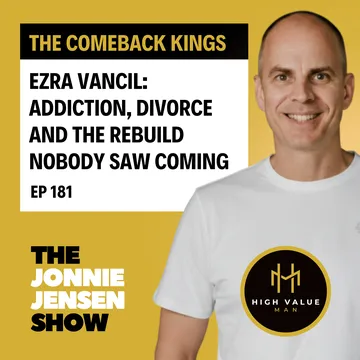
Episode 181 · Wednesday, 20 May 2026

Ezra Vancil Addiction, Divorce and the Rebuild Nobody Saw Coming

A Texas musician recounts the harrowing transition from a teenage record deal and mental hospitals to a life of sobriety and restored family legacy.

Ezra VancilAmericana musicAddiction recoveryFatherhood legacy80-80 marriageTexas folk rock
By The Jonnie Jensen Show | 1h 1m listen | 17 chapters
Ezra Vancil Addiction, Divorce and the Rebuild Nobody Saw Coming cover
The Jonnie Jensen Show · No. 181

About this episode

Ezra Vancil surrendered custody of his son during a grueling multi-year legal battle after a lucid realization that his life of jails and mental hospitals made him an unfit parent. The Texas-based Americana musician joins Johnny Jensen to detail the collapse of his first marriage, a decade of severe alcoholism, and the self-sabotage of a long-term affair used as a grenade to escape his domestic reality. Vancil reveals the moment a single therapy session at age 40 dismantled his belief that he was predestined for misery, sparking a total reinvention of his life and career.

Vancil describes the pressures of a teenage record deal in Los Angeles and the indulgent 1990s music scene that fueled a Jekyll and Hyde existence between fatherhood and substance abuse. The narrative tracks his descent from a Dallas professional to an Austin gig musician fueled by alcohol, eventually leading to the loss of an international music deal. Jensen and Vancil analyze the shift in media portrayals of fathers from the wholesome models of Little House on the Prairie to the buffoonery of Homer Simpson, arguing for a return to the 80-80 marriage model where both partners commit 100 percent to the union.

Ezra Vancil shares the profound impact of performing in a band with his daughter and the redemptive power of music that once romanced suicide but now saves marriages. He recounts the specific moment a couple tore up their divorce papers after a live performance, proving that authentic Americana roots can serve as a tool for community healing. Vancil and Johnny Jensen emphasize that shared experience is the most effective weapon against male suicide and the stigma of mental health struggles.


CHAPTER 01 / 17 Discussion

Ezra Vancil and the Comeback King Series Introduction

Host Johnny Jensen introduces the Comeback King series featuring guest Ezra Vancil, a musician and writer from Texas. Vancil shares a pivotal moment from a therapy session where he realized happiness was possible after years of cycling through mental hospitals and jail. The segment establishes the show's focus on helping modern fathers rebuild their lives with purpose and usefulness.

ezra vancil· johnny jensen· comeback king· high value man project· addiction recovery

00:00 It seems like such the smallest thing when I say it. But so I was in and out of mental hospitals, jail, therapists and psychiatrists never ended. It was just like a rotating door. I finally landed in front of this therapist who was just the only one I could afford. But she said something to me after I told her what's going on in my life and everything. And she goes, oh, you can be happy. And it shocked me. Welcome to the Johnny Jensen Show, where modern dads discover how to create the true riches, relationships, and results they deserve.

00:43 Get your high-value man blueprint and join our community at highvalue manproject.com. Let's go. Welcome to the Johnny Jensen show. It is great to have you here. Whether you're subscribing or coming for the first time, it is my pleasure to welcome you. Tonight's guest on the Comeback King series is a musician, writer, and father whose life is built around one powerful idea, and that is rebuilding with purpose. After nearly losing his identity as a husband and father, Ezra Vancil walked through addiction, collapsed, and sobriety, and spent the last 13 years rebuilding a life based on usefulness rather than recognition. Ezra, welcome to the Johnny Jensen Show. It's my absolute pleasure to have you here. Johnny, thank you so much for having me.

CHAPTER 02 / 17 Discussion

Americana Music and the Roots of Creative Authenticity

Ezra Vancil describes his musical style as Americana or folk rock, citing influences like Tom Petty, Neil Young, and Creedence Clearwater Revival. He discusses performing in a band with his daughter and working with his son in his business, emphasizing that his music is an authentic reflection of his family's rebuilding process. The conversation touches on the cultural influence of Texas and the importance of putting "heart" into creative work.

ezra vancil· americana· tom petty· neil young· folk rock· spotify

01:26 I'm glad to be on. Great. Well, you reached out to me off the back of an episode around loneliness. And loneliness is, you know, they're calling it a modern day plague, an epidemic amongst men. And I'm a little bit prickly about loneliness because at the end of the day, it's like get off your ass and go and hang around some people, right? Which is a bit too direct and it doesn't really account for a lot of the emotional stuff that can lead to loneliness. But ultimately, as the message within this podcast and the high value man show is about, it's about taking responsibility so that we thrive, so that we create the relationships that we desire, so that we really show up as the man and dad we want to be.

02:10 And when you reached out to me, just that instantly came across. I went and had a listen to some of your music on Spotify. So like, just great to have you here. Rather than me waffle on, tell everybody, you know, introduce yourself your way, your how. Yeah, I'm Ezra Vancil. I'm from Texas, if you can't tell from the accent. And I'm a performing songwriter. And I currently play in a band with my daughter. And I have a new double album that I put out and a book that I wrote recently. So I'm an all-around kind of creative guy. I like to do all things creative. And I'm also a business owner. And I work with my son. Okay, brilliant.

02:53 And I like to do this at the top of the show rather than wait till the end. Describe your music and give people a, because you will describe it both. I tuned into it. I was listening to like a bit like Americana, sort of American folk, sort of hints of bluegrass. That's what I took from it. Why don't you describe it and tell people how they can find you on Spotify? Yeah, it's mostly called Americana or folk rock. It's kind of that Tom Pity, Tom Pity. Tom Tom Petty. I know him. Oh, I know him as well. Yeah. Both of them. Tom Petty and Neil Young kind of thing. I'd really draw on the roots of the 60s and 70s music and just try to put out something authentic.

03:35 My music is really like a, I try to put my stories, even, you know, rebuilding my family became an album and bringing my family into my music. So it's it's very kind of 70s, 60s kind of music, but it, I hope that it has a heart. I really try to put myself into it. Do you know what? I just got goosebumps when you said a heart to it because it definitely has that. One of my favorite movies is The Big Lebowski. And there's a lot of, what's it called? Clear, click Credence, Clearwater. Is that the band called? Yeah, Credence, Clearwater, Revival. That's it. That's in the same ballpark as well, isn't it? That's it. Yeah. Yeah. Anything with acoustic guitar and drums, that's kind of my thing.

04:20 Fiddles and banjos. I don't go too far country, but I'm from Texas and I can't really help it. It just seeps into your blood here somehow. Yeah, it's got to have a twang to it. That was that line from the Blues Brothers. I like both types of music, country and Western. Exactly. Great movie. Absolutely. Well, listen, tell it, like, let's get into the story, right? You reached out to me, really, and said, my story can, you know, it is a Comeback King story. It would really resonate. There's some topics in there. I love the creative angle, sobriety, alcoholism. I know that they're a day-to-day challenge for a lot of guys. But before we get into all this, that, let me ask you, what does being a dad and family mean to you?

CHAPTER 03 / 17 Discussion

Legacy and the Evolution of Fatherhood in Media

Ezra Vancil and Johnny Jensen discuss the meaning of family, focusing on the concept of building a legacy for future generations. They critique the portrayal of fathers in media, noting a shift from wholesome role models like those in Little House on the Prairie and The Waltons to "buffoon" archetypes like Homer Simpson. Vancil reflects on how his perspective on children shifted from youthful skepticism to viewing them as "true riches."

fatherhood· legacy· little house on the prairie· the waltons· homer simpson· family values

05:04 And who was your biggest influence in that regard? Wow. I mean, being a family now means so much to me. I joke with my kids that, you know, when I was younger, I was like, kids, you know, it's a hard world. Why would I bring anybody into this world? That's the kind of guy I was when I was young. And of course, I had a few kids. And now I look back and I'm like, I wish I had so many more kids because it's riches. It's riches. It's true riches. It's to have a life that is full and that has a legacy built into it.

05:41 So I think family to me is our, I really believe it's our nature, you know, whether we have children or not, to be in community and family. And so it is nature, it's building legacy. You know, we're just one person with a life here, but we can do so much with what we bring to a family and the generations after us. So I see family as a very big thing. It's not just my little family. It's what do I bring to the world? What have I given them to give on? And so I think legacy is the word that comes with it. Yeah. Do you know what? One of the early stages of my work with men in my program, it asks men, what are your values?

06:24 And so many people don't think about that. Like, you know, we're old. I'm a good guy. You can trust me kind of thing. But no, no, what are your values? Like, so for me, fun, generosity, communication, love, or family, though, that's in there as a value as well. And when you're present to that, everything that you do and how you shape your approach to the world can fit those values. And then rather than being in conflict with our values, we start to live in harmony with our own values. And suddenly, relationships seem easier, communication seems easier. Our general understanding of where we find ourselves and what we're doing feels like, oh,

07:07 this fits. So I love that that's a value of yours. And that extension beyond, okay, there's blood, family, but of course, there's family, there's like my best friends. There's people that I would count and, you know, go to war for, you know what I mean? Who do you think your biggest influence was in regards to that? Is that from your own childhood or someone else? That's a question I've never been asked. It's a hard one to think of. You know, I think it is just from what I've pulled from my own upbringing, the good things that I've pulled from that. I also, I grew up reading Little House on the Prairie.

07:45 And then I read that to my kids also. And I know it's because of the TV show ruined it, the books, but there's this kind of, like you talk about, there's this beauty, there's this fun, there's this joy about being in this family and doing something together because they're not just sitting around watching TV, they're making a life together. And so I would say that, you know, I'm a little embarrassed to admit that, but I think Little House on the Prairie, when I think of family, that kind of pops in my head. Ezra, don't worry about that, my friend. I'm totally on board. Not Little House on the Prairie, but the Waltons, right?

08:23 Similar sort of time, similar sort of thing. My mum died when I was nine. And, you know, in the UK, we used to have Sunday morning TV and it would be some cartoons and it'd be some other shows. And then the Waltons came on sort of later on in the morning. And that family unit, I felt I missed out on a little bit. So TV, certain TV shows, particularly back in the day where you couldn't choose between a million and one things. You had to have a few things that you liked. And my family in America is a very big and they're mainly Irish English. Like there's the two sides of our family in Chicago are Irish English. And so it's big families, you know, like Catholics.

09:02 They love to have to have a few kids, right? But there's just such a tight unit there where everybody's always coming in and out of each other's, you know, back doors and, you know, and cups of tea and sitting around and gossiping and chatting and laughing. So, yeah, I can, I, and some of those wholesome old 80s TV shows really had that in the way that perhaps some TV shows today don't. Yeah, that's very true. I think something I noticed just over my 90s, you know, 80s, 90s life was that men in TV and movies, for the most part, are just buffoons. You know, the father always plays a buffoon and it's the wife that's got to put everything together.

09:44 And so we did have those role models, not just TV, but a lot of different things in our life were these role models of men kind of showing up in life. And then something happened. happened in the 80s where fathers just became these buffoons that were the, you know, you know, I'm trying to think like King of Queens. And I love the show personally, but at the same time, he's, he's a big kid. He's not, he's not what I grew up thinking of a, you know, and I don't know if I don't even know if he was a father in that show. But anyways, the point. Homer Simpson is the classic one. Yeah, Homer Simpson. Yeah. Yeah. Absolutely. Yeah. So let's talk a bit about your creative journey and then let's get into the rock and roll story, right?

CHAPTER 04 / 17 Discussion

Early Success and the Pressures of a Teenage Record Deal

Ezra Vancil recounts being signed to a development deal at age 19 after an engineer from Los Angeles discovered his small-town Texas band. While the sudden transition from living under the poverty line to having a label-funded house and studio felt like winning the lottery, it quickly led to depression. The pressure to create a successful second album and internal band drama overshadowed the initial excitement of the industry's "blank check."

record deal· los angeles· music industry· poverty· depression

10:28 Because I'm sure you didn't start out alcoholic, right? I'm sure there was must have been a slide into that. So tell us, like, let's go on the journey with you. Let's talk about like what you're, what this career has been. What does it mean to you? And then obviously we'll get into some of the sort of the tougher times. But where did it all start? It started with my parents were traveling music. I say traveling. We were, we moved a lot and they were gospel singers and they were, they would go and play music. We moved. I mean, we're like military family. We just moved from town to town to town over and over. And so I grew up in music. I grew up in the studio. I grew up with music playing all around me and jams in the living room.

11:10 And so as a teenager, I just took to it really quick. And what happened was it's kind of like a movie or something. We went into a studio with this teenage band that was this small town band and to make an album. And the engineer in the studio called someone from LA and they flew out there. And within a few months, we were signed to a development deal. And so that's how it kind of just picked up is I was already loved music. Age, what age are you there? You know, I'm always getting off. I think it was, I was 19. I've always thought it was 18, but last time I did an interview, my band called me and said, no, you were 20.

11:50 And I went and did the time and I was like, no, I was, I was in my teens. I was 19 years old. Wow. And so there you are. You're 19. You had this mad situation where you're suddenly signed. And, you know, where as a 19-year-old with, with, I guess that was a musical ambition, but you had no idea it was actually going to start to come true. What did that feel like? It was overwhelming. It was like winning the lottery for me and my whole family, like this, this management group and the label would fly my family out to LA and they'd come down and send limos.

12:28 And so we were, you know, I was a family that grew up under the poverty line my whole life until the very end. And so this was, it was like a blank check was just laid before me. And at first it was exhilarating. But when we started, we got our own house, our own studio that the band lived in. When it all came in, I actually got very depressed and got under the pressure of what I had to create. We had to create this new album and there was a lot of drama with the band. And so I'm sad to say it was, it was exciting, but at first, but I very quickly was not real happy with the situation.

CHAPTER 05 / 17 Discussion

Fear of Success and the Indulgent 1990s Music Scene

Reflecting on his youth, Ezra Vancil describes himself as a teenager crippled by fear and an inability to navigate the "slick" personalities of the Los Angeles music industry. He details the indulgent lifestyle of the early 1990s, characterized by endless touring, partying, and mosh pits. This period of pure indulgence ultimately prevented his band from completing their second album as they became more focused on the lifestyle than the craft.

fear of success· 1990s· mosh pits· indulgence· music industry

13:09 Wow. And do you, I mean, was how old are you now, by the way? I'm 52. Okay, I'm 51, right? Okay. Cut the 50s, boy. Yeah, that's right. Could you believe it? Can you believe it, man? We're just kids, man. Yeah, totally. But looking back on that time, as the 52-year-old man, looking at the 19-year-old man, what could you see about that guy? How much of a man was he? How much did he know himself at that time? Oh, I mean, I look back, you know, and I don't regret the past because it is what it is. But I do look back and see this kid, me, who was getting in the way of himself so full of fear that I couldn't even allow myself to be successful.

13:56 I think the biggest thing is I was a lot of people I know that are skilled when they're real young. Like I was very creative and won a few awards when I was young. We have such a high ideal of ourselves that we're a little bit afraid of success because we might find out we're not as great as we think we are. And so when I look at that kid, I just see someone just completely crippled by fear and not sure what to do. You know, I felt I was with these slick, kind of swarmy LA people. Although if they're listening, I love them, but they are slick and swarmy. For sure, LA people are slick and swarmy. And I didn't know how to combat them.

14:37 You know, they would want to change things that I didn't want to change. And I'm just this kid talking to these 50-year-olds and trying to navigate this. I just about just shut down because of fear. I was just confused. controlled by fear. Wow. Yeah, I mean, so many of us can relate to that, you know, the things that we didn't do. Even now, the opportunities that we don't take, the crazy stuff. For me, you know, you've got to ring, ring a prospect. Hi, you filled in a form on my website. You know, what can I do for you? Or what were you hoping to get? You know, and actually, it should be such a natural conversation. And still, you're like, you're trying to get it right and you're obviously like concerned about getting it wrong.

15:17 And so much gets in the way. That was your, you know, your word there. You're getting in the way of your own self. So that at that time, that was, you know, exciting. And the where you were single, I'm guessing. You were like living in the band house. Was it getting into sort of like indulgent times? Oh, yeah. It was very indulgent. I was, I was with the girlfriend that I met in the band. She was a photographer. And so I had a steady girlfriend. And as we went into this, I mean, it was just, yeah, it was pure indulgence. I mean, it was a party that never ended. We'd go. Yeah. So

16:03 what year? So what, you know, you're 19, what year are we in? So this would have to be in, I would think, 93. Okay, so it's 1993. You're 19. You're living in LA. You and a bunch of other guys. Yeah, we're still in Texas. I would go to LA sometimes. Yeah. Oh, okay. Right. So I got it. I'm just, because 93 for us in the UK was raving times. You know, like 20,000 people in a tent, in a field, bomb bomb, lasers and ecstasy and flipping. Yeah, I went to a few of those. Yeah, I mean, it was like, it was the 90s. I mean, basically, it was just 90s to me was just pure indulgence. It was just partying, like, you know, mosh pits, hurting yourself was fun, you know.

16:49 And so that, yeah, that's the era that was going on. And the band, you know, was doing well in the beginning. We would tour and we would pick up people from the, I would just come home and there'd just be new people in the, in our studio, our house. Yeah. And they would stay there for a while and then they'd ship out and it was just endless parties. You know, we actually didn't get to making that second album in that band because I think we were just so busy partying. You know, yeah, the classic story. Yeah. Right. So, so when did you start to, you know, when did you, when did you fall in love? When did the, did you, did you get married? Like, you know, getting into the dad and relationship side of things. So that skips way forward because I married that girl. She's a beautiful girl.

CHAPTER 06 / 17 Discussion

First Marriage and the Jekyll and Hyde Struggle

Ezra Vancil discusses his first marriage and the birth of his son at age 24, which coincided with his struggle to balance being a "good dad" with his internal demons. He describes a "Jekyll and Hyde" existence where he tried to provide a stable world for his son while simultaneously wrecking his own life through substance abuse. The marriage eventually collapsed when he was 30, leading to a decade-long descent into alcoholism.

marriage· divorce· jekyll and hyde· fatherhood· alcoholism

17:34 I still think she's a beautiful girl. She's my first wife. I married her when the band, the band fell apart. I did go to LA because the label signed me as a solo artist and I married that girl at that time. And our marriage fell apart when I was 30. A lot of it, I had picked up a lot of habits during the band years. I tried to put them away. I tried to become like this super religious guy in my 20s and put away alcohol and drugs. It was over. I was going to be a good guy and get a job. And we had a son at that time. And it just collapsed by the time I was 30.

18:15 When I got into another band and that band kind of blew up and I was back out, there was, you know, a fair. There was a fair. There was stuff going on. It was, it was something that I carry on myself that I just kind of exploded my first marriage and came directly out of that and married a bartender because it worked out really well for a guy that liked to drink every day, who is my wife. She's my wife now. And so it kind of starts there. That kind of goes into just the downfall years. And I don't know how much you want to go into that, but I had basically a decade of just going down to the very bottom.

18:59 Wow. Okay. Well, let's step back a little bit into like when you had a son. Well, sorry, I didn't know it was a son. Did you got married and you decided we were going to have kids, or did the kids come along accidentally? Or like, what? Because it's always, it's always fun. Like my proposal story is bonkers. Relationship from previous had gone wrong and I was desperately upset. Then when I met someone new and fell in love, I was like, I'm just going all in. And it was a roller coaster and I proposed six weeks after we first kissed. And it was great. And like you said, that love, it's still there. You know, how could you not love the woman you made children without, you know, walking down the aisle was incredible.

19:41 But ultimately, I didn't marry someone who was a good fit for me. or her, quite frankly. Yeah, what about what about you? What, how did how did the how did it all pan out? What was it exciting to start with? Yeah, I mean, I mean, I would say the same thing as you. I think we were desperately incompatible. She has a husband now that is a great man. We're friends, and I like him a lot. And I'm like, he is so much better for her. You know, if I was going to pick someone, I'd pick him before. Pick him. Like, really. He's such a good guy. And, you know, it was beautiful. In the beginning, you know, I think I had gotten dropped from the label and I had no prospects for my life.

20:24 I dropped out of school to be a rock star. And so a lot of it was just like, oh, gosh, I'm 21 years old. I got to start my life. And I have no idea. And so a lot of the early marriage was, again, just me like kind of in chaos and in fear. We did have beautiful times. I think my son came when I was 24 and it wasn't really an accident. We decided to have a child and we had him. And he, my gosh, I mean, he just was the most special thing in my life. I, he still is. Well, my daughter, I have a daughter now, too. They're both my kids are just, but when he came along, you know, I kind of, I got to say, I kind of split myself in half because I was a guy that was dealing with all kinds of demons.

21:13 And then I was going to be the good dad for my son. And I tried with all of my being, but he didn't see this other guy that was going on, that was having all these problems. And so I kind of tried to create a comfortable little world for him to live in, take care of him, teach him, make sure he went to good schools. At the same time, I'm over, I have like the Jekyll and Hyde thing going on. I'm over wrecking my life. But it really was kind of a split thing where I feel like we just had these beautiful years. Even while the marriage was falling apart, he came to live with me. And, you know, I just treasure the time that I had with him. He was, he's a, he's, I always tell him, you know, I remember when he was about 13, he's like, why do you like me?

CHAPTER 07 / 17 Discussion

Alcoholism and the Chaos of Musical Ambition

Ezra Vancil explains how his drinking problem, which began during his band years, escalated in his 30s as he tried to maintain a full-time job in Dallas while playing gigs in Austin. He used alcohol to fuel his ambition and manage the exhaustion of driving all night between cities. While alcohol initially helped him feel more open and intimate, it eventually turned into a tool for despair as his international music deal and personal life began to unravel.

alcoholism· dallas· austin· music career· substance abuse

21:58 And I'm like, you're the most interesting thing in the world. Just the most interesting thing. I'm so interested in what my children think. And he was like that as a child. He's just a beautiful, you know, mind. Yeah, yeah. And what, you know, when you said about the Jekyll and Hyde, what was going on for you? What was the Jekyll part? Part of it was there's a double Jekyll because part of it was alcohol. So in the band, I picked up quite a drinking problem. I was trying to put that away and it would just kind of sneak back into my life. Another part is I wasn't going to give up on music. And so I was always trying to restart things.

22:37 And so I would be working a full-time job in Dallas. I don't know if you know Dallas and Austin and drive after work to Austin, play a gig, and then drive all night, have no sleep and go back to work. So it's like never-ending work. And that was all fueled, but the only way I could do that was alcohol and just to complete, you know, let myself come down when I needed to. And so there's this chaos of ambition fueled by a bunch of alcohol that was a happy drunk or a violent drunk or miserable drunk? Like, how did it manifest for you? Oh, I would say alcohol was like a good thing in my young life.

23:21 It actually did all the things that we hope that it does, which is kind of loosen me up, allow me to be intimate in the sack better, to be more loving and open with people. That's how it started. It didn't go, it went wrong in my 30s. It's turned on me and I became just a man in despair, you know, trying to drink himself to death. But yeah, early days, alcohol was a great thing. It's just that when I overindulge, which was very often, it had a lot of consequences that were coming down. And what, so you're trying to, you got a young kid, you're trying to work and the music is on hold at this time. The relationship is going okay or struggling. Relationship was going downhill.

24:05 After my son was born, it was just kind of on and off again. Probably a year or two after he was born, it was on and off again with my wife until we finally divorced, where we would split up, be back together. And I think, you know, alcohol was really fueling the whole situation. I just went deeper into it. So, and I was in it. I was in a band that was doing really well. We got it, you know, international deal. And so music was coming back to. And I think that kind of tore it apart because I was also gone all the time. My wife didn't come with me.

CHAPTER 08 / 17 Discussion

Conflict Resolution and Autonomy in Modern Relationships

Drawing from his experience with two divorces and a recovered marriage, Ezra Vancil offers advice on handling relationship conflict. He emphasizes the importance of removing the word "divorce" from arguments and respecting a partner as an autonomous person. Johnny Jensen adds that curiosity and active listening can diffuse arguments, suggesting that men should look for the "grain of truth" in their partner's complaints rather than reacting defensively.

divorce· conflict resolution· relationship advice· resentment· autonomy

24:45 And so it was kind of an absence. And then again, just, you know, my demons coming back to get me. Yeah. And what's your message to me, you know, you taking that experience? What would you say to guys who, whose relationship is struggling or, you know, that basically for men going through what you just described, what's your experience and what would you, you know, encourage them about the relationships in that situation? Well, you know, I have, I have, I have the, uh, a good thing that happened to me is because I've gone through two divorces. The woman I'm married to now, we also went through this. It's just that we made it through it. And so I've got to look at it from two different sides from that first time where we became when divorce started being mentioned and, you know, we started throwing that at each other.

25:34 That's the first thing is you're committed or you're not. You know, you don't throw this word. This, I think in our, in my marriage now, there's, this is not an option. Now, it might be an option that I'm going to go stay at a hotel or something. But when I was young, just this kind of fear that both in the couple have this fear, anyways, that you're going to leave me or this isn't going to work. And so just not allowing that to be part of the conversation. And that's an agreement, even in your fights, that we don't go there. We don't talk about that's it. Because I believe, you know, my, my, my first wife, I don't think it could have worked because of my alcohol problem.

26:19 I had to go on this journey to the end of myself, but we did not have to hurt each other so bad because I hurt her so bad just in the divorce war and everything that we didn't have to go through that. We could go, this isn't working. And, you know, let's let's back away from this in a way that doesn't destroy each other's life, you know. And we both, my ex-wife, we've, we know this now, you know, we know that we were just in this state of a frenzy of resentment. And so looking at that compared to today, which I can talk about later. I'm going to put my phone in.

26:56 Hold tight. Keep talking. Yeah. If I compared the two, you know, because I went through a divorce with my second wife again that was, we recovered from, I just see a lot of things that could have been done a lot differently. And I don't know that I could go back and change that, but I do know that this is, there's this, this idea when we're married that we're so tangled up together that we can't see that this is another person, an autonomous person that deserves respect. And that's something that I've come in later life to see is that it doesn't matter what I think my wife's done to me or whatever, or if she's mad or yelling or whatever, she's still an autonomous person.

27:42 I have to respect her like I would any other, like I would want for myself. And I didn't know that then. I didn't do that. And so I think that's a huge deal is just kind of putting some separation, even if they're like going after you. Just go, give them, they have a right to do that. They're their own person. I have a right not to take it on, you know. And I didn't learn that till I was in my 40. Yeah. That's such a powerful message for couples that are in argument phase. You don't have to argue. Now it's an obvious like nonsense statement, yeah, but the things that she's shouting at you, the upset that you feel, the justification that this isn't fair or you don't understand, far better to just almost like switch off your response mechanism and just hear it all.

28:31 It doesn't mean it's true. It doesn't mean it's at you. It's just her going, I've got all this stuff that I need to say. And actually, in that moment, if we were far more willing to hear that, like out of curiosity, like out of interest, wow, I didn't know you were feeling that. Let me take that away and process it. Let me see what I could do that might help some of those things. By the way, if you're interested, these are some of the things that I'm really struggling with rather than you this, you that, when I get you, how dare you? You didn't need it. It's not fair. You don't know what it's like, you know.

29:11 I made so many mistakes in previous relationships for sure. I mean, that is just the best advice, you know, and like, once again, it's not something to learn to later, but I always like to now, because I still get it, we get in fights, not very often, but not just her, but with other people coming at me or something. I always like to ask my question is, what's right? about what they're saying? And so, I'm not listening to all the other things, the things maybe some arrows are being thrown, but there's something at the core of what they're saying. So, it's kind of like what you're saying. It's a little more curious of what part of this is right, what part of this can I take and own?

29:51 Yeah, and I find that it can diffuse a problem if I really do see, oh, that really is true. And I take it and I own it. And I just own that little part that's true and go, that is true. You know, I was dishonest or whatever, you know, and then it kind of brings it down to two humans talking, you know. Yeah, you're really taking on that responsibility. I'm someone who can be a bit late, and there's a sense of people who do that, right? That, oh, I was only five minutes late. Like, how dare you be annoyed that I was five minutes late? Well, hang on a minute, right? How about you take responsibility for being five minutes late and start turning up five minutes early?


CHAPTER 09 / 17 Discussion

The 80-80 Marriage and Mutual Commitment

The discussion shifts to the necessity of mutual effort in a marriage, comparing it to the dedication required to build a successful business. Ezra Vancil and Johnny Jensen explore the idea of the "80-80 marriage," where both partners are 100% committed rather than simply splitting responsibilities 50-50. They highlight how different personal values, such as perspectives on punctuality, require grace and understanding to maintain harmony.

marriage· commitment· values· 80-80 marriage· partnership

30:35 Like, it, that's like, I want to have an argument with you about it's okay being late. No, no, you were left on your own, you were worried about where I was, you were scared about being in a dark corner, like whatever, whatever, blah, blah, blah. But it's that level of responsibility where you go, Oh, yeah, I wonder what that is like for them when I'm like that. Okay, what could I do about that? What could what could I take responsibility for? Yeah, yeah, yeah. And it is kind of like you said, values earlier. It's, it's that they, whoever that is, has a different value of time than you do. And I don't, I don't think it's right. Like, I'm a, I'm a time nut. If somebody says they're going to be there, I expect them to be five minutes early. I'm glad I was on time there. You were. My wife is not like that at all.

31:18 Five minutes to her could be 20 minutes or 30 minutes, as long as she gets there. But what we've realized over time is we really have a different value. I don't think hers is bad. I actually love that part of her. She's kind of like free-floating in life. I wish I could be like that. So I can value that. And she can value that I'm still somebody that is a stickler about time. Give me a minute to get over it and then realize, oh, yeah, that's just how my wife is. She's here. It's okay. Yeah. I'm going to let her off the hook. You know? Yeah, that let off the hurt was beautiful. Like a mutual commitment to see the best in each other, a mutual commitment to have each other thrive, a mutual commitment to have each other feel supported and safe.

32:00 Like these are some of the kind of foundational baselines that I don't, you know, you go and get married and you say these vows. I mean, vows that like hundreds of years old, they don't really mean anything. We need some modern vows along those lines, basically. Yeah, I think you take them up. Like, like you said, it's a, it's a, it's not something we said at some point. It's something we take with us in our marriage. I had a, a, uh, I have a few friends. My brother is a big tycoon business entrepreneur kind of guy. He started companies and sells them. And I've known a few guys like that. And I love asking them, what was your first year like in that business?

32:40 And they always laugh and go, man, I was sleeping on the floor. You know, the lights were turning off because I didn't have enough. And then turn that back to marriage and go, what makes me think now? They have this thriving business that they've put their, they put their self into and knew that it was going to be tough and that they were going to work on it still. Why do we think that we just marry somebody we love and then it's just all going to turn out okay? It's, we don't have all that planning and value and realize that just like the businessmen, they know they got to show up every day or the business is going to fall apart. They got to take inventory. It's the same thing in marriage. If I want a good marriage, I've got to be all in to work for it.

33:21 And, you know, and I see that that's something that's a commitment with me and my wife both is we're both 100%. You know, I'm working on the marriage 100%. She's working on it 100%. And that way the gaps get filled if one of us isn't doing great one day, you know? Yeah. Yeah. There's a good book called The 80-80 Marriage and Similar along those lines. It's not 50-50. Like, I've done my share. Now you got to do your share. No, no, no. We're both all in. And that's a great way of also helping avoid arguments. So back to the story, right? The booze is starting to become a problem. The relationship is on the rocks. What did the crash look like? What happened? What took you down? I had an affair at the end of the marriage.

CHAPTER 10 / 17 Discussion

Sabotaging a Marriage Through Infidelity

Ezra Vancil admits to having a long-term affair at the end of his first marriage as a conscious way to force a divorce. He explains that his strict religious upbringing made him feel that infidelity was the only "valid" way out of a marriage he was too weak to end through conversation. This act of self-sabotage served as a "grenade" that finalized the destruction of his domestic life during a period of heavy drinking.

affair· infidelity· religious upbringing· self-sabotage· divorce

34:03 I was kind of flirting with affairs for a while, but I had an actual long-term affair towards the very end of the marriage. And it was a decided, you know, like this podcast where we were talking about, you know, changing your life on purpose. I destroyed my life on purpose. I knew this affair would destroy my marriage because I was too weak to like, you know, say I want out. And so I just, I just sabotaged it through. a grenade on it. That was the end of the marriage, you know, and then it just started unraveling at that point. And so that's how it finally came apart. Took, you know, as divorces do, it took some years.

34:43 It could took some maybe we shouldn't and get back together and a couple of years of painful back and forth. And then the lawyers came in, and, you know, you know what happens after that. Yeah. Yeah. What about two topics there, actually? I'm going to ask you about the sort of separation and family court and contact with your kid. But before that, I see when the men I work with, right, that are going through a divorce or they're rebuilding after a breakup, affairs happen because people are unhappy, generally speaking. Now, there's a percentage of men who are just flipping, can't stop waving their dicks about, right? But that isn't the majority of people that end up in affairs. Affairs happen because someone's unhappy.

35:27 And the other person says, it's an outrage. How could they possibly have an affair? It's like, well, someone, or at least one, maybe two of you weren't happy in this relationship. You interestingly said you didn't have the balls to bring it to a head. So you went and had the affair. Sounds like that was quite a conscious thing, or did it become more conscious once you'd fallen into it? It was a conscious decision. I grew up very religious. And so, really, in my mind back then, the only way to get out of a marriage was an affair. You know, it's kind of a messed up way to think. And since she wasn't going to do it, I'll go and do it.

36:09 And then she can divorce me. And this is how my mind was working back then. Okay. It was a very conscious decision. I mean, a girl did come on to me, but that wasn't abnormal. You must have had groupies all the time, right? I mean, there were opportunities all the time at bars and clubs. But I just made a conscious decision. Just like you said, the marriage was falling apart before this. I wanted out and I didn't know how to get out. I was very religious. So it's the strangest thing to go and have an affair to get out of a marriage. But I was also drinking. So you have to excuse that. There was some logic somewhere. Yeah, yeah. It got lost somewhere in a bottle. Yeah. Okay, good. And then when it came to the breakup,

CHAPTER 11 / 17 Discussion

Family Court Battles and the Lucid Moment of Surrender

Ezra Vancil describes a grueling multi-year legal battle for custody of his son that exhausted his financial resources. Despite his efforts to keep his son, he experienced a "lucid moment" during arbitration where he realized his ex-wife's stable home was a better environment for the child than his own life of jails and mental hospitals. He chose to surrender custody, recognizing that his descent into "hell" made him unfit to provide the care his son needed at that time.

family court· child custody· child support· arbitration· legal battle

36:54 you know, family law, family courts, you know, father's rights around the world are a complex topic. And interestingly, a couple of states in America, they've now made 50-50 as the starting point. I believe Kentucky and Kansas. And the divorce rates have plummeted. The number of cases going through family courts has plummeted. They're looking at the impact on male suicide, all these hot topics around families and men's mental health. What was the experience of contact and the arrangement with your child as you went through the divorce?

37:38 So once again, I have two because I went through this again with my second wife. Oh, okay, right. And it was a totally different experience. My first experience is me and my ex-wife, our divorce, it was emotionally hard. It was back and forth that way. But we, we amicably, that's a hard word for me to say, split up and she gave me my son for as, and so it was a little bit different. And she actually played, paid child support to me. Now, I took that child support and took it back to her house every week when it came. I didn't want it. The courts made us do that. And so I would just take that, cash it, and give it back to her. And so that's how ours. But what happened is she decided she, it's not that she didn't have visitation.

38:23 She did. She had weekend visitation, but she decided she wanted him full time after I had another child with my second wife. And then the battle began and the lawyers came in and we spent so much money. I can't believe with me trying to keep my son because I had raised him up to that point. And he was probably seven. No, this is probably started when he was seven and got done when he was preteens. The battle for this. Wow. And we spent, you know, we didn't even have money, really. What happened is I borrowed money. I had a lawyer cousin that helped me. Cousin Michael Vinny. Yeah, yeah. He was like, Cousin Vinny, he'd go after your throat. I'd be like, that's a little mean.

39:08 But we battled it. And something very kind of healing came out of the end of it because so this was happening again while I was, you know, I was bad in my 30s. This was in my mid-30s and I was just, I was devastating my life. I was going to jail. I was in mental hospitals. I was trying to kill myself and still trying to keep my son. And I remember we finally went to arbitration and we were ready. Our lawyers were ready. We had like all this stuff. We were going to go in there and just go to court or win it and arbitration and convince them. And I remember before anything started, I told her you couldn't have him. And I realized looking at her and her husband, her new husband, that their life was a much better place for him to live right then.

39:54 I was going down and it just diffused the whole thing. And he went to live with her at that time. But boy, we just about, I mean, we went, there was no college fund. We spent everything to fight for something that I eventually just decided I can't even take care of him. What am I doing? You know, let her have him. And that's his mother. He's, he's been with me, you know, for half his life. He needs to go be with her. And so I kind of had like this lucid moment when we were sitting in there after all this battle. Yeah. And would you, are you kind of at rock bottom at that point, or is there still some depth to go?

CHAPTER 12 / 17 Discussion

Mental Health Stigma and Romancing the Lone Wolf

Ezra Vancil reflects on his history with mental health, starting with the trauma of visiting his father in a state mental hospital at age 14. He discusses how he "trained" himself to be a "lone wolf" and wrote sad music that romanced suicide, effectively manifesting a dark reality in his own life. Johnny Jensen shares his own experience with burnout and the tragic loss of his brother to suicide, emphasizing the danger of being oblivious to one's own brokenness.

mental health· suicide· depression· lars von trier· lone wolf

40:33 I was, it depends who you are. Like, I was at most people's rock bottom. I was, I had a lot further to go, though. So I was probably like halfway through my descent into hell. Yeah. Wow. Wow. Yeah. And you mentioned mental health before as well. Like, you know, so when was the first time you really became aware that your mental health was being affected? Because speaking for myself, I wasn't that aware. You know, there's one inside one of my main talks that I give, there's a line that says, the day you search Google for am I burnt out? The answer is yes. Am I burnt out? Yes, you're absolutely destroyed.

41:17 Like, go and get some help. But I was oblivious to the fact. I was just like, we just got to keep going. I can just get us through this. If we can just keep the business going, if we can just keep the family going, we'll all be okay. I was completely unaware of how broken I was. And, you know, the story is, I was 10 and a half stones, 73 kilograms when we broke up. You know, there was there, I was utterly, utterly burnt out. And sadly, my brother had thrown himself in front of a train, you know, a couple of months before. So, but it was being aware of it is a completely different thing to it to it happening.

41:52 What was that like for you? Yeah. You know, I mean, I really relate to that because I was just like pulling this mountain trying to keep this idea of a life that I had to keep, you know, and just working like a maniac to, you know, to just keep this idea that what really was long gone of Little House on the Prairie. Right. There you go. They go back to it. Yeah. And, you know, mental health. So I'd have to step, I'm going to step back into my teenage years because there's something kind of that really ties into this. Because when I was, I think I was 14, my dad, who was an amazing creative guy.

42:37 You know, he led big congregations of music and was really powerful guy. He ended up going through something and ended up going, getting put in a state mental hospital. And I remember when I was 14, I went to visit him there at this place, which is a horrible place. And I walked away with this incredible fear that what if something's wrong with me at that moment? And I don't blame my dad at all. Like many people, he just had a crisis in his life. He never went back, you know, but he had to have some help at that point. But what I took away from it is there's something wrong with me.

43:20 And I talk to young guys about this a lot that are real into like sad music and, you know, horror films and depressing Lars Ventir movies. I don't know if you know who he is. Horrible. I definitely don't. And I definitely don't want to. Okay. I actually kind of trained myself as the lone wolf, sad dude. And I wrote sad songs, kind of romancing suicide. This was my young life. And I just romanced this sad thing to the point that I manifested it in my life. And so I was completely oblivious to this being anything but who I was.

44:01 You know, my mental health, ideas of taking my own life and all this, that was just normal because I was just a sad creature behind a veil of tears, you know? And so I did not get a view of that till I was, till I got sober at 40. And I finally saw that I had created this really. dark world that I lived in. But I did not see it. I just thought this is just naturally my life. I'm going to die before I'm 40. Do you know what? I don't love that you suffered, but I love that moment of realization because so many men will say to me, like, well, this is just the way it is. I'm just like, I've just got to, this is what I've got to be like. This is what this is, this is what it's like. And I'm like, well, no, you can create a new version of you.

CHAPTER 13 / 17 Discussion

The Catalyst for Change and the Possibility of Happiness

Ezra Vancil identifies a specific therapy session as the catalyst for his recovery, where a therapist simply told him, "Oh, you can be happy." This statement acted as a "worm" in his head, challenging his belief that he was predestined for a dark, miserable life. This realization opened the door for him to seek sobriety at age 40 and begin the process of reinventing himself.

therapy· recovery· sobriety· personal development· happiness

44:45 It's one of the most powerful and incredible things about human beings is that we can literally invent and reinvent ourselves whenever we want. And whether that's, you know, if we take it basic, someone who likes dance music or punk music, like you can change. A leopard can't change its spots or Americana or Americana music. You can literally become a different human being by choice. Yeah. Personal development, that mental health journey and awareness is so freeing. Was there a catalyst for it? If you know, start to deep into sort of the recovery now. What was the catalyst for that for you? It was, it seems like such the smallest thing when I say it.

45:30 But so I was in and out of mental hospitals, jail, therapists and psychiatrists never ended. It was just like a rotating door. I finally landed in front of this therapist who was just the only one I could afford. But she said something to me after I told her what's going on in my life and everything. And she goes, oh, you can be happy. And it shocked me. Like literally, what? And I walked away from that. I was like, and I realized I've never heard that in my entire life. And I grew up in a nice Christian family and everything, but I've never heard that you could be happy.

46:07 And I'm not saying that this was like, it was a catalyst. What it did is it put like a worm in my head going when I would go into my dark, disgusting life, you know, it would go, you don't have to live like this anymore. You can be happy. And I'm like, what? Where did that come from? And it just kind of started opening up this idea. Can I? Like, is happiness, is a happy life even possible for anyone, especially me, a guy that's destroyed it. And so that was the catalyst, I think, that started me thinking, maybe I can change. And it's, it's amazing to look at that. A mid-30s guy that doesn't believe he can change.

46:46 How did I even think that? You know, it's this life that's kind of set before, I forget the word for it, predestined life that's just there and you just got to go live it. It's not like that. No, so it's, it's, it's ours to create. But I, but I, I do have an expression as well, which is the man you're meant to be tomorrow had to get through today. And, and these experiences that we're, that we're in are here to shape us. And my faith is a curious mix of a lot of things. I have a strong faith. I have a not a great view on church so much, but I've had the experience of God or the higher being in my world.

CHAPTER 14 / 17 Discussion

Finding Purpose in Past Pain and Shared Experience

Ezra Vancil explains that he does not regret his past because it allows him to help other men facing similar struggles with addiction and despair. He and Johnny Jensen discuss the power of shared experience in preventing male suicide, noting that seeing someone else overcome hardship provides a roadmap for others. Vancil views his past pain as a tool for empathy, giving him a purpose that transcends his music career.

empathy· recovery· male suicide· shared experience· redemption

47:31 And one of those moments was, don't expect me to answer your prayers how you want or when you want. I'll answer them, but I'll answer them for your own good. And here you are at this point in your life creating very different music now, or music was certainly with a different, with a different vibe. You're able to do that with your children. You've put your marriage back together by the sounds of it. And so that roller coaster, that journey that's brought you to here. You know, did it, do you think it had to happen? Was it part of the experience that you were meant to have? Yeah. I mean, it's a strange thing to say because I really do say I don't regret my past.

48:14 I regret anybody that was hurt by my past. And I try to fix that, you know, the best that I can. But I don't regret my past. My past is like something now that I have that I can help other people with that are there. So it's, I don't think I would choose to do it again because I don't know if I'd make it. But because I was there, I can sit down and I have with many guys that deal with the same things that I was. And they see something in my eyes and they know I'm not bullshitting you. You know, when I tell one of my stories, they know that I've been there and that at least I'm somebody that can kind of be there with them.

48:55 And so I'm very grateful. And like you said, today I'm grateful when hard things happen now because I know that it's building me now. It's making me stronger, you know, and it's, it's, it's turning me into the man I need to be. So I don't know how to look at it in a whole world picture and everything. I also have a faith that somehow this. mysterious thing all works. But I'm so glad that I went through that, that me and my wife did, because I really feel like it's something that it gave me a purpose in life that was real more than music, more than anything, is that I have this pain that I've shared with many people in the world, and I can at least be there and understand what they're

49:34 going through. Yeah, so powerful that relatedness, that experience, that shared experience. And what I hear is so often, particularly when you create a group event or you're sat around a fire, you know, at some point over a men's weekend, and someone says, oh, yeah, well, this happened to me. So my wife died, and I'm now broken and depressed and whatever. And someone else says, oh, I was in a rock band and became an alcoholic and I'm broken and depressed. And suddenly, from a place of thinking, I'm the only one who's going through this, you hear another guy across the fire who's going through exactly the same thing, but for a completely different reason. And then you suddenly go, oh my gosh, it's not about the circumstances.

50:18 It's about what we do now. It's what we do to get out of it. Yeah, I think even more powerful is when you see somebody, when you can relate to something somebody's gone through, but you don't have to tell them, but they can see that your life is different now, you know, and they can see what it gives to me is that, because I look, when I'm challenged with something, I look for somebody that's overcome it. And when I see that they're not much different than me, they've got brains and guts just like me. When I see that they can do it, I go, oh, well, I can too, you know.

50:54 And so it's something it's both of that. It's the empathy of being there with them in that moment, but it's also showing that they don't have to, that they can make it through it. It's going to be okay, you know? Yeah. And that is such an important message for men. That was an important message for men and women, but here we are talking to men, right? And male suicide is the level it's the level it's at, which is which is which is no good for all of us. And I think that the part of what brings that about is this sense of it's too hard. No one else understands. And you know what? I'm just going to flick the switch and be done with it all. Failing to see not so much that, oh, we're going to leave all these other people behind, because when you do it, you're not really bothered about the other people that are going to be left behind.

CHAPTER 15 / 17 Discussion

Simple Faith and Taking Responsibility for Outcomes

At age 40, Ezra Vancil adopted a "simple faith" that moved away from rigid religion toward a functional relationship with a higher power. He describes this as "working with God" rather than expecting God to work for him, which involved taking practical actions like opening foreclosure letters and showing up for his family. This shift allowed him to surrender the outcomes of his life and focus on being the man he is capable of being each day.

faith· higher power· sobriety· prayer· responsibility

51:37 But it's that sense of maybe this next chapter is going to be even better. And I think that's what that's what I'm taking from your message and why it's so powerful is that this new chapter is even better. So share with us some of the richness of this new chapter and how it's serving you so well. Yeah. So at 40, I had an incredible change. I quit, I put the bottle down in drugs completely out of my life. And I began a journey that, you know, you said something earlier, and this is going through my head. There's this saying that God will work with you, but he won't work for you. And so

52:23 when I got sober, I was basically an atheist at that time, but I got sober because I got down on my knees and said, whatever you are, I don't know. Help me. And so when I woke up that next day and change started to happen in my life, I went back to that, that idea of a higher power to that God and considered him my friend. And so that's the first thing that changed is I had a faith that wasn't based really on religion, which it had before, which I don't have a big problem with religion. I did at that time. But it wasn't like that. It was a true faith that had some kind of action behind it.

53:05 And so if I prayed for something, that meant I was going to get up and go show up for the thing. If I was worried about, you know, like back then, I would get all these red letters that were telling me my house was in foreclosure or something. I used to just hide those. But if I prayed about it, I got to pick that letter up, open it up, call them up because I've just given that to the creator of the universe. And we'll just see what happens, good or bad. It's not, it's no longer in my, the outcomes are no longer my deal. I'm just becoming the man and taking care of the stuff that I think my God wants me to be.

53:44 That's it. And I think that's the biggest change in my life is that this very simple faith, it was a very simple faith in the beginning of just going, you know, I give up these ideas of outcomes that I can't figure out how to get them anyways and just go, you know, you take it, whatever great power, what the creator, whatever, you know, anybody out there wants to call, I call God. God. If you want to take this, just take my life wherever you want. And what I'm going to do is just show up. And if something needs to be done, I'll be doing it. And my life has become about just take care of what God has given me.

54:25 That's plenty. Every day I've got something that I've been given, whether it's an opportunity, whether it's my daughter walking in with a problem or my wife or a piece of music I need to, and that's it. And I've given up the outcomes of my life. And I don't worry about those so much. And if I do, I know I'm in the wrong headspace because I should just be becoming, you know, I'm just becoming what I am capable of becoming this day. And so I think that's the huge thing that changed everything was just, it is a faith, but it is something of a faith of working with God, of saying,

55:05 I give this to you, but I'm going to do what I can do, you know, and going off with what He's given me. He's given me all this faculties and brains and creativity and using that. You know, somebody said, answer, you know, early on, somebody said, answer your own prayer. You know, I pray to God, but then I go out and try to answer it with what He's given me. And not with an idea of an outcome either. Just, it's life comes to us one day at a time. Just whatever's in front of me, just try to answer it with what I have right then. Yeah. I mean, it's like music, right? You're the musician, not me, but you could pray to be talented, but unless you pick up the guitar and actually work on it, you got no idea whether you've been blessed or not.

CHAPTER 16 / 17 Discussion

Creative Evolution and the Impact of Authentic Music

Ezra Vancil discusses his current creative life, which is defined by gratitude and a healed relationship with his daughter. He shares a story of a couple who decided to tear up their divorce papers after attending one of his shows, illustrating the real-world impact of putting "heart" into music. He rejects the modern "rock star" archetype in favor of being a community-focused musician who uses his life experiences to help others.

creativity· songwriting· marriage· healing· gratitude

55:50 Like, that's this kind of conversation of having a, you know, doing this with a musician. Like, that's, you know, it's like the same as a sport. You don't pick the racket up and hit the ball. You're going to have no idea whether you're any good at it. Pray for a wife, pray to fall in love. And if you don't go out and talk to some people, you ain't going to meet someone. And by the way, if you're into sport and you go and keep going and talking to people who are, you know, doing something completely the opposite, probably not going to happen. You know, so like, don't prove the universe wrong. Go out there and prove it right. I love that. Lean into the prayer. Be the answer to the prayer you're asking. Beautiful. And the space that you're in now creatively and what you're producing is this like the highest kind of evolution of your work?

56:38 Like it's, is it, do you feel like it's exactly where you're supposed to be? Yeah. I mean, it's just this is another thing that's come to me in this new life is just this gratitude and fostering gratitude in my life, making sure I'm grateful for what I have. And my creative life right now, I'm sitting in my studio right now, is beyond. This is another reason I just gave it to God because the things that come to me are beyond my imagination. I'm in a band with my daughter, who I very well could have just ruined that relationship, but instead we're healed and we're in a band together. And the work that I do in music now is not about being famous and putting my leather pants out on and strutting and whatever.

57:24 It's about I want to give this world something of myself. You know, like we're talking here, I want to put that in music. And, you know, to me, that's very beautiful when I'm no longer thinking of the outcome of the music and just going, what do I want to put into this world? My one little life, what do I have? And lo and behold, I have a lot of beautiful things. I've got children to write about. I've got hardships to write about, you know, and I've got a marriage and love. And it feels like what creativity was always supposed to be, which was, we, we have this, I'm going to kind of go on here because we have this idea of music that I only started like back in the last hundred years that we're supposed to become rock stars and everybody's supposed to know us.

58:11 That's not the case all through history. Musicians traveled around. They were just normal people. They played for their families and their community at the bar. My music is now for the people around me and in my life and for me. And it's just, it's my thing. And I get to carry it. I get to love it. I get to do it. That's enough. Yeah. And have the faith that it's enough. And have the faith that it's going to deliver exactly what you need. Yeah. Yeah. And I've seen a few times. And, you know, I don't, other people have to judge my music. I don't, I don't, it's according to what they think, but I've had a few signals.

58:51 I do think that's important for somebody that's attempting something is there needs to be signals back that this is not a dead end road. You know, if you're writing songs and they're really terrible and you go, but I'm going to pursue this. for 20 years, maybe you should have put it down. So there's signals back where music has, people have been given one of my songs or videos, and I've seen like major crazy changes. Like I saw a marriage that they were sitting down to write their divorce papers and they were accidentally at one of my shows that was at a park and they were sitting at a table and they said, they wrote me years later and said, we were sitting there and we ended up just watching your show.

CHAPTER 17 / 17 Discussion

Ezra Vancil Contact Information and Show Outro

Johnny Jensen concludes the interview by directing listeners to Ezra Vancil's website and social media profiles. Vancil encourages people to find his music on Spotify and Instagram under his name. The show ends with a call to action for fathers to join the High Value Man Project community and download the "high-value man blueprint" to begin rebuilding their own lives.

ezra vancil· johnny jensen· high value man project· spotify· instagram

59:33 And when we walked away, we tore up the divorce papers. So we went back and we're together now. And so stuff like that's a signal back going, okay, put your heart out there, be true. And every once in a while, you might, it might help somebody. That is epic. A beautiful, beautiful way to actually wrap this up. It's what you know, we said people, I'm sure, would put your link to your Spotify and to the book in the show notes, and there's the website address as well. But where do you want to send people to specifically if they're interested in listening to you or finding out more about you? The best place would be my website, which is just my name, ezravansil.com.

1:00:17 And you can also search for me in any of the streaming apps and you'll find my music there. And also on Instagram, I'm at Ezra Vancil. Okay, perfect. Well, we'll link all those up. I could talk to you for hours and certainly we have repeat guests back on. So when the time's right, I look forward to catching up and hearing more about the success of the music and what's going on. I guess for both of us, somewhere down the line, we're going to become grandparents at some point. Hopefully not soon. That's what I'm saying to that one. Not my daughter. She's too young. Yeah. Yeah. Yeah. Good stuff. Okay. Well, listen, I'll see you on the other side of the outro.

1:00:59 But Ezra Vancil, thanks so much for being here. I really enjoyed it, Johnny. Thank you very much. Thanks for tuning in to the Johnny Jensen show. Be sure to subscribe, leave a review, and share it with fellow dads. Creating the life you deserve starts with you. Get your high-value man blueprint and join our community of motivated modern dads at highvalumanproject.com. Let's go.