

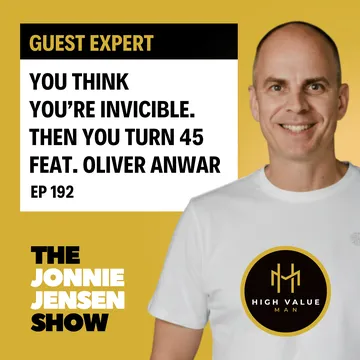
Episode 192 · Tuesday, 11 August 2026

You Think You're Invincible. Then You Turn 45 feat. Oliver Anwar

A leading health officer for global executives breaks down the biological and psychological systems required for high-performing men to maintain their edge well past forty.

Executive HealthHormonal OptimizationDubai BusinessMasculine PolarityTRT RisksHigh-Value ManBiohacking
By The Jonnie Jensen Show | 58m listen | 19 chapters
You Think You're Invincible. Then You Turn 45 feat. Oliver Anwar cover
The Jonnie Jensen Show · No. 192

About this episode

Oliver Anwar and Johnny Jensen challenge the illusion of invincibility that often leads high-performing executives toward physical and mental collapse by age 45. Anwar, the Dubai-based Chief Health Officer for Global Executives, details how business-owning fathers frequently sacrifice their hormonal health and family presence while climbing the corporate ladder. The discussion centers on a radical responsibility framework where physical vitality serves as the non-negotiable baseline for professional leadership and long-term legacy.

Anwar outlines his transition from manual labor in London to running a global coaching brand, citing the discipline learned in elite youth football as his foundation. He warns against the rising reliance on TRT and Ozempic as shortcuts, instead advocating for optimized sleep, protein-heavy nutrition, and comprehensive blood work to track markers like Lipoprotein A. The segment highlights specific claims regarding declining testosterone levels since the 1990s and the necessity of one gram of protein per pound of body weight to maintain muscle recovery and cognitive drive.

Beyond the gym, the conversation explores masculine polarity and the archetypes found in King, Warrior, Magician, Lover. Oliver Anwar shares how moving to Dubai shifted his social circle toward high-achieving peers, reinforcing the value of healthy competition. Johnny Jensen recounts his 365-day bodyweight challenge, illustrating how ten-minute daily habits can outperform sporadic, intensive training for the modern busy professional.


CHAPTER 01 / 19 Discussion

Oliver Anwar, Chief Health Officer for Global Executives

Host Johnny Jensen introduces Oliver Anwar, a health and fitness expert who serves as Chief Health Officer for high-level executives worldwide. Jensen highlights Anwar's consistent presence on LinkedIn and his alignment with the show's mission of helping successful men maintain their physical and mental performance. Anwar, based in Dubai at age 31, works with business-owning fathers who fear losing their edge at home despite professional success.

oliver anwar· johnny jensen· linkedin· fitness· mindset· executive coaching

00:00 If you're a high performer, you think that you're invincible. And then what happens, you get to like 40, 45, and you're like, man, I'm slowing down. You've not got the energy I want. I've got this big gut that I've got now. You maybe go to the doctor and you've got some health issues that you weren't sure about because you can't operate at that kind of pace. And then that crisis is really then the pivotal point that then causes men to be like, damn, I better, you know, start looking after this. Otherwise, I might not see my 50s, 60s, 70s because I've not looked after myself. Welcome to the Johnny Jensen Show, where modern dads discover how to create the true riches, relationships, and results they deserve.

00:42 Get your high-value man blueprint and join our community at highvalue manproject.com. Let's go. Welcome to the Johnny Jensen show. Today's guest expert is Oliver Anwar, the chief health officer to top execs around the world. Now, what drew me to Oliver wasn't hype, it was his consistency on LinkedIn day after day, quality, simple, clear messages. And I was like, this guy never misses a day. So then I had a sniff around. Turns out he's English, 20 years younger than me, but very aligned in what we think and talk about. Works with some seriously cool people around the world, top-level executives, helping them with their fitness and mindset.

01:25 And Oliver's building something really real, as we'll get into in the show. A lot of guys at 31, maybe myself, still drifting, still figuring it out. But here you are, as we'll get into absolutely smashing it. I work with successful business-owning dads who fear losing it all at home, men who've won on paper but know something is slipping. And when I started checking you out, Oliver, I realized you do very similar stuff and are really creating some great results around the world. So good to see you, Oliver. How are you doing? I'm good, Johnny. Thank you for the intro and I'm excited to be on the podcast today. I think there's an alignment in the way that we kind of do things and our messaging. So yeah, looking forward to giving some value today.

CHAPTER 02 / 19 Discussion

Oliver Anwar's Career Transformation from Vending Machines to Dubai

Oliver Anwar details his professional journey from filling vending machines in central London eight years ago to running a global coaching business from Dubai. After quitting a corporate job and going broke, Anwar worked 12-hour days in manual labor while listening to business podcasts and building his online brand at night. He attributes his success to ruthless consistency and a long-term vision of achieving location and time freedom.

london· dubai· vending machines· remote work· personal branding· career change

02:08 Yeah, brilliant, brilliant. And at 31, living in Dubai, a lot of people your age will be like, yeah, living the dream, man. Like, was that always something you were planning on doing? And was it easy to get out there? Yeah. So I came out here two years ago and I have a bit of a crazy story. So I was probably eight years ago, I was actually filling vending machines in central London. So I'd quit my corporate job, I'd gone broke, and I was trying to get this business off the ground, which I have now, but I didn't really have the traction I wanted. So I quit the job and then after a few months, didn't have any money. I was like, damn, I need to start making some money for rent. So what I actually did was then started getting some vending machine work.

02:52 So waking up at 4 a.m., driving around van around central London. And yeah, COVID hit. And luckily, my business had picked up. And then over the past, you know, five, six years, I've been running it full time. And two years ago, I decided that the UK was a bit too cold. I didn't like the weather. So I decided to move out here to Dubai. And it's been a great move. So that's a short backstory of how we've got here. So I had clocked a little bit of this, right? And one of the other series I do on the podcast is the comeback kings, right? So let's just, let's just not miss that out. Eight years ago, you were filling vending machines in London.

03:32 Today, you're working in living in Dubai, working with top executives around the world, and quite honestly, built a pretty great personal brand for yourself. How does someone create that level of transformation in that period of time? Yeah, I think a big part of it is like ruthless consistency and just keeping the belief that you're always going to get to where you want to be. Because I always had the dream when I was filling the vendor machines that I would be able to work remotely. I'd be able to work online with the people I want and have like the time freedom, location freedom to do what I wanted and really have an impact. So I remember I was waking up at 4 a.m. I was driving down the motorways in, you know, around London and I would be listening to podcasts about how I can improve my coaching business as I was going between different sites.

04:18 So I would be listening to this in the car before I'd go and then I'd go empty the van, fill up the vendor machines with coffee and chocolates, which is quite ironic because I'm a health and fitness nut, but I had to do what I had to do to make some money. And I was always focused on the business. So when I'd get home after a 12-hour day, I'd continue recording podcasts, putting content out, just trying to build my brand alongside it. And I think that that like ruthless consistency, coupled with the fact that I just had this internal self-belief that I was going to do it, helped me a lot during that time and helped me build the personal brand. Yeah, that's brilliant. And so 2020, eight years ago, you're 31 now, still 31, 32?

CHAPTER 03 / 19 Discussion

Elite Football Background and Early Entrepreneurial Discipline

Oliver Anwar discusses how playing elite-level football as a youth instilled the discipline and competitiveness necessary for his business success. He recounts launching his first fitness website while a broke university student in London and making his first sale on the opening night. This early experience with imposter syndrome and self-development shaped his approach to coaching men who have let their fitness slide due to career and family demands.

elite football· university of london· entrepreneurship· discipline· fitness website

04:56 I'm 31, yeah, 31. Yeah. Still, though, there's not a lot of people at that age who are, I mean, I was raving at that age and how I was like smoking a lot of weed, dancing in clubs at the weekend and having a load of fun, no, no doubt. And I think there is sort of generational differences is there, but still, there's something about a, I'm going to say lad, but I don't mean that in a patronizing way. There's something about a lad at 21 who's up to stuff that is that motivated. Did you grow up with that sort of messaging? Did, you know, where did that come from? Yeah. So I played a lot of elite level football in the UK as a young kid. So I was like traveling around the country playing against the academies. And my goal was to become a professional footballer.

05:40 So I was kind of like driven from a young age to be very competitive, to have discipline, to train quite a few days a week, play on the weekends. And it's quite nerve-wracking when you're going to play big clubs on the weekend and you've got to perform at a young age. And I think that that kind of discipline helped me develop myself in regards to other things that I do within business, managing my own health and fitness. And the start of my business was I was at university actually, and I was a pretty broke university student with no money in London. So I decided to actually set up a website and just launch a fitness website to share what I was doing. I got everyone on Facebook to actually share it for me, like all my friends and my family. And on the first night, someone had actually paid me for a fitness package.

06:21 This was on the first night of launch because everybody shared it. And I felt like a huge imposter because I'm like, man, I don't even really know how to do this yet, but I better figure it out because someone's actually paid me some money. So that was like a good motivational starting point. And then from there, it's just been a journey of learning, taking on mentorship, just really trying to develop my own self is the biggest thing I think that has come from it. So yeah, man, pretty wild start to what I did. Yeah, brilliant. Yeah, funny, funnily enough, my lad is 16. And so he's got his GCSEs this year. And he's chosen to go into an academy in September. He's a good little player. You know, they just got into the Sussex County Cup and he plays up front. So my daughter dances, just in case she's listening.

07:05 I love you as well, Rose. So that's your fitness. One of the reasons I wanted to get you on today was just really around the journey that men go through in their fitness. You and I sound, you know, we're clearly both people that had fitness as part of our values, part of our operating system from a young age. But a lot of men either didn't grow up with that or did, because they were playing football and rugby and doing whatever, but now they're busy and their dads and their life gets in the way and everything, everything goes to pot.

CHAPTER 04 / 19 Discussion

Health Crisis as a Catalyst for High-Performing Men

Men aged 40 to 65 often deprioritize their health while climbing the corporate ladder, leading to a loss of energy and the development of chronic issues. High performers frequently operate under an illusion of invincibility until a physical crisis or a doctor's warning serves as a pivotal wake-up call. This segment emphasizes that neglecting health in one's 20s and 30s can jeopardize the ability to enjoy life in later decades.

high performers· health crisis· longevity· aging· physical health

07:46 So that's the kind of a direction I'd love to take this thing. I think it'd be a real value to the listeners. What do you see with business? It doesn't really matter. You're working with higher level people in business. What do you see about men's fitness and their attitudes around it in the world today? Yeah. So I think especially for like busy, high-performing men, you know, 40 to 65, they've probably spent a lot of their life deprioritizing their health because other things have come first. So what's happened is maybe they played a lot of elite level football or they went to college in the US, played a lot of high-level sport when they were, you know, in that, in that area of college. And then they've got into their career. They've moved up very fast in their career. And it's required a lot of sacrifice.

08:30 As you know, with success, it requires you to sacrifice a lot. And one of the first things that gets sacrificed is health. And for a long period of time, men, I think as well, if you're a high performer, you think that you're invincible. You think that you can do more, that your body's not going to cause you any issues. And then what happens, you get to like 40, 45, and you're like, man, I'm slowing down. You know, I've not got the energy I want. I've got this big gut that I've got now. And it's also the fact that, you know, you maybe go to the doctor and you've got some health issues that you weren't sure about because you can't operate at that kind of pace without looking after your health like you did at 20. So I think that that's one of the big issues is it doesn't get deprioritized until there's a crisis.

09:09 And then that crisis is really then the pivotal point and the catalyst that then causes men to be like, damn, I better, you know, start looking after this. Otherwise, I might not see my 50s, 60s, 70s because I've not looked after myself. So I think that is a huge thing is just not prioritizing it during those key areas of like their 20s and 30s, if that makes sense. Yeah, yeah. And I see men in that regard. There's almost like a societal expectation that we have to do the business. We have to be the dad. We have to look after the family. We have to be successful because that's how the people around us end up being happy. And if they're happy and well, then I'll be happy and well. So I've got to keep on doing that.

CHAPTER 05 / 19 Discussion

Societal Expectations and the Burden of Male Responsibility

Societal expectations often pressure men to prioritize financial provision and family stability over their own well-being, leading to a lack of space for male empowerment. This neglect contributes to rising rates of mental health struggles and suicide among men who feel they must "just get on with it." Prioritizing personal health is framed as putting on one's own oxygen mask first to better serve those who depend on them.

mental health· suicide· masculine empowerment· societal pressure· self-care

09:53 And in this world that we live in live in and women's empowerment, very valid and important. But the idea, the topic of men's empowerment, there's not really a lot of space for it. But aligned with that is the men's mental health and suicide, all these things. So you've got this expectation inside of men that they have to be doing their best. They're not. There's all this talk about, oh, we need to talk more, but there's a degree to which men don't really feel that they're allowed to talk about these things. I've just got to get on with it. I've got to get up. I've got to go and do the work. And then, like you say, something happens.

10:29 They're standing in the shower, washing their fat gut, feeling a bit like, I don't really like that. Or I've got a couple of clients now recently, both pre-diabetic, both working on losing three stone. And now through working with me, they're now motivated and excited and they've reframed that whole thing. But still, they're like, I don't know what I'm going to do. And I'm like, it's okay. All this stuff's happened. You've got the family, you've got the kids. And then you let yourself get out of weight. And now we've got to put the focus back on yourself. When we get to that point, and I've just said a load of different stuff there, so try and turn it into a question. This societal expectations of what men need to be and then how we overcome that to start looking at putting ourselves first.

11:13 I'm sure you have to talk to men a lot about that to get them down to the gym and doing stuff. What do you see about that? And how do you approach it? Yeah, absolutely. I think first on that, there is this stigma around men that like, you know, as men, we take on so many burdens and so much responsibility, whether it's running a business, having a family, making sure everyone else is happy. And then we kind of leave ourselves as a last priority. But that's actually counterintuitive because everything good that comes from you that you provide for everybody else comes from your energy. It comes from like your clear decision making. It comes from your own self-esteem and your own alignment as a man and a person. So if you're not prioritizing that, you feel this mismatch because you've maybe got financial success, maybe you've got the great title, you've got a big house, you've got a great family, but internally, you're not happy with the way that you look, the way that you show up, the feelings of energy that you've got.

12:03 And, you know, society doesn't help with that, right? Society says that if you, you know, you're masculine, you're trying to improve yourself, you're driven, that it's toxic. And, you know, there's a lot of stigma around that as well now, as well. And I think that the main thing there is you've really got to look inward and be like, what is actually going to be best for myself? And that really is putting on your oxygen mask first, making sure that you prioritize your health, because then that gives everyone around you the best version of yourself. And that's the most important thing that you've got to think about. Yeah. And men, anyone who listens to the podcast regularly will know this is a theme that comes up regularly. You ask a man what he wants, they don't know. They can tell you what they don't want, like I'm fed up with this and I don't like that.

12:48 Or they'll be able to go like, oh yeah, business. I want to 10x to so-and-so. We want to improve the performance in the African region or whatever, like those kind of things. But ask them about what they actually want. 100%. It's been a while since I thought about that. I heard a podcast the other day and they were saying that actually that's that's part of our survival mechanism to look out for what is wrong. And X thousand years ago, when that was important, it meant that we survived. But in a world where there's not actually that much wrong, what it does is it just creates this innate level of underlying anxiety and fear, which actually robs us of so much of what we need to thrive as men.

CHAPTER 06 / 19 Discussion

Identity Shifts and Sustainable Habit Building for Health

Successful health transformations require a shift in internal identity rather than relying on extreme crash diets or temporary fitness challenges. By adopting the mindset of a "healthy person," men can build sustainable habits that align with their professional success and personal values. Lifting weights is described as a gateway drug to broader self-improvement, leading to better relationships and increased presence at work.

identity· habit building· weight loss· self-improvement· sustainable lifestyle

13:35 100%. No, I completely agree. So men are coming to you overweight and is their first message, I need to lose weight or is I need to get fit. And then when you start talking to them, I guess it's a classic case of give them what they want, but sorry, sell them what they want, but give them what they need. You see a great deal more of what's missing other than just the healthy diet and exercise. Yeah, absolutely. Like when we bring a client on, the first call is always like a very big, deep discovery in regards to what someone's like real driver is, because everybody wants to lose weight and, you know, feel better and all of those generic things.

14:17 But deep down, there are pains and things that sometimes men don't talk about that are very important. They're actually the anchors as to why they want to do something. A lot of the time, it's to do with the role models that they are to their kids, the way that they show up in their executive meetings. It's their longevity for their health as they're older and really like their identity. And a big thing that we focus on with our clients is really focusing on driving and fixing the identity as the main driver is their transformation. Because a lot of people, and they've done this before, they've been on these crash diets, you know, 7500. hard, they go keto, very extreme ways of doing things, but it's not aligned with their lifestyle. And they haven't actually built the identity to say, Hey, look, I'm going to do this for the long term.

14:58 Now I'm going to be a healthy person. I am a healthy person. This is what a healthy person does. And that takes a lot more long-term habit building, you know, removing a lot of the vices, removing the self-sabotage that actually helps them. So, yes, the weight is important, and obviously, the right diet and the right training plan. But what's more important is actually developing this identity internally that actually matches their success with what they have in business, right? That their health identity is someone that is disciplined, that does have the right habits, that wakes up early and goes to the gym because it's the right thing to do for who they are. And once they've built that, those habits are actually much more sustainable and sticky long term for them, if that makes sense.

15:36 Yeah, it makes perfect words. Certainly makes perfect sense to me. Absolutely. Yeah, giving them a reason, you know, a classic one when I'm talking to people. You know, the idea I'm on a diet, I've got to lose weight. If you're talking about I'm on a diet, I've got to lose weight. There's a conversation running that you're a fat bastard, right? So all of those are pretty disempowering. Plus, no one wants to go on a diet and lose weight. But the picture in the mind of I am runner or I am granddad, I am playing with my kids, I am hot naked, my wife fancies me still. I am alive is a much more empowering image, vision, goal than I'm fat and I've got to lose weight or again kind of thing.

16:19 100%. Yeah. And it's just about like raising the standards. Like one of the big things we tell our clients and why I think our program is very successful is we help them really raise their standards when it comes to their health, right? Because for such a long time, when it's been deprioritized, the standards on that side are so low. And I think raising the standards in your health also raises it everywhere else because once you take care of your health, you start taking care of other things, like your relationships become better, you become more present, you turn up to work with more energy, you want to push promotions more. Like it has this snowball effect. And one of my most famous tweets that went out on Twitter was that, you know, lifting weights is a gateway drug to self-improvement, which I think is so true, right? Like taking care of your health, like just majorly impacts every other area of your life as well.

CHAPTER 07 / 19 Discussion

The Dose Effect and Hormonal Optimization in Men

The modern sedentary lifestyle often tanks essential neurochemicals like dopamine, oxytocin, serotonin, and endorphins, which are necessary for motivation and thriving. Oliver Anwar explains that declining testosterone levels in men since the 1990s are largely due to environmental stress and poor nutrition. Optimizing these hormones through lifestyle changes can eliminate brain fog, improve decision-making, and enhance overall drive for entrepreneurs.

tj power· dose effect· dopamine· testosterone· brain fog· hormones

17:02 Yeah, yeah. Well, part of my program is I've often talked about the feel-good chemicals and the reward systems and how dopamine fuels motivation. And then I read a book, an old friend/slash work colleague, an associate of mine called Thomas Power and his wife, Penny Power, really amazing people. So their lad, right? I first met him when he was about 10 or whatever. His name's TJ Power. He's written this book called The Dose Effect. He's absolutely smashing it. And so, and The Dose Effect is a brilliant book. Taps into how everything that we're talking about actually fuels the essential reward and feel-good chemicals in our body of dopamine, oxytocin, serotonin, and endorphins.

17:48 And so, yes, going to the gym is good because it helps us build muscles, it helps us energize us if we sleep better. What TJ's book does so brilliantly is tie into these actions, these habits, these activities fuel the essential chemicals that our body needs to thrive. So, it's like a chicken and egg situation. If you want to feel motivated, you've got to do something to fuel your dopamine because your dopamine is how you generate motivation. But then, the modern lifestyle that we live in robs us of so many of those things. So, it's no wonder that modern men are struggling so much when we sit on our ass all the time and

18:29 game and drink and are in unhappy relationships. Like, literally, we've tanked all the essential feel-good chemicals that are that we need to thrive. 100%. And, you know, the modern environment, like you said, is just not conducive to optimal health and performance, right? You look at the food environment, it's very toxic. You go online to social media sometimes, you know, that can be toxic in what you see. And if you're not intentional and you're not precise and you're not specific about like your inputs and the things that you're reading, the things you're putting into your body, then you are like setting yourself up for disaster because the environment is not there to help you as the way it was. And, you know, one of the big things as well is testosterone. Like, testosterone in men has dropped significantly from where it was in the 90s.

19:14 And that's really a big portion down to the lifestyle, you know, the stress, the food environment, and things like that. And what you'll find is once we start having the right inputs on these things, the oxytocin, the serotonin, the endorphins, all of those feel-good chemicals come up, but also things like our natural testosterone and our hormones improve, right? And testosterone is a really big hormone, especially for like busy execs and entrepreneurs, because it not only helps with your energy and your drive and the things you want to do each day, but it also gives you the best clarity of. thought and helps with decision making. So, you know, with that, when you are underslept and you have low testosterone, you know, you get a lot of brain fog, like you, you can't really think properly, you get very irritable and it makes you less present.

CHAPTER 08 / 19 Discussion

Risks of TRT and the Importance of Health Foundations

While testosterone replacement therapy (TRT) and weight-loss drugs like Ozempic are rising in popularity, they are often marketed as shortcuts that bypass necessary lifestyle foundations. Oliver Anwar warns that these interventions can have significant side effects, such as impacting fertility or stripping muscle mass if not managed correctly. He advocates for fixing sleep, nutrition, and stress management as the primary means to naturally boost hormonal health before seeking pharmaceutical solutions.

trt· ozempic· testosterone replacement therapy· glp-1· fertility

19:56 Whereas when you've optimized the testosterone, what that actually does is helps you think clearly, make better decisions, and actually helps with like self-esteem because you actually feel driven to want to do things. So, yeah, I completely resonate with your point on that. Yeah. And what do you say? There's quite a drive at the moment for people to get on TRT testosterone replacement therapy. I've read up on it a lot. I haven't spoken to that many people that take it, but I've spoken to a couple of people. It just occurs to me that there's so many things that you can and should do before you opt down the TRT route. And a bit like the flipping weight loss jabs these days, it seems easier to take the jab than do the work.

20:37 Yeah. But I'm like, well, do the work. I mean, as a lifestyle choice, you need to be doing these things. By the way, half of these things are going to make you more attractive to your wife and it's going to make your relationship better, which can make you feel a lot happier in life anyway. You know, what do you see about this sort of rise in everyone jump on TRT? Yeah, I mean, the fitness industry has always loved the shortcut, right? You know, it's come from like these extreme diets, you know, cutting out food groups. You know, there's been like the TRT and testosterone, and now you've got the GLP ones and Ozempic. And what you've got to realize with taking this stuff is, yeah, like these drugs are groundbreaking and can be very useful for people in specific scenarios, but it does miss the context of the fact that foundations need to be fixed first, right?

21:20 Because without taking TRT, if you fix your kind of baseline of sleep, nutrition, training, reducing body fat down, managing stress, that will naturally boost your testosterone by significant points, right? If you just did a blood test, right, at month one, then you go on to a program or you yourself put together a sustainable lifestyle plan where you lost body fat, you got leaner, you built muscle, you looked after your sleep and your stress. Month six, your testosterone will be significantly higher and you'd feel way better. And you wouldn't need to take TRT or any of those other things because you'd actually see that difference.

21:56 But again, the way that these drugs are now marketed, it's the quick fix. And someone that is in a position that's feeling a lot of pain and is struggling a lot, it seems like the easy option. But there can be ramifications later on. For example, like with fertility, if you're not taking testosterone properly, as well with like these side effects of, you know, GLP1s that not a lot of people talk about. So again, you really should fix the foundations first before you even consider doing anything like that. It's like my girlfriend, long-term girlfriend, she's a menopause coach. And, you know, it's just, she's like, like, just banging her head against a wall with some of women who are jumping on the GLPs as a solution, but it's stripping their body of all the muscle and

CHAPTER 09 / 19 Discussion

Radical Responsibility for Personal and Professional Performance

Taking 100% responsibility for one's physical health serves as the baseline for resolving issues in relationships and the workplace. Life is inherently difficult, but neglecting self-care adds unnecessary stress that impairs a man's ability to lead and provide. Anwar's executive coaching philosophy centers on the idea that a healthy foundation makes every other professional and personal challenge easier to navigate.

radical responsibility· executive health· performance· leadership· accountability

22:43 healthy fat. Like literally, it's like a nuclear, yes, I've lost weight, but you screwed the rest of the system over. Yeah. So, and I think men need to consider that, yes, as you just said, those drugs fall in, as well as TRT fall into this, into the same bracket. Yeah. Yeah, 100%. How do you address, you know, this? And I've got, so I really feel like this is this is this whole conversation today for people that are tuned in, this is about success and performance, both in work, in yourself, in your relationships, at home. It comes back around or sits under the umbrella of fitness and working out. But I hope as Oliver and I are talking about, you realize that if the relationship's not working, it's probably you can square it back to something that you can be responsible for.

23:30 If you're struggling at work, you can square it back to something that you can be responsible for. And if as men, we are healthy, our mental health is balanced, we're looking after ourselves, we're well slept, we're well hydrated, and then the relationship's still not working, and then we don't still, and then we still don't enjoy our job or something's off, then you can go and address those individual things. But we are talking about taking 100% responsibility as the baseline, as the start point. And then we build ourselves as the man, as the confident masculine presence from there.

24:10 100%. No, I completely agree with that. And, you know, I always say life is hard, but you make it harder by not looking after yourself properly, right? So if you want to add more stress to your life, then, you know, you could be even more overweight. You could have less energy. And those problems that you have that are very real are going to be much harder to deal with if you've not got that good baseline and foundation, which all comes from that health point of view. Yeah, excellent. And before we crack on, where can people, people leave this till the end of the show? I'd like to try and bring it up a little bit sooner. What do you do specifically? specifically for people and where can people come and find and work with you? Yeah, so I run an executive health coaching company. So we work with executives and entrepreneurs that are looking to optimize their health long term, but also optimize their internal blood work too.

CHAPTER 10 / 19 Discussion

Biomarkers and Comprehensive Blood Work for Longevity

Comprehensive blood testing provides a data-driven look at internal health markers that standard physician checkups often miss, including hormonal panels and metabolic health. Oliver Anwar shares a personal anecdote about discovering a genetic marker for heart disease, Lipoprotein A, despite being a lifelong fitness enthusiast. Understanding individual biology allows for personalized supplement and nutrition protocols to mitigate long-term health risks.

blood work· biomarkers· heart disease· lipoprotein a· preventative health

24:52 So it's not just about weight loss, it's about building muscle, losing fat, having a sustainable system that helps navigate travel and everything. But we base everything around blood work. We base it around data and numbers. So we know that actually the changes that we're making are quantifiable and that we can actually see those changes. So you can find me on LinkedIn, Oliver Anwar. If you go to my website, which is easy, fitnessforentrepreneurs.com, you'll be able to find out more about what I do. So yeah. Yeah, brilliant. And whilst we haven't worked together, I flipping on the basis that I've watched you post every day for like the years that I've noticed you. And you respond back as well. And here we are chatting today. So definitely a top guy. Tell us a bit about that blood work because I don't think this is something that a lot of men understand.

25:37 I've had mine done every now and again. I used, I pretty much used Thriver consistently, an English car, British company, nice guy that runs it, at least when I met him on the podcast. For someone that doesn't understand what that is or why is it important, tell us a bit about that. Yeah, absolutely. So especially as you get older, you know, into your 40s, 50s, and 60s, it's not just about the way that you look, but also what your internal health looks like. And, you know, maybe you do a test with your GP or with your local physician if you're in the US. And what tends to happen is they, firstly, they don't measure everything. So it's not a comprehensive blood test. There's a lot of stuff that they don't see, which again could be life-threatening. And then secondly, they're kind of like measuring, you know, internal markers that are maybe based on the average population, right?

26:22 And if we look at the average population, you know, hopefully people don't get offended, but most of them are overweight, they're underslept, and you know, they're not as healthy as you want. So that baseline isn't always the best. So one of the best things that you can do if you're a successful man is to go and get a blood test done, a comprehensive one. There's plenty of places in the UK you can do that and also the US. And what that does is it actually gives you a reading of what your biomarkers look like. And what your biomarkers are are things like your hormonal panel, so your testosterone, your free testosterone, things like your thyroid. It's also going to look at your metabolic health as well. It's going to look at your like fasted insulin levels and things like that, your cholesterol, and even, you know, stress markers like cortisol.

27:03 And what you might find is if you're a man that's got a lot of low energy, you're not feeling good, you're training a lot, you feel like you're doing everything right, but you've not maybe done your blood work, then that could be the reason because, you know, a lot of like genetic markers and health markers are kind of you know caused by not having optimal blood work, right? So if you get the test done, it actually gives you like this eye-opening experience where you can see internally what's going on and then you can implement a plan that's based on that that's going to help you. And one of the most important things to note is that everyone's biology is different, right? So Johnny, if you get a blood test and I get a blood test, we're both going to have completely different challenges in regards to what we need to improve.

27:39 One of the things that I didn't know was I had a genetic marker for heart disease. So I've been a health nut for my whole life, but I tested for something called lipoprotein A, which is a marker for heart disease. And mine was like ridiculously high, despite the rest of my blood work being like near perfect. So for me, I've then had to do some supplement protocols, like remove some habits of like smoking cigars and shisha that I do enjoy doing sometimes and to actually help improve that. So without that blood test, I wouldn't have had a clue about this. And my granddad sadly passed away when I was seven years old of a heart attack. And there's lots of heart disease in my family. So it's actually genetic that I didn't know about. So again, like it just gives you this really good insight.

28:18 And then you can build a plan, whether that's nutrition, training, and supplements based off of that to then improve them, if that makes sense. Yeah, it makes total sense. Yeah, yeah, yeah. Again, comes back to that word responsibility. Like you couldn't, you so many parts of our lives we run in ways that are different to how we look after ourselves. So we take our car for an MOT, we get our carpets and ovens cleaned. The garden gets looked after by someone who's actually a gardener or people that take on that as a hobby and they know what they're doing. And yet we have got no clue what's going on with our body, what we're putting in it, whether it's any good. Yeah, absolutely obvious, particularly for longevity and healthy, you know,

CHAPTER 11 / 19 Discussion

Overcoming Time Constraints with Sustainable Health Systems

The excuse of lacking time for fitness is addressed by building sustainable systems that fit into a busy executive's existing schedule. Prioritizing sleep is identified as the most critical foundation, as poor sleep leads to a downward spiral of bad nutritional choices and skipped workouts. Effective systems focus on manageable 30-minute windows for exercise and prioritizing protein intake to maintain energy levels throughout the day.

time management· sleep hygiene· nutrition· home workouts· consistency

29:02 being around for our kids, grandchildren, whatever that looks like. Yeah. Yeah, absolutely. Yeah. Thinking about the habits and routines, you know, and how you would talk to a client about optimizing their lifestyle. The classic one I always get back is, oh, well, I haven't really got time. Like, like clearly, you know, an easy excuse to make. And then you challenge them on it and you realize that we've all got the same amount of time and it's just about what they're making. making their time for. Optimizing habits and routines is the biggest both breakthrough and barrier for people taking on any desired outcome in their life.

29:47 How do you coach and work with men to make that shift in their habits and routines? Yeah, for sure. So one of the first things is actually like we don't use the excuse of time because, you know, everybody has got the same amount of time and other people are willing to do it. And one of the first things that I like to do is when someone says they don't have time, I'm like, oh, well, these like 500 clients that we work with got these great transformations. They seem to have time. Like, what do you think that they're doing differently compared to you? Right. And that kind of just wipes out any kind of, you know, objection or any kind of excuse, right? But it's not to say that it's not real. So, you know, if you are like very busy, like you are going to be more time crunched compared to an 18-year-old kid that's got all the time in the world.

30:30 So the first thing that you need to do is actually build a system that's going to be sustainable around your life. Now, that doesn't mean going to the gym two day, two hours a day, you know, carrying chicken, broccoli and rice with you and doing those extreme things. It's more about saying, hey, look, let's craft, you know, 90 minutes in a week where I can fit in some workouts three days a week and actually just stick to that, whether that's, you know, walk-in, some body weight workouts. And it needs to be personalized to you. So for example, if you're working from home a lot, then trying to have a setup at home and doing something at home is really useful because it stops that kind of like excuse of, oh, I can't go to the gym. It's busy. There's traffic and things like that. So really finding something that aligns with your lifestyle. It's not just the training side, though, either. It's the nutrition. So with nutrition, it's about having an understanding for your body and your goals.

31:12 Like, well, how much do I really need to eat? You know, what should the meals look like? And how am I going to prioritize the protein within that? And then just have a system that helps, you know, build that in. Another big one is a system for sleep. Like I always say to my clients, like sleep is the number one foundation out of everything, right? So if you don't have good sleep, you know, we've all had it four hours of sleep a night. We wake up, low energy, you know, we don't eat properly. Our training usually gets skipped and then we end up having cravings in the evening and then we eat tons. Then we get a bad sleep again and then we're on this downward spiral, right? So if we can fix the sleep part, we're able to make better decisions. Our hormones are also more optimized. We're then able to make better decisions with food and also want to have the energy then to exercise.

31:54 And that really helps. So really just having a system around those three things to start is like a really, really good baseline to begin to set. Yeah, it seems so. The magic of this is it is so obvious. It's not just it seems so obvious. It is so obvious. COVID in a strange way was really helpful for me around home workouts because I thought, I sort of thought it was weird. Put the telly on and do a workout in front of it. Like that's what as Jane Vonda or some kind of, you know, like, you know, women, like, you know, being able to realize, yeah, a 30-minute workout is clearly better than no workout.

CHAPTER 12 / 19 Discussion

The Power of Ten-Minute Daily Workouts

A ten-minute daily workout is more effective for long-term habit building than sporadic two-hour sessions that are easily skipped. Johnny Jensen shares an anecdote about completing a 365-day challenge of press-ups, sit-ups, and burpees, which led to significant physical changes despite the short duration. Habit stacking—starting with small, non-negotiable tasks—creates the momentum needed to eventually take on more intensive training.

burpees· habit stacking· consistency· bodyweight exercise· fitness challenge

32:36 And what I say to a lot of clients as well is a 10-minute workout is better than no workout. And a few years back, I did, I just, I did an, I did a, a 60-day workout challenge in my group, got to the end of the 60-day, 30-day, got to the end of the 30-day. And I was like, I'm going to carry on. So if anybody's just joining and wants to start like, you know, just whatever your 30-day is start, I got to like 100 days. I was like, I wonder if I could do this every day. So I did it every day for a year, but it wasn't this hour-long workout. And sometimes I went to the gym and so it got incorporated as part of that. But the thing I did every day was press-ups, sit-ups, or some kind of crunch and burpees.

33:18 And it was three sets of each of those. And the whole thing lasted. If that was all I did, the whole thing lasted like less than 10 minutes. And anyone who's done 45 burpees, like, is going to know that you're blowing out your ass at that point. At 365 days, I was ripped. And it turned out, as you did in the second part of the story, which I'd love your input on, it turns out I wasn't looking after myself properly, mainly from a nutritious point, nutrition point of view. But also I put quite a lot of wear on these specific muscles.

33:59 I hadn't like balanced it out. So that goes back to you talking about knowing what you're doing. But that 10 minutes a day, you know, talk into that about like, what is the value of doing 10 minutes a day versus doing nothing a day? 100%. One of the biggest things with doing just 10 minutes a day is like the start of the habit building, right? So I think as people that are successful and successful in your career, you kind of have this type A personality where you want to like do everything all at once, right? So you're like, I need to do this. transformation. I'm going to do two hours of training today. I'm going to be really extreme. I'm going to make all of this happen. And it's just not going to be sustainable because you've got so many other stresses in your life where that's just not realistic.

34:39 And then the habits tend to fall off. So, starting small and slowly, like stacking habits, is a really good thing. So, some of the things that we do with our clients is like we just do one thing a week that we introduce that helps them with building the habit. So, for example, week one could be build 10 minutes into your day where you do some form of exercise. It could be going for a walk, you know, whether that's a walking treadmill, going outside for a walk, a body weight workout, something to just get the body moving and just build that every day. Now, once we've done that, we can then maybe upgrade next week to something different. Maybe we do 20 minutes, or it could be a case of actually instead of that, we're going to build a nutrition habit. And what you find is if you do a small 10 minutes, you end up wanting to do more because you get the endorphins, you get all of those great feelings and hormones that you mentioned.

35:20 You end up doing 20, 30 minutes, you're like, Man, I feel great. Like, I only went in to do 10 minutes, I've just done 30 minutes and I feel awesome. So, it helps build that habit. And then, obviously, you can stack those habits as the weeks go on. And if you're then consistent over a long period of time, and I'm a big person on consistency, I just like to say, like, I don't like to miss. Like, that's one of my mottos. So, again, if you can get to this point where you don't miss and you just do something small every day over the course of 365 days, that's a huge transformation that you're going to make. And again, it's from that small, small bit of investment that you do each day to begin. Yeah, totally. Because when you set out, oh, my workout is two hours long,

36:00 the potential to miss that window is huge. But if your workout is, oh, I do a 10-minute body workout every day, or I do a 10-minute body workout every other day, then there's infinite capacity to do more. You're never ever really able to say, I didn't have 10 minutes. Absolutely. Yeah. And what about you mentioned, I mentioned in my story, and you mentioned just before that about nutrition and protein. When I ultimately, I really hurt my shoulder actually doing that, that 365-day thing.

CHAPTER 13 / 19 Discussion

Protein Requirements and Muscle Recovery for Men

Protein is the most frequently deficient macronutrient in the Western diet and is essential for muscle recovery, joint health, and satiety. Oliver Anwar recommends a baseline of one gram of protein per pound of body weight, a target that often requires doubling or tripling standard portions of meat or eggs. Tracking intake is necessary because most people overestimate how much protein they actually consume through regular meals.

protein· macronutrients· muscle building· satiety· nutrition tracking

36:38 When everyone should have a good osteopath, in my opinion, I've got a great one. And he said, Well, you also need to go and do some like real, like specific exercising. So I went and saw a guy for that. He got talking to me about my protein levels and really how much protein I was taking on board. This gets thrown around a lot, and you walk through the supermarket and you see protein shakes and all, you know, and big tubs of it. And it looks like, especially now in the UK, I don't know what it's like in Dubai. All the supermarkets have got these added protein, protein, like super protein yogurts and super thing.

37:17 But protein is really, really vital. Yeah. Can you tell us a bit more about why it's so important and how much should we be getting and what happens if we don't get enough? Yeah. So protein is probably one of the most you could say deficient forms of macronutrients that we get in our diet. So if you just look at like a standard Western diet, it's full of carbohydrates, fats, you know, processed food a lot of the time doesn't have much protein in. So protein is key because it helps us build muscle, which is very important. It's also the most filling macronutrient. So if you're trying to diet and you're trying to stay full, then protein is going to keep you really full and actually stave off a lot of the cravings that you have.

37:55 And when you take it, what happens is like your body kind of breaks that down a lot slower within the body. So again, this helps us actually just feel a lot fuller because our body's kind of breaking that down. It's the key to muscle building, really. So if you're looking to build muscle and recover, then your protein is very important and so is your sleep. When it comes to protein, I would recommend like most people start, and this is very simple, like one gram per pound of body weight. Now, you can actually have a little bit less than that, but just for the mass, it's easy. So let's say you weigh 200 pounds, ideally 200 grams of protein. Now, when you actually execute on that, you're going to be shocked by how much protein that actually is compared to probably what you're currently eating, right? It's shocking. So with that,

38:37 I always say like whatever a normal person's like portion of protein is per day, you want to like double that, if not triple that, because people are so deficient in protein. So each meal that you have, whether that's like breakfast, lunch and dinner, try and always start that with some form of protein. So for example, in the morning, if you're having breakfast, start with like some eggs. You could have cottage cheese, Greek yogurt. For lunch, if you want to have some like minced beef or you want to have some, you know, chicken, that's fine. Then in the evening, if you want to go for some fish, like some salmon and other things there, that could be great. And then, for example, as snacks, you can go for a protein shake if you want to, but there's other things that you can operate from as well. But just having that baseline of protein is going to be good for your diet in phase. You're going to lose more fat.

39:20 You're going to build more muscle whilst you do it. You're also going to feel fuller for longer. And it's also going to help prevent you. getting injuries, right? Because you're going to start building muscle around your joints too. And that's going to be really key. So yeah, protein is key. And those are some guidelines that I recommend to people. Yeah. And that's how I, that's how my shoulder hurt. And here's a classic one, right? So how many people say to you, oh, I do eat a lot of chicken? Everyone. But how much chicken would you need to eat to get, you know, is it like 200 grams? You know, you're going to need to eat at least half a whole chicken a day. So I think people need to recognize that some kind of, well, first of all, tracking it, measuring it, but then

40:01 literally something that's going to give you 60 to 70 grams in a, in, in one go is probably going to be a protein shake or something like that. Exactly. Yeah. Yeah. Classic. No, I eat a lot of chicken. It's okay. There's no way on earth you eat enough chicken every single day to be hitting your protein, to be hitting your protein targets. Absolutely brilliant. So change your gears slightly. Just around, you know, I always, when I bring up the word masculinity, right? People, people, people think about it in different ways. And I probably hadn't planned to cover this or have this chat with you, but I saw, you know, Sora gets asked about in quite a lot of the podcasts that you've been on.

CHAPTER 14 / 19 Discussion

Healthy Masculinity as Emotional Stability and Leadership

Healthy masculinity is defined by integrity, emotional stability, and a clear sense of purpose rather than the "toxic" traits often highlighted in media. Men are encouraged to be the "rock" for their families, providing a stable presence that children and partners can rely on during times of stress. A strong sense of identity prevents relationships from drifting and ensures that a man's values are not compromised by external pressures.

masculinity· leadership· emotional intelligence· protector· provider

40:50 Why do you think you get asked that in podcasts? Yeah, I think a lot of the time it, I think because I work with a lot of men and I'm a man myself, I can kind of like speak, speak on it. And I do put content on about that. And I think that masculinity really is about having a really good driving force and purpose in what you do, right? So it's about having integrity. It's about having the right values, like a mission that you're really focused on, whether that's in your career, whether that's in your family life and what you want to achieve. Because, you know, masculinity in itself is really about like the driving force of what you want to move forward. And for people that are listening, I think that like the stability and like the emotional balance that you need to have as a man is very important because there's a lot of stresses that are going to happen in your life from, you know, family events that are going to happen, work stresses, could be health, all of those things.

41:42 And for you to move through life in the right way, you've really got to have this iron mind. You've got to have this strength, this stability emotionally that helps you drive forward. And what that does is it helps support the other people around you because, you know, if your wife is feeling stressed, your children are feeling stressed, they've got other demands on them, they're looking at you as the leader. And as much as people might not like to say it, like you're always the man of the house. People are always looking to you to be this strength and this rock that's there. And then if you start acting out emotionally, you don't have the drive, you don't have the focus, you're not disciplined, that rubs off on everybody else. So there's a lot of stigma around masculinity because people view it in a bad way, right?

42:23 And there is obviously bad forms of masculinity, toxic masculinity, but the actual healthy masculinity of being the protector, being the provider, being emotionally stable, caring for other people, but also having a driving mission and pushing yourself forward is so important. And I think that this is the key successes that you can have as a man is having that strong, healthy masculinity to help drive you forward. Yeah, I couldn't agree more. I mean, it's to own our own masculinity, first of all, requires a strong sense of identity. And this whole idea of like, well, what is masculinity? Or what have I got? I've got to go and read about it. And I go, to be honest, it's about being really strongly connected with who you are and what you want.

43:05 So that when a challenging moment comes up or when your values are called into question, you can be like, no, no, no, this is what we're doing or this is the path we're going down. And if, and in terms of a relationship, if you have that strong positioning at the start of the relationship, then I, then you'd like to think you're going to attract someone who enjoys and wants to be around that strong polar, you know, like rock, you know, that, that, that, that, that, that energy in the middle of everything. I think the problem comes in relationships in particular is when men aren't clear on who they are and what they stand for. And they get into a relationship somewhere down the line, their values are either being compromised or she realizes like, actually, he's a bit of a flaky dick.

43:49 I don't know. I don't know why. I don't know why I'm with him. But of course, they fell in love because there was passion and energy and it was fun. And it's what we were supposed to do when we're in our 20s and 30s. In the absence, though, of a clear sense of identity, relationships can really, really drift and become, you know, I struggle with the phrase toxic masculinity. I think that's just shit blokes, really. And then, are there shit women? Yeah, there's definitely shit women. So we could talk about toxic women and toxic men. Are we just going to talk about like low-grade humans? Like, yeah, exactly. Let's, let's, let's not be low-grade humans. Okay. Let's be high-grade in my terms. Let's be high-value humans.

CHAPTER 15 / 19 Discussion

Masculine Polarity and Attracting High-Value Relationships

Maintaining masculine polarity in a relationship involves being value-driven, disciplined, and occasionally disagreeable when personal standards are at stake. This clarity of direction is described as highly attractive to feminine partners who seek a leader for their family unit. The segment posits that individuals do not attract what they want, but rather what they are, making self-improvement the primary path to finding a quality partner.

polarity· dating· high value man· attraction· relationships

44:27 Yeah. 100%. Just on that point as well, I think that from relationships that I've had, it's very important that like, if you have that masculine, you know, you know, polarity within a relationship, it's actually more enjoyable because a woman wants to come into your world and experience what you do, see what you believe in, your values, and like what your mission is. And for guys here that like dating feminine women and that's attractive to them, having more of a masculine polarity is really going to help with that because, you know, the opposites do attract in that sense. And you're then able to introduce someone to you that's like way more compatible. They like what you're doing. They like the fact that you're value driven. They like the fact you've got purpose. They like the fact that you've got discipline. They like the fact that you don't agree with everything.

45:09 Right. That's another big thing with masculinity is it's okay to be disagreeable. It's okay to say, no, I don't like that shit. I'm not doing it. That's not for me. Women love that because their whole life, they've had these nice guys simp up to them and say, oh, no, but I like this too. I believe in all of this. I believe in whatever you say. And like they're bullshit detectors, just like, you're just saying that because you want to get something out of it, right? Whereas if you actually have something you believe in that you truly believe in and you live your life aligned like that, a woman's going to walk in and think, man, this is exactly what I want. I want someone that's got that direction that's going to push myself and my family forward and really help us have a great life. Yeah. Yeah. Like being really attractive, like it's literally cut you down the middle and it's, it runs all the way through it.

45:52 Like when you talk about masculinity like that, the way I hear it is like, well, why wouldn't you all want to be like that? Or when you explain it like that to women, you'd like to think that women are going to go, yeah, that's what I want. Yeah. Yeah. And it gets dressed up as, oh, there's no good men in the world or, you know, men in the same thing. I can't find a decent woman. And I'm like, well, there's a lot of low-grade people out there. But by the way, there's also a lot of people who are saying that they want to meet someone good. So go out there and be great. Worry less about finding the relationship. Be the kind of person that would attract that. And you can be pretty sure that it's going to come to you.

46:32 Yeah. 100%. I always say like, you don't attract what you want. You attract what you are. And the funny thing is, as you start to like raise your man, raise your value as a man. And we talk about the high value man project, which I love the name, right? As you become more high value in what you do and, you know, becoming more successful and more aligned, they actually start coming. Like you start attracting great people into your life and you're like, wow, like, how does this happen? Well, it just happens because like you're attracting it, right? Like the energy is at a certain point. You're that kind of person and other people can feel that. And then you bring that into your life. So I'm always a big proponent of like, you know, you have to be the change that you want in the world to see the change and the people that should be in your life. Yeah, I love that. Yeah. Yeah. Be the difference you want to see is kind of my version of it. Yeah.

CHAPTER 16 / 19 Discussion

Influential Books for Male Development and Archetypes

Oliver Anwar lists several foundational texts that shaped his understanding of masculine energy and personal growth, including "The Way of the Superior Man" by David Deida. He also references "King, Warrior, Magician, Lover," which outlines the four archetypes men must balance to be well-rounded individuals. These resources helped him navigate past relationship failures by teaching him how to maintain polarity and emotional maturity.

david deida· way of the superior man· king warrior magician lover· archetypes· personal development

47:15 Yeah. And I mean, just going back to something I touched on right at the beginning, where did you pick this up from? Because my personal development journey, the first book I read was Feel the Fear and Do It Anyway, Susan Jeffers, around 1998, basically. And then my journey was kind of of someone my age, the classic kind of Tony Robbins, Zig Ziglar, Jim Rohn, you know, and Wayne Dyer. And then getting interested in going backwards in time, Napoleon Hill and Earl Nightingale and some of those guys.

47:54 And then getting into Stoics and stuff. So it's for me, it's been, it's a fascinating exploration into what it means to what goes on in our mind, who we are as humans, and then who we are as men. Where did your journey start? Considering you're only 31 now, what was your like gateway, your personal development gateway? Yeah, great question. So in my early 20s, I think I went through some relationships that helped me. Well, not helped me, but got my heart broken. And then it helped me, you know, navigate actually, okay, relationships in general. I started watching a YouTube channel called, and I think this was big back in like the 2000s called Real Social Dynamics, which was basically these pickup artists that would go out and like teach you how to speak to girls because I was really interested in what that was.

48:42 But like on a deeper level, I focused on following one of the founders called Owen Cook. And he spoke a lot about like masculine energy, like polarity and things like that. And he got me onto the book, The Way of the Superior Man by David Dieda. And that one is actually the game changer for me. I go and reread that book so many times. And that actually helped me understand a lot about like masculine and feminine polarity when it came to relationships. Another really big book that influenced me is King, Warrior, Magician, Lover. So it talks about the four different archetypes of man. And I think that that's what. what really resonated with me: as a man, like you are wearing lots of different hats.

49:19 And I think to be the best version of yourself, like adopting the king, the warrior, the magician, the lover archetypes helps you be the most rounded because you can actually give the best to everybody. So, yeah, that kind of what got me in. And then I just kind of studied it. I followed other people there. And I think a lot of my own relationships, I learned a lot of things as to, you know, why did my relationships go on wrong? A lot of the time, it was actually down to me that I was maybe not holding that polarity. I wasn't behaving in the right way, acting in the right way. And I know I'm only 31, but I think I've gone through a bit of a journey in regards to that that's helped me now have better relationships.

49:56 I've got a girlfriend as well that's really aligned with me now. And I think that understanding the masculine-feminine polarity has really helped with that for sure. Yeah. It's obvious. And not enough men realize this that we get born, we learn to walk, we learn to talk, we learn to wipe our ass, then we learn maths and history and other random things that we may or may not need. At no point does the majority of us take the time to learn like who we are as a machine and as a thinking machine, let alone a physical machine.

CHAPTER 17 / 19 Discussion

Social Connections and the Value of Healthy Competition

Surrounding oneself with high-achieving men is vital for personal growth, as the "average of five people" rule applies to both wealth and mindset. Oliver Anwar discusses the benefits of healthy competition within friend groups to drive business and fitness goals forward. Moving to Dubai allowed him to level up by being around individuals who are more successful, reinforcing the idea that a rising tide lifts all ships.

bristol· dubai· social circles· competition· male friendship· community

50:35 And then we walk around wondering why things aren't working out, why we don't feel that great, why relationships don't work, why is nothing ever working out for me? Well, maybe you're putting petrol in a diesel car, like maybe it's not. And what about some of your friends and you know, that you grew up with? Have any of them come on the journey with you or is your lifestyle sort of evolved that you've now got pretty much you know a new set of friends and and and sort of places you're you're you're operating and showing up in yeah good question so i'm friends with all of my school friends that i played football with and like my day one friends back in bristol they're recently out here in dubai coming to visit so um they're they're great man and like they've all gone on their own you know journey in different ways in regards to like their own

51:19 improvement and yeah that's one of the things i'm proud about with my group of friends is in their own way in whatever kind of like realm they've gone on they've all tried to improve and be better men which is really good and then along the way i've also met some really good friends that were on that journey with me and that have become like some of my close friends too so i think that's a big thing as well with like masculinity and men is like you need good groups of people and men around you that are going to help you right because a lot of the time people don't understand the stresses you go through the problems that you have sometimes you know you don't want to go and sit with a therapist for an hour and talk about your problems but if you speak with a close friend that you're with that knows you and they're going through the same thing it's so much

51:59 more actually conducive because they understand your problem they're going through the same thing and they actually kind of give you this kind of like level of support that you didn't think that they could so yeah surround yourself with other men that were on that journey and like obviously listening to this podcast is a great way to do that online but i think in person if you can have those communities or go to retreats or be a part of communities like that it's going to have a huge difference in regards to like how you operate um you know they always say you're the average of the five people that you hang around the most and i'm a big proponent of that and one of the big reasons i moved to dubai because everybody here is richer than me and is doing very well so it kind of helps me level up my game and uh become my best version of myself so yeah like

52:39 competition is healthy too like another thing as well that's kind of been demonized is oh you shouldn't be competitive you shouldn't be driven you should be as competitive as possible it's healthy it's like what drives you forward and even in my friend groups we have like healthy competition in what we want to achieve with our businesses with you know whether our fitness goals and like it helps push each other together it's actually a healthy thing um so definitely like don't shy away from that i think that's really really important yeah social connections challenges leveling up like the what's it called the the tide rises you know what's it called a rising tide lifts all lifts all shit that's right yeah and i don't know why but just i've got this this this word on my mind as we get towards the end about vision and and and direction

CHAPTER 18 / 19 Discussion

Future Vision for Family and Business Growth

Oliver Anwar expresses an optimistic outlook on his future, focusing on expanding his elite performance business and personal brand over the next five years. He also anticipates starting a family, viewing the role of a father as the ultimate purpose for a man's drive and fulfillment. The discussion concludes with the idea that raising strong, capable children with integrity is the most significant legacy one can leave.

optimism· family planning· personal branding· entrepreneurship· legacy

53:25 seems to me that you've had targets had goals and you've leaned into it and the results have come you know and a lot of men worry about the results and then don't take don't take the steps where are you headed next and and how are you staying tuned into that that vision yeah so i think one of the big things i focus on is i try and always like presuppose that good things are going to happen and like have optimism so i always like presuppose that there's going to be success i remember when i was filling vending machines i would kind of like smile some days i was like i'm not going to be doing this forever

54:02 you know i'm going to be you know running my own business at some point and having some freedom and i always like believe that and like presupposes success and know, belief systems are really important. Like, if you believe bad things are going to happen and it's not going to work and things are terrible and people are terrible, women are terrible. Guess what? Your reality is going to show you that. But I think if you have that optimistic viewpoint of like, actually, there are great people out there. I can be very successful. I'm going to go and achieve this. The world just kind of like bends to your kind of will, right? And it does take action. It does take you to push forward. But that belief there actually helps you during those hard times. So that's one of the things that's helped for me. And for me, it's really continuing to grow my business and my personal brand, which is like a big focus for me.

54:46 Build more into our team that we have on our elite performance business and program. And I think I'm 31 now. So I think in the next four or five years, actually, family and kids is going to be on the line for me as well. So I think for me, that's going to give me a different level of purpose because I don't have kids yet. So I can't speak to it. But friends that I know that have had children and had families, it's the number one thing that has actually given them even more drive and actually happiness and fulfillment in their life. So yeah, I think that's so important, man. Having a family, you know, raising kids, you know, raising like strong, capable, kind, you know, people with integrity within your family to then go on and live and have a great life.

55:29 Like, I don't think there's any other purpose that's bigger than that. So for me, business is important, but actually like a family and like living, you know, in that way is going to be huge, I think, for me over the next four or five years. Yeah, beautiful. I had my kids a little bit older than that. I don't know that it was necessarily planned. If I'd have found the right woman, I'd have probably had them sooner. But I think there is that age bracket that you just spoke about is great because when you hit 50, which is where I'm at, they're going to be 20, you know, 19, 20. And then you get that kind of 50 to 60 age bracket for yourself, where then you're going to actually be doing less of the dad duty stuff.

56:12 And they do say, I've read and seen some stuff recently about women's health, the success rates of births. And of course, there's nothing wrong with having children at whatever age you're able to do it. But there is something about this kind of early 30s time, which is actually the, you know, the best time to be having kids. Yeah. Yeah, 100%. Beautiful. Oliver, I have absolutely loved this. I hope it's been an enjoyable session for yourself as well. Remind people again where they can find you if they want to connect up. Yeah. Firstly, Johnny, thank you for having me on. This has been a great podcast, great conversation. And I hope everyone listening has enjoyed it.

CHAPTER 19 / 19 Discussion

Closing Remarks and High-Value Man Project Resources

Host Johnny Jensen concludes the interview by encouraging listeners to share the episode with other men who could benefit from the discussion on health and leadership. Oliver Anwar provides his contact information, directing listeners to his LinkedIn profile and his website, fitnessforentrepreneurs.com. The show ends with a call to join the High-Value Man Project community for further resources on personal development.

johnny jensen show· high value man project· health coaching· podcast outro

56:51 So you can find me mostly active on LinkedIn. You can find me, Oliver Anwar, same on X, Twitter. I'm pretty active on there. And then you can also find my business if you're interested in what I do, fitnessforentrepreneurs.com, to find out about my health coaching program. Awesome. To the people that have been listening, I really appreciate you showing up or you watching, listening. Please remember to like, share, subscribe this, in particular, sharing it with other men in your life that you think could be that could take something from this. We've talked a lot today about health and fitness, but not just the six-pack and having some, you know, some biceps to flex.

57:30 This is about showing up in your life, being the best man, being the best dad, the best version of yourself that you can be. Because when you can be that, you get to be more for everyone else in your life. It doesn't really work the other way around. And I really hope that has come across today. So tune in to the next episode. I'll see you on the other side. Thanks again, Oliver. Thank you. Thanks for tuning in to the Johnny Jensen show. Be sure to subscribe, leave a review, and share it with fellow dads. Creating the life you deserve starts with you. Get your high-value man blueprint and join our community of motivated modern dads at highvalumanproject.com. Let's go.