

Friday, 18 July 2025

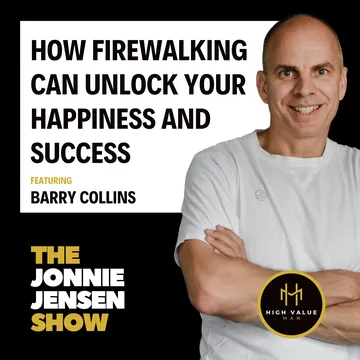
How Firewalking Can Unlock a Man’s Happiness and Success feat. Barry Collins

A corporate veteran turned firewalking instructor reveals how ancient rituals and modern psychology provide the ultimate breakthrough for men trapped in cycles of professional and personal despair.

By The Jonnie Jensen Show | 56m listen | 10 chapters
How Firewalking Can Unlock a Man’s Happiness and Success feat. Barry Collins cover

About this episode

Barry Collins of KickAsh Firewalks challenges the modern epidemic of male stagnation by reviving a 6,000-year-old Kalahari ritual for the corporate age. Collins and host Johnny Jensen dismantle the skepticism surrounding firewalking, positioning the practice not as a stunt, but as a psychological mirror for professional and personal hesitation. By confronting the fire pit, participants expose the internal narratives that dictate their capacity for risk and leadership.

Collins details his transition from a 25-year corporate sales career to becoming a master instructor under human potential pioneers Tolly Burkan and Richard Bandler. The discussion explores the efficacy of Neuro-linguistic Programming (NLP) and the symbolic power of the wooden board break exercise in Lodi, California. Beyond the physical act, the conversation addresses the alarming suicide rates within the construction industry and the pragmatic escape some men seek when trapped in cycles of mental anguish. Collins cites Burkan’s survival of multiple accidents and his book Dying to Live as the catalyst for a movement that eventually birthed the coaching styles of Tony Robbins and Mel Robbins.

One standout moment involves a 13,000-foot tandem skydive metaphor where Tolly Burkan argues that a choice is only real when you are sitting in the airplane doorway. This episode captures the raw reality of men’s mental health, identifying how coping mechanisms like Xbox and caffeine often mask a deeper lack of courage. Johnny Jensen concludes with a call for men to join the High Value Man Project to break these repetitive cycles.


CHAPTER 01 / 10 Discussion

Barry Collins and the Psychology of Firewalking

Host Johnny Jensen introduces Barry Collins of KickAsh Firewalks, the instructor who trained him in the practice of firewalking. The discussion addresses the common resistance and skepticism men feel toward firewalking, framing it as a tool to move beyond comfort zones. They explore how hesitation at the fire pit often mirrors hesitation in other areas of life, such as career and relationships.

barry collins· kickash firewalks· firewalking· high value man project· personal development

00:00 Welcome to the Johnny Jensen show. Right. What if walking across fire could unlock your confidence, your courage, even your happiness? It sounds ridiculous. And I know from the number of friends who I've said, why don't you come firewalking? I know exactly what most people think of that invitation. But the reality, the unbelievable surprise that comes at the end of a firewalk, let alone the end of a firewalking weekend, is absolutely incredible. And I'm thrilled today to have someone that I learnt my firewalking trade from, which is Barry Collins. I'm going to play the intro and bring him in.

00:45 Welcome to the Johnny Jensen Show, where modern dads discover how to create the true riches, relationships, and results they deserve. Get your high-value man blueprint and join our community at highvalumanproject.com. Let's go. Hello, Barry. Great to have you here with us on the Johnny Jensen show. I gave a little preview to who you are in the intro, but you are Barry Collins of KickAsh Firewalks, and you were one of the team that I did my firewalk instructor training with. So you are integral to my whole love and passion even for firewalking.

01:25 It's great to have you here on the show. How are you doing today on the hottest day, I think, ever in British history? Yeah, well, I heard Earl today that in Wimbledon, they're going to hit the highest temperature in 147 years of Wimbledon history. So yeah, I'm guessing it's warm where you are. It's definitely warm where I am. Good news is that I've had to turn the fan off and shut the window. So I truly am melting. But do you know what? Like, you know, it's like whatever, Arnold Schwarzenegger or Tom Cruise doing his own stunt. So here I am, you know, suffering for my audience, for the people that want to hear about firewalking.

02:02 Well, put your firewalker shoes on or take them off, I suppose, is a better reference. And, you know, we're used to the heat as firewalkers in one way or another, you know, being at the holding your foot to the flame. Yeah, exactly. So when I have asked my mates or people I know or men inside the High Value Man project, come and do a firewalk, many of them say, as if I'm fucking doing that, right? Now, of course, I think it's a bloody brilliant idea. Why, you know, why do people have such a resistance to something that is so amazing? I mean, maybe it's bloody obvious. Maybe I don't want to burn my feet. But like, what is the resistance?

02:43 Do you think? There's a couple of parts that I've noticed are common. And the first thing is that you and I, having done multiple firewalks, we understand and appreciate how powerful an experience it can be. And so we just think everybody should have an experience of that magnitude. But when you're selling the firewalk, when you're saying, come and do a firewalk, people who have no concept of what it's about, they just think you're nuts. And so they just want to perhaps take out a restraining order, keep you at arm's length and distance you and remove you as a friend on their friends list.

03:23 And the other part is that it's so far beyond most people's comfort zone that even those people who have maybe a glimpse of what the potential of that sort of experience could reveal to them and help them become, it's still so far beyond their comfort zone that they're like, there's no way I could do that. That's not for the likes of me, you know, is a common thing. Yeah. And the magic of that last bit there is that we say that all the time, even subconsciously in our lives. So we don't realize how many times we hold back from doing something that could be incredible.

04:01 And it might not be as inverted commas dangerous as firewalking, but it's that little hesitation where we don't go after what's possible on the other side. Absolutely. Absolutely. The key component, and you've hit the nail on the head there, is that the people who are most inclined to decline that invitation are probably the ones that would benefit most from it. Because that hesitation, that doubt, that uncertainty, if they're feeling it at the invitation to firewalk, they're probably feeling it elsewhere in life. Yeah. And it's a little bit of a leading question, but is that why some people get to the end of their first firewalk and just burst into tears?

04:42 Oh, absolutely. The people who struggle most to kick their shoes off and to step up and to take that first step, to step through that membrane of fear and step onto the coals. When they get to the other end, they're the ones that have had the biggest breakthrough. The people who step up nonchalantly and stroll across like it was nothing and get to the other end and kind of look back over their shoulder and go, Well, was that it? You know, have you got a bigger one? Yeah, you know, have you? Where's the where's the big one? Where's the hot one? And occasionally, you'll get somebody like that, but it tends to be because they've missed the context of what they're doing.

05:25 They've shown up because they think it's some sort of sideshow carnival trick and they've missed the real reason behind it. But the people who really engage, who contemplate what it means to them and what it symbolizes, when they get to the other end, yeah, you know, people can have monumental breakthroughs as a result of having that four or five second experience. Yeah. And I called this, um, you know, how firewalking can unlock success and happiness because it is personally speaking. I took so much baggage into my first ever firewalking weekend, and I didn't really have any expectations other than, oh, wow, that is definitely something I want to do.

06:10 But it was about a year and a half after my divorce. So I had a lot of stuff I was bringing in, let alone the previous 35 years worth of stuff. And I didn't, it's that classic expression of you don't know what you don't know. I had no idea what was possible. I had an expectation that it was going to be cool, but I had no idea of the deeper levels of freedom that I got from it. And there's a lot of other activities that go on in a weekend like that. And we'll talk a bit about that as we go on. But why does it, and maybe we've answered this a little bit anyway, but in terms of unlocking, unleashing that success and happiness, why do you think, why is it such a monumental moment for people?

06:57 I think because whether it's an evening event or a full day or even a multi-day event, typically, even the people that know that there's a firewalk, if it's their first event that includes a firewalk experience, there's some part of them, maybe a very large part in some instances, that turns up still thinking, there's no way I can do this. What was I thinking? How did Johnny talk me into this? What was I thinking about? Perhaps I can sneak out the back door and nobody will notice. And the role that we have as facilitators is to bring context to that experience, to bring meaning to it, to make it symbolic of what else is going on in their life, so that as they step off the coals at the end, they look back.

07:46 And many people will say, you know, to themselves, something along the lines of, you know, I didn't think that was possible. Or I didn't think it was possible for me, but I was wrong. What else have I been wrong about in life? What else did I not think I was good enough, ready for, young enough, old enough, smart enough, pretty enough? All the stories that we tell ourselves in that moment, they just burn away on the coals. And what you're left with is the truth of who you really are and what your potential is. And that's the potential to be confident, to be successful, to be happy. And to rather than putting all those things off for I'll be happy when, realizing that you can be happy now.

08:32 Yeah. That might sound like a right load of bollocks to some people. Right? It really would, right? Oh, yeah, as if as if I'm going to get that from hoofing across, you know, you know, three meters of hot wood. But that's that's almost like the ancient wisdom of firewalking. And I guess there's so much of what we as humans have let go from, you know, whatever, not even just decades, millenniums, whatever, whatever the right word of describing that is, thousands of years of human history and practices such as these that give us breakthroughs that help us become something even more than what we thought possible.

CHAPTER 02 / 10 Discussion

Ancient Origins and Modern Personal Empowerment Movement

The practice of firewalking dates back nearly 6,000 years to the Kalahari Kumbh as a spiritual ritual for connecting with ancestors. In the late 1970s, Tolly Burkan integrated firewalking into the human potential movement, transforming it into a tool for modern personal development. The experience serves as a social leveler, impacting CEOs and janitors equally by stripping away external status and forcing a confrontation with internal doubt.

kalahari kumbh· tolly burkan· human potential movement· personal empowerment· ritual

09:13 And I know from the people I've seen do fireworks that it's a great leveler. You could have someone who's really not achieved as much as they hoped they would in life. Maybe they're at the start of their journey or maybe they're older and they're full of regret. And then someone else who's like absolutely a game smashing it. And the experience, the outcome is such a leveler. It can be, you know, it can be like equally as impressive, equally as significant for both those people. What can you say about the practice, the ancient sort of rites of firewalking and why it makes such a difference? So firewalking itself, it's nothing nothing new. It's been around for thousands of years.

09:58 The earliest recording example is nearly 6,000 years ago, the Kalahari Kumbh. And for them, it was a connection to greater power and ancient wisdom and their ancestors. And for much of the last, you know, several thousand years, that's what it's been. It's a ceremony, it's a ritual, sometimes shrouded in mystery. And then in the late 70s, it was not discovered, but it was added to the field of personal empowerment by a man called Tolly Burkhan, who was in the personal development field.

10:35 He was part of the human potential movement back in the 70s. And he came across firewalking and had his first experience and was so blown away by the impact I had in him that he immediately started to integrate it into the personal development seminars that he was delivering. And the breakthroughs that people had as a response to that were significantly more as a result of including the firewalk as part of those seminars. Yeah. You're absolutely right when you say it's a leveller because it doesn't matter whether you're a multi-million pound CEO or you're the janitor or anywhere in between. Yeah. When you're stood looking at three meters of glowing red embers and your socks and shoes are off,

11:19 those people are having a very similar experience. The same thoughts are running through their head. It doesn't matter how much money you've got in the bank or how tailored your suit is and what cars at the end of the drive. When you're looking at those calls, you're going to receive a lesson. I just got goosebumps. I love it when I'm going to do a podcast and I get goosebumps. Regular listeners will say, oh, go on, Johnny, again, right? But every, like, I know when they get it, it goes right up your spine. And it is like a human experience. There's not a lot of everyday life where we get to really experience that I'm okay. I'm a human. I'm having a human experience here. Whoever stood here is probably thinking similar things and they're about to experience something similar.

CHAPTER 03 / 10 Discussion

Barry Collins Career Transition from Corporate Sales to NLP

Barry Collins details his 25-year career in corporate sales and management before becoming disillusioned and discovering Neuro-linguistic Programming (NLP). After studying under Richard Bandler and Tolly Burkan, Collins transitioned into therapy and firewalking instruction. He has since trained global instructors and emphasizes that the practice is a "powerful medicine" for realizing human potential rather than a carnival trick.

neuro-linguistic programming· richard bandler· tolly burkan· corporate sales· therapy

12:05 Sticking with my promise of introducing you properly, how the hell do you know all this stuff? Like, why should we listen to Barry Collins? Barry Collins, and give us a bit of background into your firewalking journey and stuff. So for 25 years, I was in corporate sales, management, team development. And you loved it. You loved the grind. Well, I started off loving it. But as I came to the end of that 25-year career, I was very disillusioned. And in the last eight or nine years of that, I'd been going through the motions. I'd been ticking the boxes and attending the refresher courses for management development.

12:50 And they were just recycling the same old stuff. But in 2004, I was introduced to this new stuff, this wonderful stuff that I hadn't seen in the previous 15 or 20 years. And it turned out it was NLP, Neuro-linguistic programming. And this was something very interesting. I thought, oh, I can see how I could apply this in the sales environment. And, you know, my teams would outperform all the. So I started a course of self-study. But learning NLP from a book is like trying to learn to drive a car by reading a book.

13:27 It can't tell you what it's like to feel the biting point of a clutch. So between 2008 and 2009, I went and studied with Richard Bandler as a practitioner, then as a master practitioner of NLP, purely for the intention of bettering the sales performance of my teams. But I quickly realized that actually, outside of the sales environment, people's lives could be better as a result of the stuff that I was learning directly and damn so quickly. And so I began, not intentionally, building a practice where I would, you know, work with people on a one-to-one basis, helping them overcome

14:05 the stuff that goes on in between the ears that holds you back. The doubt, the fear, the uncertainty, phobias, anxiety, stress, all of that stuff. And by 2013, I was very lucky. I was able to step away from the corporate world. The practice had gathered momentum. And so for a couple of years, I just threw myself into being a therapist. And that involved immersing myself in the personal development field, meeting lots of different people, connecting with lots of people. And of course, fire walking came up as one of those things. It was like, oh, yeah, that would be cool. I'd like to do that one day. And so the opportunity arose in 2015.

14:48 And my wife and and I both helped organize an event. We got somebody in to run the firewalk. And the next morning we both woke up and it was like, holy shit, how do I get more of that in my life? Right. Okay. And that was kind of the start. And that was, well, back in 2015. And I began the training just a couple of months later to become a firewalking instructor. Two years, sorry, 18 months later, I found myself sat in the lounge of Tolly Burkhan as part of the mastery training. So I was there learning from the guy who had started it all back in the 70s.

15:27 And that for me was really profound to spend time with someone who, you know, he was the creator of everything that it is today. You know, he trained people like T. Harbecker, Andy Harrington, Tony Robbins, Edwin Gaines, Dan Brulee, all these people who are, you know, significant within the world of personal development. And so that was kind of where, you know, I'd started that journey and now it just skyrocketed. So over the last eight years, I've, I suppose, become a master of my craft. And, you know, I had the fortunate opportunity to work with you when you were training.

16:11 So, you know, I was glad to be part of that. And, you know, I've trained people from across the globe to become instructors and run hundreds, if not thousands of events and thousands of people across the coals. And everyone has their own individual experience. And because of the way that I was taught, the way that I was trained, it's very much, it's not a carnival sideshow trick. You know, it's a powerful medicine. And so I always want to honour the origins of the teachings through Tolly that this is about helping people to realize their potential.

CHAPTER 04 / 10 Discussion

Mindset Science and the Observer of Thinking

Success in firewalking depends on mindset rather than conflicting scientific theories like the Leidenfrost effect. Approaching the coals with fear or doubt increases the risk of injury, whereas a focused presence allows participants to become the "observer of their own thinking." This mental detachment helps individuals recognize self-limiting stories and safety mechanisms that prevent them from taking risks in daily life.

mindset· psychology· fear· cognitive behavior· intentionality

16:52 You know, it's not what you learn when you firewalk. It's who you become. And that's what it's really about. You know, who could you become if you just set aside all the doubt and the fear and the hesitancy and stop hesitating and take action today? Yeah. And that bit you mentioned there about the fairground sort of version of it. I've been at events like that and I thought to myself, oh, I don't like the look of this thing. And that doesn't mean like how long or short it is. And that's not to discredit charity events. I've been at charity-based events and they've been run brilliantly. What's the guys in Brighton?

17:38 TJ, is it TJ or something? EJ. H and EJ. H and EJ, yeah, yeah. I've tended, I've helped set the fire up and be a support to them at a couple of their events. But equally, I've been in places where there's happened to be a firewalking thing going on and there was way too much razimataz about it. Is that when things go wrong? Is that when people aren't set up in the right frame of mind? It tends to be, you know, if you get into the science of firewalking, you know, there's lots of scientific explanations as to why it's possible. The challenge is that many of those scientific explanations contradict the other scientific explanations, which all stand up, you know, under scrutiny as a standalone explanation, but not as soon as you compare them.

18:24 The only common factor across all of the reasons is the attitude and the mindset of the people approaching it. If you approach it with fear and doubt and uncertainty, then yeah, you run the risk of getting injured. And the challenge with many of these events, you know, I run charity events and the firewalk in those instances, the firewalk is the sizzle. You know, it's what gets people interested. It piques their interest and they go, oh, what's this about? But when they turn up, that's when they get the meat. You know, that's when I heard them for an hour and a half or a couple of hours before the firewalk. And that's where we really explore what it's really about. We give it context. We give it meaning.

19:06 There are other people that will just get you across the coals. And at the end of the night, you go, yeah, I've done a firewalk. Great. Why? I don't know, but I've done a firewalk. And that for me is not what it's about. It's about as the people come off, they look back and, yeah, sure, they've done the firewalk, but it's what they've learnt about themselves in the process, how they have learned that perhaps they're not showing up as their best self in day-to-day life, but now they're aware of it. They can choose to show up better, to show up differently. Yeah, and that, you know, fear being a, what's it called when you put letters together? Acronym. Acronym, yeah, of false evidence appearing real, which people will have heard.

19:50 People will have sat in conferences and the bloke at the front will be like, fear, false evidence appearing real. But firewalking is the most beautiful example of this because the evidence is it's bloody hot and it's going to burn you to a crisp. Oh, yeah. The experience is actually very different. And so anybody who's ever thought, I can't do something or I don't think it's worth it or putting something off or procrastinating or, you know, like, again, it's not about success or lack of success. It's about the things that we hold off on. Could be a relationship that we're not happy in, could be a job that we're bored with, could be a vision for our life that we always had and wanted to follow, but never fully stepped out into it.

20:36 Like these things eat away at us. And it's often for fear, like, oh, I can't risk it or that it's not going to be worth it or something's going to go wrong. False evidence appearing real, firewalking is that in a like there is, can there be a more profound illustration of that? No, that's the beauty of the firewalk. You can't deny that you've just done it. There's no, well, maybe I was just lucky. Maybe I just got lucky this time. You know, if you've done a firewalk, if you've walked across three or four meters of glowing red embers, which, you know, typically in excess of a thousand degrees Fahrenheit, if you've walked across that, that is, that is an indelible experience.

21:19 That makes you question reality. It makes you question the belief systems, the things that you tell yourself and you accept as fact. You know, when we, our self-talk is one of the most convincing voices we will ever hear. That little voice between your ears that says, but what if you can't? Maybe you shouldn't. All those things. The unconscious is trying to protect you. It's trying to keep you safe. That's its job. But sometimes it gets it wrong and it overprotects you. And so we miss opportunities. We let moments that it's not until months or sometimes years later we look back and realize that that moment was a golden opportunity and you missed it.

22:05 Yeah. You know, I talk a lot to the men in the High Value Man Project about this concept, really, just, you know, using the movie. Oh, my brain. Come on. I call this is definitely male menopause, right? The matrix, right? The matrix. Slowing down time in our minds, like literally as we're living the moment and go, oh, hang on a minute. That's my flipping brain telling me not to risk it. Or that's, you know, I shouldn't say this or I'll just keep playing it safe. I won't do that. And then when we've started to train ourselves in these ways or become aware of our own, like the difference between us as the machine and us as this wonderful free spirit that can pretty much do anything that our bodies will allow us to.

22:54 And being able to catch that. And that allows us, it allows us to avoid an argument with people. It allows us to take a risk and it go our way. And this for me is a, is a, when you talk about firewalking, and actually there's other practices that go into firewalking and prepping people and the empowerment, which we can talk about in a second. But doing things like this is like a press up for our for our mind. And it allows us to actually realize, oh, I decided I couldn't do that. And then I didn't say this, which has given me this result. What if I'd actually done something different to that?

23:34 What if I'd actually thought, no, that's just a safety mechanism. I wonder what's on the other side of, fuck it, let's go for it. And there, that's where our real power lies. You know, as you say, there's other tools, I'm sure we'll talk about them. But, you know, what it does is it provides a controlled environment for people to step into and experience that fear, that doubt, that uncertainty, and choose to become the observer of their own thinking, which I think is kind of, you know, what you're saying. Exactly. But that's just a fear about this. So that's a doubt about that. That's just that voice telling me not to because that one time this thing happened.

24:17 And when you can become the observer of your own thinking, you can detach the emotional and go, right, so that's just a thought. Now I can make a choice about what to do freely. And it allows you to rehearse being successful, to rehearse putting your foot forward, to take that first step into the unknown and being okay with not knowing what the next step is. step holds. It's like it's, you know, people just think of this as woo-woo stuff, but it's about harnessing the power that's all around us and within us and putting it into action. I mean, the board break is a beautiful thing. I'll let you explain how the board break works and what goes on. But you've got a room full of people, the same piece of wood, you know, in terms of dimensions and what it's, you know, where what tree it's come from.

CHAPTER 05 / 10 Discussion

Symbolic Breakthroughs through the Wooden Board Break

The board break exercise involves smashing a one-inch thick wooden plank to symbolize breaking through life's obstacles. It serves as a measure of commitment rather than raw physical strength, often resulting in small-framed individuals succeeding where larger men fail due to mental focus. The exercise challenges participants to evaluate whether they are giving 100% effort to their goals or merely "giving it a shot."

board breaking· martial arts· commitment· personal growth· empowerment

25:02 A little old lady goes right through it, and some big geezer can't break it. I mean, that's that's that is this thing that that is this realizing or not realizing or accessing or not accessing this innate power in all of us. Yeah. And this is this is the power of describe what is tell us all about the board break. Sure. So, you know, in terms of the board break, it's essentially it's a square plank of wood that's typically about an inch thick. And, you know, if you're a fan of martial arts, you know, or you've seen any sort of martial arts movies or, you know, been to personal development seminars, you will invariably probably have seen someone smashing through a wooden board with their bare hand, you know, in a karate-esque type way.

25:51 Now, the thing with this is that, as you quite rightly said, you can have some small, frail little old lady who comes up and absolutely destroys it, and some big boots guy who, you know, if you were to look at him, you'd think, oh, he's just going to sail through it, really struggle with it. And in many instances, that is a credit to the facilitator. Because if it's just a test of strength, it would probably happen the other way around. The frail little old lady would, you know, have difficulty with it, and the big books guy would smash it, but not really know why. But with all these exercises, you know, the exercise is not what the exercise is about.

26:31 It's about what you can learn about yourself. And that's the facilitator's job to present it in such a way that it has a deeper meaning, a deeper structure. To so, what is this actually about? Is it about breaking a wooden board? No, I could take it out and take a hammer to it, you know, and I've still broken a wooden board, but what does it represent? And where else are those patterns of behavior showing up in my life? Where else am I holding myself back? What do I need to break through to get to the stuff that I want in my life? And that's what these exercises tend to be about. Yeah. And that's why people get confronted. That's what you're saying. Like, if you just walked up to him in the street and said, push through this, you'd get different versions of people doing it successfully or otherwise.

27:14 But when you're in the context of the day and you're saying, you know, you're almost like asking people or challenging people to be confronted by those things that they don't want to talk about. And then they get that loss of power, which is that is about taking them on that journey to kind of break them down and build them back up because that's where the ultimate breakthrough comes from. Yeah. And it's also a measure of commitment. And again, in all these exercises, there's an element of commitment. You have to make the decision to commit to these exercises. And we've all done it. We've all done something in our life where we didn't get the outcome that we'd hoped for. And we've all said a version of, at least I gave it a shot.

27:54 We've all said something like that. Ah, I gave it a shot. And because we didn't get the outcome, but if we were honest with ourselves, you know, in your heart of hearts, in that dark secret place, did you give it 100%? Could you have given it a little bit more? And if you had, would you have maybe got the outcome that you were chasing? And I'm not, I'm deliberately not talking about success or failure here because it isn't about that. It's about going after the things you want. And if you want them, then go after them. Throw yourself into it 100%, heart and soul, and go after the things that you want. But don't hang your happiness and your success on those things.

28:34 Realize that you can be happy and successful now on the road to those things. You know, it doesn't matter if you've got the right car or the right relationship or the right bank balance. You know, if you're hanging your happiness on them, you can be miserable now and then you may get happy one day. But if you can make the decision and if you become the observer of your own thinking, like you spoke about, you can make a choice to be happy and still go after those things. And best case scenario, you get those things that you're chasing and you're happy. But worst case scenario, you're just happy. Yeah. And that's why I called this interview, this video, this podcast, you know, unleashing

CHAPTER 06 / 10 Discussion

Tolly Burkan Skydive Metaphor for Decision Making

A story from a training session with Tolly Burkan involves a surprise trip to Lodi Airport for a 13,000-foot tandem skydive. Burkan argued that a person cannot truly choose to opt out until they are sitting in the airplane doorway, as any prior decision is based on a projected story rather than reality. This metaphor illustrates how people often avoid opportunities based on internal narratives instead of actual experiences.

tolly burkan· lodi airport· skydiving· decision making· fear

29:15 how firewalking can help you unleash your success and happiness. Because it is about experiencing the journey. And too many men get caught up in trying to support everybody else and be the man and do everything that they're supposed to and fulfill the role of the man. And I talk a lot about masculinity because I do believe that. that the world is missing masculinity, but not in flipping six-pack or flipping misogynistic. I don't know, I hate that bloody word, but you know, take-esque type stuff. Men who are present and bold and have a willingness to step out when the opportunity arises, who are present to the journey that they're on, and they're enjoying the wins and the losses in equal measure.

30:02 And that's what stuff like, and I dare say people who flipping do skydives and things like that, or, you know, I know from my own snowboarding experiences, you know, there's something magical about tossing yourself off the side of a mountain down some off-piste after there's just been a heavy dump of fresh powder. And, you know, in your mind, you're like, I'm pretty certain I'm going to make this, but there is a definite element of risk. And my legs are going to be burning. And I'm going to, and there's a whole kind of like getting to the bottom and turning around and looking back and going, oh my gosh, that

30:41 is what being alive is about. And so unleashing that success and happiness is about doing these things, about literally setting yourself free. If I can share a quick story that kind of alludes to that, which is please. When I went and spent a week with Tolly, all I knew was that for those seven days, and if you've ever been to any of these personal development seminars where there's 200, 300, 400 other people in the room, it wasn't that. There was eight of us in Tolly's lounge from across the world. So this is small, intimate, there's nowhere to hide. And all I knew for those seven days was that each day was going to challenge me more than the day before.

31:21 That was it. And so you can imagine my surprise when on day three, we're, you know, we arrive, we're taking our coats off, putting our bags down. He says, no, no, no, don't take your coats off. You're not going to be here long today because today you're going to take the 90-minute drive up to Lodi Airport. You're going to watch a short video. You're going to sign a form. You're going to put on a jumpsuit. You're going to get in a plane. You're going to get up to 13,000 feet. You're going to get a man strapped to your back. And then you're getting out before lunch. Now, hands started to go up in the room as to all the reasons that wasn't going to be working for me today. You know, I wasn't the only one. And he said, no, you don't get to choose now. You have to take the 90-minute drive and sign the form and watch the video and put on the jumpsuit and get in the plane and get up to 13,000 feet and get the man strapped to your back and sit in the doorway.

32:08 And when you're sat in the doorway, that's when you get to choose. Because up until that moment, you're basing your decision on what you think the experience is going to be. Once you've sat in the doorway, you're basing the decision on what it's actually going to be. But up until that moment, you're just telling yourself a story and making a decision based on that. And that's what we do in life all the time. We tell ourselves these stories about, well, I think it'll be like this, or I think it would be like that, or I don't want to do it because. And then we base a decision on our own internal experience rather than the reality of the experience. And so, you know, all these exercises that we do, it gives people the opportunity, whether it's firewalking or board breaking or walking on a bed of broken glass, it calls your attention.

32:55 It calls you to be very present and to pay attention to your own experience and your own thinking. And you begin to see these patterns. We say that, you know, the way you do one thing is the way you do everything. And these patterns, they begin to show up when you're in these sort of environments. And so you can look at these patterns analytically and you can go, is this serving me? Where else is this showing up in life? Do I want to keep doing this? But now you're aware of it. You can choose to change it if you want. Yeah, I use that all the time. How you do one thing is how you do everything. And I'd say it in the mirror. I'm not like preaching this to people. I look at it from my own perspective in the mirror.

CHAPTER 07 / 10 Discussion

Self-Awareness and the Definition of Courage

The discussion shifts to the importance of self-awareness in daily habits, such as recognizing when caffeine consumption or entertainment like Xbox becomes a coping mechanism for misery. Courage is defined not as the absence of fear, but as the ability to take action despite it. This framework is presented as essential for men striving to be present and bold in their family and professional roles.

courage· self-awareness· masculinity· habits· mental health

33:38 This last week, I've given up caffeine. And I don't mean giving up for life. I just like, do you know what I normally do in the winter? And I like blast it past. I can't do that this winter. I'm too tired. And then, of course, I'm drinking more and more of it. And I'm just like, this isn't right. This isn't. And I know part of it is good because it like focuses me. And the other part of it is bad because I know that it gets to a point where I'm drinking too much of it and it's not actually healthy. And few people have that level of self-awareness. Like they're miserable, so they play flipping Xbox. These are married men, by the way. I'm not talking about my son. They're miserable. So they play Xbox. And then guess what? She's bitching to her mates. Oh, he never does anything.

34:23 He's always playing on his Xbox. Meanwhile, he sat there going, fucking woman always nagging at me. Low responsibility, no self-awareness. I love it, the bit about firewalking. It says, you know, get this wrong and you will burn your feet to a Chris. You know, like, there's no. That's not my approach. No, no, but like, no, in my mind, because I told, like, oh, if you run, I say to people who say to me, I'm not doing that. I'm like, yeah, if you run across it, you're going to scuff the coals up and you're going to kick them, you know, hot, you know, embers up onto the top of your feet, and that's going to burn. If you panic and you kind of like almost like hop across them, then you're going to push way too deep into it.

35:05 And like, that's not the way to do it either. And, you know, for me, that is also a metaphor about how you approach a relationship, about how you approach a negotiation. Like, get this, like, tune into what you're doing. Be present to the way that it's going to work for everything involved. Your feet, the embers, the people around you, like you be present to what it's going to take to get through this successfully, and you will create that win. And that's like a level of intentionality and focus. Ah, solid, we'll be fine. Yeah. Oh, yeah. I mean, I sometimes get asked, you know, as I said, I do do charity events, you know, as well as.

35:45 And one of the questions that sometimes comes up is: okay, can we not cut the talk a bit shorter? Do you really need an hour and a half? And so, you know, at that point, I go, right, let's imagine that it's not a firewalk, that it's a skydive. And you're saying to me, okay, can we cut it short? So, if you know, if you're saying to me, can you cut the safety briefing short? I would say to you, sure. Which part of the safety briefing do you want me to cut out? You know, because everyone in the room is a grown adult, they can make their own choices.

36:24 And so, you know, and I say to them, look, these people, if you've ever done a skydive or any, you know, I know, but you go, the bit where you pack, the bit where you pack the parachute or the bit where you land, which bit do you want to cut? Like, you know, and I say to them, so you know, as you approach this, if we're going to train your people to do, you know, to have the best possible experience. Because if like, if you go for a skydive or a bunch of jump, they're going to prepare you to have the best possible experience, the experience that, you know, most people are probably turning up to have. And so if, you know, we make the decision, okay, that's the experience we wanted to give you, we have to prepare you for that experience because if you're not fully prepared, you could choose to do your own thing, like not pull the cord at 3,000 feet.

37:08 And you'll still have an experience, not for very long, but you'll still have an experience, but not the one that we want you to have. And so all of these things are about preparing you to have the best possible experience. How often do we do that in life? How often do we take time to prepare ourselves to have the best possible experience? Or in life, are we more often going, but what if? And preparing ourselves for the worst possible scenarios. Yeah, and that is, I mean, that's part of my training program as well is courage is the second part of the 3XC formula.

37:48 And having courage, I love the definition of courage. You're probably well aware of this, right? But when I looked at it, I was like, that is beautiful. It's not the absence of fear. It's the ability to push through fear. That's courage. Yes. Beautiful, I think. Oh, yeah, absolutely. And it's true, again, coming back to all these empowerment activities. Many of them, most of them, will create an element of fear. And that's natural. It's the people who don't have fear that I'm normally more concerned about. But the ones that have fear, it's preparing them to have the fear and still take action. That's what we're preparing them for. Well, in the realms of preparing people,

CHAPTER 08 / 10 Discussion

Male Suicide Rates and Breaking the Cycle of Anguish

The conversation addresses high suicide rates in the construction industry and the societal pressure on men to conform to stoic stereotypes. They discuss the "mental anguish" of repetitive negative cycles and how some men perceive suicide as a pragmatic escape when they feel they have no other choices. The hosts advocate for men's groups and physical challenges as alternative ways to explore identity and find a way out of despair.

suicide prevention· mental health· construction industry· masculinity· depression

45:04 better days, and a better life. Awesome. Kicking back into this conversation we've been having about unleashing success and happiness. Given all your experience of NLP and coaching people, let alone all the fireworking stuff, where do you see men commonly getting stuck? Like what's what has men commonly find themselves in this stuck sort of experience, this endless repeat cycle? I think there's several parts and part of it is the stereotype of what is a man.

45:41 The construction industry is one of the industries that has the highest suicide rate because men are expected to be these boots, manly, you know, and without being able to freely express themselves and their emotions and say, I need some help. And so there's this kind of this pressure to conform to this stereotype. But also the, you know, the other part I think is not having the guidance to kind of have someone help them to explore how do you get happy? How do you go after the things that you want in your life? You know, we get stuck in the rot. You know, I was there for 25 years.

46:26 And if not for a few chance encounters, God, I might even still have been there. And, you know, I would have been a basket case if that had happened. I'm sure of it. So I think recognizing that, you know, if you're doing something that's not fulfilling you, that's not feeding your soul, that's not making you happy, that isn't, you know, nurturing your relationships either with partners or children or parents, then you don't need to keep doing it. But sometimes it's seeing the way out is where the challenge lies. And so, you know, I think those two things: recognizing that, you know, if you're doing something that's not serving you, don't keep doing it.

47:08 Find a way out. And asking for help if you need that help to get the way out. Yeah. That is just beautifully summed up, Maurice. Because people get this experience of being stuck. And suicide actually is quite an easy choice. One of the things I've talked about, and I do get challenged on it quite, it normally challenges people when I say suicide is quite easy compared to the mental anguish of going round and round and round in that loop. And as blokes, as men, that's what breaks us.

47:49 It's that thing of, I can't go around that route. I can't go around that roundabout one more time. I've got to, like, is there any way out? Is there any way out? Oh, there is one way out. Okay, you know what? I'm taking it. And it doesn't, it's not like people go, how could you be so selfish? Whatever. It doesn't come like that. But also, it just doesn't come like people I'd never expected. They didn't see it coming. Well, maybe not, but that's because guys do hide it quite well. Yeah. And they're not trying to make everybody else in their life miserable. They're not trying to be selfish. They're just like, I can't like the choices I need to make to break out of this job, this family, this, like this, the whole situation. I can't upset all those people. I can't risk that. I'll tell you what, I'll take the easy option. And maybe that is a bit selfish, but also I think for as a bloke, it's quite a pragmatic choice.

48:36 That's why I say quite often people, the straw that broke the camel's back will be I lost my wallet. It can be literally as basic as, do you know another thing? I can't do it. But you know, sometimes it's even simpler. It's that they don't see any other choice. You know, it's not that it's the easy choice, it's that they perceive it to be the only choice. And I think that's even more heartbreaking. Yeah. Well, I know from my own backstory that the possibility of taking my own life was just one of many possibilities that was when I was actually doing okay, it was like one of 20. You go like.

49:15 never do that, that's ridiculous. But anyway, interesting thought. Carry on with your day. When the chips get down and down and down and down, you're suddenly left with, like, okay, I haven't, I can't see, like, like you say, I can't see many other choices. And that's when it, that's when it takes people down. Um, oh, and obviously, people aren't at not everyone listening to this is going to be at that stage. But if you're a bloke who's juggling a load of subjects and you think, I just can't find a way out of this, I just don't know how I'm going to fix this. I just don't know if I can make that difficult decision. Then I hope what you've taken from this conversation is that even before you take that drastic decisions, there are things that you can do, such as go on a firewalk, such as maybe do a skydive, such as join a men's group, like such as put yourself in a program where you explore exactly who you are and what you want out

CHAPTER 09 / 10 Discussion

Tolly Burkan Life Story and the California Movement

Tolly Burkan's life story is detailed in his book *Dying to Live*, which recounts his survival of multiple suicide attempts and severe accidents, including a broken neck. His realization that unhappiness comes from within led him to the 1960s and 70s California personal development movement alongside figures like Werner Erhart. This era laid the foundation for modern influencers like Tony Robbins and Mel Robbins.

tolly burkan· dying to live· landmark forum· werner erhart· personal development

50:03 of life so that you actually do get to show up as that man you want to be. Um, I just want to ask a question about Tolly because uh I love his books, I love the expression, let it be easy. I don't even know where I don't even know if I've got a question at the end of this. I think it's going to probably be, Can you tell me a bit more about him? Basically, I've had the pleasure of being on a couple of Zoom-type calls with him. Um, what the book was his sort of life story, everyone should read that was Dying to Live. I think that's called Dying to Live by Tolly Burkin, T-O-L-L-Y B-U-R-K-A-N. And you'll get it on Amazon, or you probably get it on tollyburkan.com.

50:48 And it is, it's his life story of being a young man in his 20s attempting to take his own life twice, and once he was successful, of being hit by a car that caused his neck to break, and then being hit by a truck a second time that broke his neck so badly he had to have cadaver bones you know fused into his neck. And wasn't one of his suicide attempts chucking himself off a boat? I think so, yeah. That's the one I love that he chucked himself off a boat. No, I think that was when he faked his own death. Oh, right, that's right, he faked his own death. He faked his own death. He was in all the press and he was gone for I think it was seven or eight months. They had a funeral and everything.

51:32 And then he returned because he realized that, you know, he'd faked his own death because he was miserable. And he thought, you know, if I can just get away from this life, I can start again and I'll be happy. And what he realized was that his unhappiness was on the inside. And so wherever he went, he would be unhappy. And so that was when he came back and thought, right, okay, I need to try something different. I need to sort myself from the inside out. Yeah. Dying to live. And what people need to know is that this, rather than this just being a bit of fun or a bit of like random, I don't know what, like there is a heart to this, which even in this modern era is already going back.

52:14 What are we now? Must be just 50 years. And right to the cool like California personal development movement of the 60s and 70s. I love that really old video on YouTube where he's doing the session in his lounge with the coaching session with just brilliant. You really get a sense of, oh, yeah, okay, this guy was right there, right? When, what's his name? Was doing the Est. Werner Earhart was putting together, you know, the forum, which is now a landmark forum.

52:52 And obviously, all this, this whole movement, it's an important thing. So anybody who listens now to whatever you might have seen Tony Robbins on TV, you listen to Mel Robbins, no relation, you know, Tony, no, what was he called? Bellieu guy, Tom Belliou, Lewis Howes. These are people who are podcasters now with millions of listeners. Blind me, Jim Rohn and all those guys. There's this real physical aspect of that that you can gain access to all the things that probably years of personal development reading can get you. You can have a real strong taste of it

53:32 in just an afternoon or a day of coming and doing something like this, this firewalking experience. Absolutely. And, you know, I think a lot of what's going on today is really just a diluted and rehashed version of, you know, when all this started back in the 60s and 70s and 80s, I think a lot of it is just, you know, it all has its foundations in that movement. Oh, yeah, totally. You watch some podcasts or listen to some, and it doesn't matter about how old people are, right? Because I've seen older people do it and younger people do it. And you kind of listen to them and you kind of go, yes, basically, it would be.

CHAPTER 10 / 10 Discussion

Johnny Jensen Show Outro and Subscription Details

Host Johnny Jensen concludes the interview by thanking Barry Collins and encouraging listeners to subscribe to the show on Apple Podcasts and Spotify. He invites men to join the High Value Man Project Basecamp group online to connect with like-minded individuals. The episode ends with a call to action for modern dads to create the lives they deserve.

apple podcasts· spotify· high value man project· johnny jensen· social media

54:09 like listening to me after I went and did the landmark forum, like super excited with no depth to the with no depth to it, you know, like thinking, thinking you listen to a um, I don't know, a Drake song and you think you know hip-hop, right? It's just not anywhere near the whole story. Uh, Barry, we're going to start to wrap this up. Uh, such a great uh privilege to hang out with you. Like I said, um, um, I've met uh various people on my firewalking journey, um, and it's a real privilege uh to still be uh connected, um, you and your lovely wife, and um, and putting together this event in November.

54:50 Uh, just remind us one more time, where can people come and find you if they're interested in getting involved? To find out more, you can visit kickashfirewalks.co.uk or visit us on TikTok, on Instagram, and on Facebook at kickashfirewalks. Uh, and that's it, that's for me. If you've been uh listening to this, uh, on the live, then please subscribe so you get all the updates when we go live again. Um, probably more importantly, to me, go over to Apple Podcasts, Spotify, wherever you listen to your podcast, and search up the Johnny Jensen show and get yourself subscribed to the podcast. I absolutely love podcasting, I've got fully back into it in the last year. If there's people you think should be on this show, then recommend them to me.

55:35 Um, and the best way to do that is to come over and get yourself involved at the high value man project uh base camp, which you just go to highvalumanproject.com forward slash group, and that'll get you in there. All the free entry-level stuff that we offer, and um, and just an opportunity to meet like-minded guys like us and uh and start your journey to really create the life that you deserve, not one you feel stuck in. Barry, absolute pleasure to see you. Thank you, Johnny. It's been a pleasure. Catch you next time. Cheers, guys. Thanks for tuning in to the Johnny Jensen show. Be sure to subscribe, leave a review, and share it with fellow dads. Creating the life you deserve starts with you.

56:17 Get your high-value man blueprint and join our community of motivated modern dads at highvalumanproject.com. Let's go.