

Friday, 24 January 2025

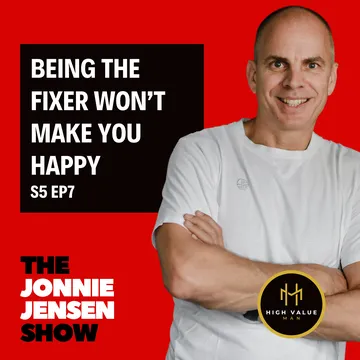
Being The Fixer Won't Make You Happy

High-performing men often trade their own happiness to solve everyone else's problems, but true leadership requires the courage to stop fixing and start leading.

By The Jonnie Jensen Show | 14m listen | 6 chapters
Being The Fixer Won't Make You Happy cover

About this episode

Johnny Jensen challenges the pervasive fixer mentality that leaves 60% of men feeling burdened by external expectations and personal resentment. The High Value Man Project identifies this cycle as a core obstacle for business owners and fathers over 40 who prioritize solving others' problems while neglecting their own health and professional growth. Jensen argues that this unsustainable pattern leads to burnout and a total collapse of personal integrity.

Nice guy syndrome manifests when men attempt to fix marriages or relationships with unspoken expectations of a reward, a strategy that Jensen claims frequently fails because people resist being managed. The 3XC formula—Clarity, Courage, and Commitment—provides a framework for breaking these habits and establishing self-leadership. Specific steps include setting boundaries to protect well-being and taking ownership of one's path to inspire respect rather than resentment. Jensen emphasizes that failure to maintain these commitments directly impacts physical fitness and daily productivity for high-performing men.

Johnny Jensen delivers a blunt assessment of how carrying the burdens of others destroys self-respect and family dynamics. He calls for a shift from being a reactive problem-solver to a proactive leader who models success through the High Value Man blueprint. The episode concludes with a reminder that a rising tide lifts all boats when men prioritize their own development first.


CHAPTER 01 / 6 Discussion

Johnny Jensen Show Introduction and High Value Man Project

Johnny Jensen introduces his podcast dedicated to helping dads over 40 and business owners create fulfilling lives. The program focuses on building relationships and achieving professional results through the High Value Man Project community. Listeners are encouraged to access the High Value Man blueprint and engage with the community online.

johnny jensen· high value man project· modern dads· business owners· personal development

00:00 Are you the fixer? Always helping out other people, expecting that that's going to give you the joy and happiness you desire, then you're looking in the wrong place. If you put yourself last, you're going to feel like that. This is the Johnny Jensen show. Welcome. Role theme. Welcome to the Johnny Jensen Show, where modern dads discover how to create the true riches, relationships and results they deserve. Get your high value man blueprint and join our community at highvalue manproject.com. Let's go. Hello men. Welcome to the Johnny Jensen show.

00:42 Yes, you are back here. I am the founder and head coach at the High Value Man Project and we are helping, serving, mainly business owning over 40s dads across the world, helping them create the life they deserve, not one they feel stuck in. If you've been listening before, then welcome back. If it's your first time, then good to have you here. Let me know in the comments where you found us, who recommended you, and what exactly it is you're hoping to get from this. Like I said, the High Value Man Project is our community. It's our program for modern dads, really men to level up and create the life and the success, both at home and at work that they deserve.

CHAPTER 02 / 6 Discussion

Fixer Mentality and Burnout Risks for Men

Men often fall into the role of the "fixer," attempting to solve everyone else's problems while neglecting their own growth and happiness. Statistics indicate that 60% of men feel burdened by external expectations, leading to exhaustion and resentment. This pattern is unsustainable and frequently results in personal goals, such as learning new skills or maintaining health, being pushed to the bottom of the priority list.

fixer· burnout· mental health· responsibility· self-care

01:24 And too many men are getting this wrong. And today's episode is all about being the fixer. The fixer. Yes, I am fairly, or certainly in my past, I've been fairly guilty of being the fixer, thinking that if you can just fix everybody else's problems, fixing, you know, keeping everything else together, then that's going to somehow give you the result that you desire. But here's the thing. If you're constantly taking on everyone else's problems and in the process, putting aside your own growth and happiness and purpose, then sooner or later, you're going to get to a place where you feel like they don't appreciate me or why am I not experiencing the kind of happiness and results that I thought I was going to get from helping all these people from fixing everybody else.

02:14 Putting out everyone else's fire whilst you're standing there in flames. It just doesn't work, right? And worse than that, it leads to a lot of burnout. Some stats, you know, 60% of men report feeling burdened by other people's expectations, leaving them drained and unfulfilled. They're playing the role of fixer rather than that of true leader. And it's, I don't know, you know, it is a common problem because as men, we want to look after, well, I say as men, a large percentage of men feel like they've got to provide and be there, be the man of the how, be the dad, be the husband, be the boss.

02:58 And of course, when you take on those roles, naturally there comes a level of responsibility with that. And that's right. That's totally justified. And putting yourself in that position means that you're going to need to take on those responsibilities. However, the big mistake comes when you put your own needs and wants and goals, health even to the back. Because like anything, you know, if you've got a list of jobs to do, there'll always be that one job that ends up going to the back and never getting done. And quite often, in that scenario, it'll be the thing that you want to do most. You know, it's various men inside the High Value Man project will have

03:43 something they're trying to learn, you know, like Italian or learning the piano with one particular guy, trying to learn both at the same time, right? And of course, in the busyness of life, what comes last? What comes last is those two things. And then he's like, I just ain't got time to do these things. And I said I was going to do them and now it's on my list and I'm feeling crap about that. It's not sustainable. If you put everybody else first, you'll have heard me say this all the time. If you put everybody else first, you're naturally going to come last. So what then kicks in is some kind of survival mode where it's like, I've got to fix everybody else.

CHAPTER 03 / 6 Discussion

Nice Guy Syndrome and the Failure of Fixing Others

Attempting to fix things outside of one's control, particularly in marriages or relationships, often leads to frustration because people frequently resist being "fixed." This behavior is identified as a symptom of "nice guy syndrome," where individuals do things for others with an unspoken expectation of a reward. True leadership requires moving away from this cycle to avoid the common pitfalls of feeling unappreciated and unfulfilled.

nice guy syndrome· marriage· control· leadership· resentment

04:26 I did this in my marriage. I thought if I could fix everything else that was going wrong, but they weren't things that were in my control. They were things that were more someone else's domain, let's call it, if we go down that direction. And quite often people don't like being fixed. Whilst they appreciate your help, right? The degree to which you can change someone or fix something might actually be outside of your control. So that in itself is horribly frustrating. frustrating and unsustainable

05:03 you know if you are not leading in your life then those who look to you for you to be that person are going to be disappointed and then it's just going to make the whole thing seem even worse because i'm doing all this for you and you're now pissed off with me well how dare you and it's a that phrase gets thrown at me a lot they don't appreciate me So you can see that it all starts to stack up as this fixer is not really the role that you want to take. And in terms of the high value man work, it falls very much into the nice guy syndrome. You know, doing everybody, doing everything for everybody else with an expectation that it's going to provide you with a reward.

05:44 But it just doesn't work. And over and over again, the number of men who are feeling unfulfilled and dissatisfied, frustrated, even resentful, they are the common problems that are bought up in group events, in one-on-one, welcome sessions, breakout sessions, or we call them the blueprint call. These are the common things that come up. So the solution, moving from fixer to leader in your life, right? Three steps, three steps to breaking the fixer cycle. You've got to start by prioritizing yourself, you know, self-leadership, leadership in your own life.

CHAPTER 04 / 6 Discussion

Three Steps to Transitioning from Fixer to Leader

The transition from a fixer to a leader involves three specific steps: prioritizing self-leadership, communicating clear boundaries, and taking ownership of one's path. Effective communication ensures that others understand these boundaries are for personal well-being rather than selfishness. By setting an example and staying true to personal values, men can inspire respect and lift up those around them rather than simply carrying their burdens.

self-leadership· boundaries· communication· 3xc formula· personal growth

06:25 And that will come in the first instance, really by having clarity around who you are, where you're headed. We call that the first of the three C's in the 3XC formula for living. It's about deciding what those things are and then setting boundaries. These are in boundaries for your own growth and satisfaction. If you keep on taking on every task or problem of everybody else's and leaving yours till last, you're not really going to be able to sustain that and you're going to end up burnt out, unfulfilled and pissed off. So you have to put in place self-leadership. Number two, you've got to communicate those boundaries because there's no point just simply going out and doing, oh, right, sod you lot, I'm going to go and do this all for myself and leaving those people like confused and,

07:17 you know, particularly if this like comes out the blue and you just, you just flip-flop from one way of being to another. Communicating those boundaries so that lets other people know I'm still here for you, but I've got to do this for me as well. You know, people respect boundaries when they're set clearly. It's when they're not set clearly that the confusion and arguments come. You know, the classic one is the bloke playing golf all the time. You know, that's not really, given that a game of golf can take like two or three hours, right? It's not really responsible in regards to the relationship or maybe there's a project that you're responsible for.

07:58 But if in terms of your own well-being and happiness and social connections, even a degree of fitness, that you're going to do that once a week, then you're going to set that boundary and communicate it well. Managing your diary and their time so that everybody feels understood and appreciated, but you're getting that piece done. And then taking ownership of your own path. It's about shifting the focus, not off everyone else because you're selfish, but shifting it off them onto your own goals and growth because that's how you can be more. Leadership isn't about solving every problem. It's about setting example and staying true to what matters to you most.

08:43 That's where you get the respect and you inspire those around you either to take on that way of being in their own life or say either. It allows them to take on that way of being in their own life, and also have more respect for you. So that fosters a greater sense of support and excitement and all of you being lifted up, all of you reaching the heights that you want to do, as opposed to you constantly feeling like you're carrying the burden of holding all them up. So stopping being a fixer isn't actually that easy at first, particularly if that's the way that you've been and you've been like it in a, let's say, a relationship for a long time.

CHAPTER 05 / 6 Discussion

Clarity, Courage, and Commitment in Habit Formation

The 3XC formula—consisting of clarity, courage, and commitment—serves as the framework for breaking old habits and establishing a new way of being. This process requires the courage to speak up and the commitment to follow through consistently to maintain personal integrity and trust. Failure to show up as promised leads to a loss of self-respect and can negatively impact every area of a man's life, including physical fitness and daily productivity.

clarity· courage· commitment· integrity· habit formation

09:25 So you're going to have to bring it to the table. It's going to have to be something that you try on and work through yourself in order to create this new habit, this new space, this new way of communication. And you've got to follow through as well. You can't suddenly flake out of what you said that you're committed to. So, and the high value man project, this cuts across multiple tenets of the work. You know, the 3XC formula for living. is clarity, courage and commitment. You can see inside of those three C's that we've touched on each of them through this conversation.

10:03 Clarity about where you're going, the courage to speak up, to take responsibility and be your true self, and then the commitment to follow it through. And let me be clear, it doesn't mean that you stop suddenly being there for everybody else, that you stop suddenly doing everything for well, you stop doing anything for others. It's just that you stop doing everything. It is kind of a human nature to take the piss. We know this from our kids, right? If you keep doing everything for them, they ain't never going to learn. I mean, it's a classic one when they're toddlers and you start to try and stop them sitting in their buggy all the time.

10:41 They get the asshole because they want to sit in their buggy. Teenagers, if you constantly make their bed and put their clothes away, I'm pretty sure, and bloody hell, I haven't cracked this yet, but they're never going to start doing that if you constantly do it for them. And good on my lad. He did remarkably for some unknown reason last week, not just tidy his room, but also polished and hoovered it as well. So yes, there is a slim hope that it's coming together. And then commitment. You know, it's about having the structure in place, building up the habits and routines for you to actually embrace this new sense of putting myself first so that I can achieve and then being more for others.

11:29 If you don't do that, if you say you're going to do it and then flipping flake out, inconsistent, not showing up as the person you said you were going to be, both to yourself and to others, then the impact's going to be worse. You're going to lose the trust and respect of those around you. You're going to lose that sense of integrity inside of yourself. There's nothing worse than laying there knowing you should be at the gym, but feeling like you can't be asked. That will bleed into and screw up your whole day. So the role of the fixer. It's unsustainable. It's wholesome and it's got a lot of merit in terms of being a good guy.

CHAPTER 06 / 6 Discussion

Johnny Jensen Show Outro and Subscription Call

The episode concludes with a call to action for listeners to like, subscribe, and leave reviews on Apple Podcasts or Spotify. Johnny Jensen reiterates the importance of the High Value Man blueprint for motivated dads. He encourages sharing the content with other men to help foster a community where "a rising tide lifts all boats."

apple podcasts· spotify· high value man blueprint· social media· subscription

14:03 And the high value man project is about living a life on fire, living a life of high value standards such that all boats rise. A rising tide lifts all boats. And that's what I want for you. Thank you for listening. Be sure to like and subscribe. Leave a review on Apple Podcasts or Spotify. It's a real help. And share this with other men in your life. I'll see you on the next episode. Thanks for tuning in to the Johnny Jensen show. Be sure to subscribe, leave a review and share it with fellow dads.

14:41 Creating the life you deserve starts with you. Get your high value man blueprint and join our community of motivated modern dads at high highvalumanproject.com. value management. Let's go!