

Thursday, 24 July 2025

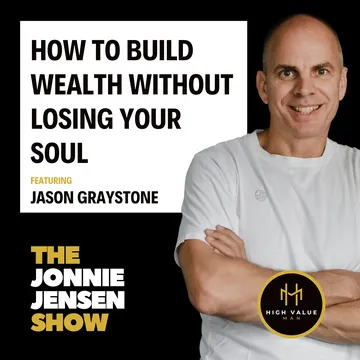
How to Build Wealth Without Losing Your Soul feat. Jason Graystone

A viral TEDx speaker reveals how to escape the midlife success trap by trading high-overhead status for genuine financial autonomy and time freedom.

Financial FreedomMale SuicideJason GraystoneAlways FreeTime DelegationWealth Building
By The Jonnie Jensen Show | 52m listen | 14 chapters
How to Build Wealth Without Losing Your Soul feat. Jason Graystone cover

About this episode

Jason Graystone and Johnny Jensen confront the male suicide epidemic by dismantling the success traps that lead to terminal resentment. Graystone, author of Always Free and a viral TEDx speaker, argues that the pursuit of external status markers often forces men into a midlife crisis of identity. By redefining freedom as the alignment of mind, movement, and money, Graystone provides a blueprint for reclaiming the autonomy lost since childhood.

Male conditioning frequently prioritizes income over time, resulting in a compound effect of resentment that fuels high rates of depression among men under 44. Graystone details how a single two-hour YouTube video generated twelve million dollars by prioritizing high-value service over traditional sales tactics. The strategy involves conducting rigorous time studies to identify energy-draining tasks, applying the 80-20 principle to delegation, and optimizing lifestyle expenses to fund freedom. Specific examples include the High Value Man Project's use of project managers to scale productivity and the cautionary tale of a millionaire neighbor whose overhead left him as financially vulnerable as a local paperboy.

Graystone shares how a 2012 trip to Disneyland sparked his realization that adults can reclaim the total freedom of a seven-year-old through leveraged income. He warns against volatile Bitcoin speculation for those without a stable financial pyramid, suggesting that index funds must precede high-risk trading. Johnny Jensen concludes the session by challenging fathers to audit their daily questions to shift from survival to service.


CHAPTER 01 / 14 Discussion

Jason Graystone and the Pursuit of Financial Freedom

Johnny Jensen introduces investor and author Jason Graystone to the first episode of the new season. Graystone, known for his viral TEDx talk and upcoming book Always Free, discusses his mission to help individuals achieve financial independence without sacrificing their values. The conversation establishes the theme of reclaiming time and energy rather than simply chasing income or hustle culture.

jason graystone· johnny jensen· always free· financial independence· wealth creation

00:00 What if everything you've been taught about money is keeping you broke and stuck? Most men think they want more income, but what they're really chasing deep down is freedom. Freedom of their time, their choices, their energy, their life. And today's guest, he lives that truth. This is the first episode of the new season of Guests on the Johnny Jensen Show, and I am delighted to welcome Jason Graystone. We've known each other for about seven or eight years now. He's an investor, a proper investor, speaker, and author of the upcoming book, Always Free. He's helped thousands break free from financial dependence without selling their soul. And his TEDx talk on freedom from anything has gone viral for good reason. This episode is about real freedom, not just hustle or some kind of crypto scam, not grinding yourself into the ground.

00:44 It's about buying back your time, reclaiming your values, and living like you mean it. The sound on my side is a bit of a mess, but I've done my best to improve it. Jason, however, is the man that does most of the talking and his sound is gold. I think you're going to love this role theme. Welcome to the Johnny Jensen Show, where modern dads discover how to create the true riches, relationships, and results they deserve. Get your high value man blueprint and join our community at highvalumanproject.com. Let's go. Jason, great to have you here. How are you, Ragger Man?

01:28 I'm very well, thank you. Cheers. It's great to be here. It's great to be on the show. I know. We did actually do an episode together about four years ago now, if we can believe back that time flipping. It's so fast. And everything you've been doing in your always free videos, podcast, you've written the book, The TEDx Talk, things going from strength to strength for you. Yeah, it's been a crazy, crazy journey, really. Just focused on sharing information that I feel is important and valuable.

CHAPTER 02 / 14 Discussion

Defining True Freedom through Mind, Movement, and Money

Jason Graystone outlines his philosophy of being "always free," which requires a balance of mind, movement, and money. He observes that many wealthy individuals lack identity, while successful business owners often fail to manage their money to buy back their time. True freedom is defined as knowing one's identity, creating income as an extension of that self, and managing finances to secure future time.

wealth creation· financial empowerment· mental freedom· asset management· always free

02:06 And it's been amazing to see all the growth and the kind of reward from doing that. It's just been magical, really. Amazing. Yeah. So just, you know, by way of introduction of people who haven't heard you or seen any of your videos, what is it that you do and why do you do it? I basically educate people around wealth creation and financial empowerment and how to become truly free. And the reason I do it is because over the years, you know, I was in a position at 29 where I didn't need to work anymore.

02:46 And over the years, I've spent a lot of time with all kinds of walks of life, entrepreneurs, business owners, people who have never earned too much money in their lives. And I've seen it all. And I started to see that it doesn't matter how much money you've got. You know, there's people born into wealth who've got all the money in the world to do anything they want, go anywhere they want, and yet they don't know who they are. And they're like far away from freedom. You know, they don't actually know what they're doing. On the flip side, I've seen business owners are really great at earning money, but have no money. And they have nothing to show for it because they can't manage it and they're not buying any freedom whatsoever.

03:27 And then I've seen people who like really low pay, but very spiritual, really in touch with who they are, love their job, you know, but they don't earn any money. And freedom, you know, what I started to see was the pattern of true freedom is being free in mind, movement, and money. So who, you know, knowing who you are, being mentally free, being able to create an income as an extension of who you are, and then have it being able to manage your money in a way that you could buy time into the future should you wish to stop one day. And when you work on all of those three things, you become you have a greater sense of true freedom, you know, and that's basically what I call being always free.

04:12 Nice. And just for the benefit of anybody, right? What I love about you, Jason, is you're someone who walks the talk. You've not just sat on YouTube making up videos about how to trade because you've learned, you want to sell an affiliate link to an app. So in case anybody's thinking that Jason might be one of those guys, he very, very much isn't. So it's a pleasure to have you here. So just touching on what you just said there about people having money, not having money, being happy, not being happy. What I see and talk a lot about is how men are very, we end up being conditioned about how life should be.

CHAPTER 03 / 14 Discussion

Male Conditioning and the Compound Effect of Resentment

The discussion shifts to how men are conditioned to pursue external markers of success regardless of their internal well-being. Jason Graystone explains that making thousands of daily decisions based on the expectations of others leads to a compound effect of resentment. This lack of mental freedom often results in a midlife crisis when individuals realize their path was influenced by external pressures rather than personal alignment.

mental health· midlife crisis· decision making· social conditioning· identity

04:56 We should have these things which should then make us happy. and we should carry on doing it regardless of how we're feeling because eventually it will give us what we desire. And no one's really challenged that enough. And then a lot of men find themselves unhappy whether they've got stuff or haven't got stuff. What do you see about that conditioning and why in many instances men have got it upside down about how they, you know, who they should be and what they should be up to? Yeah, it goes back to the kind of mental freedom. I think if you're not mentally free, and I'll explain a bit about what I believe that is in a moment, but you'll never be free in any way.

05:36 Because if you don't, if you're not living congruently to who you are, one, when you try and do something, you'll feel that you hit burnouts and you need motivation and you're trying to please and appease someone else, you know, and you're living as a slave to someone else's thoughts, you know, and whatever it is you're going after, eventually there's going to come a point where you'll just be like, I can't, you know, you'll cap out income because the level of responsibility and pressure at a certain level of income that you've acclimatized to now, you'd rather have less income and more free time to do what you actually want to do.

06:19 And I've seen that so much within like mid-30s, early 40s, you know, that kind of age bracket where people are just like, oh man, I've done all this. I thought this was the right path, but actually, I thought I'd end up here, but I'm actually here. And when you kind of unpick why they're here and not here, it's because all of the decisions that they've made along their life have been influenced by someone else they're looking up to or not truly aligned to what they want out of life. I'll give you a really kind of, you know, jovial example. When I learned to drive, I said to my stepdad, you know, should I learn in an automatic or a manual car?

06:57 And he said, learn in a manual. And I was like, okay, learn in a manual, it took me longer to pass because it was more difficult. I spent more on lessons because it took longer. And as soon as I passed my test, I bought an automatic car. And now all cars are going automatic, right? All these Teslas and the hybrids and they're all going automatic. And I don't even like driving. I got rid of all my cars in 2019. I just, I can't stand driving. So that's a small example, but when you think about it, we make about, I think it's like 36,000 decisions a day or something in our head, right?

07:34 So imagine the compound effect of resentment of every decision being influenced by someone else that isn't truly what you want and how that will grow inside of you. And eventually, you know, the midlife crisis or the, I'm not doing that anymore. You know, I'm going to be me. And that's what I see happen over and over again. Yeah. And, you know, we're reaching this crossing point for men, really, the way I see it. There's so much suicide you hear a lot of talk about. But what I like to reference around that subject is the number of men who try and don't succeed and the number of men who are thinking about it but aren't actually going to go and do it.

CHAPTER 04 / 14 Discussion

Male Suicide Epidemic and the Trap of Unrealistic Expectations

Jason Graystone addresses the high rate of suicide among men, noting it is a leading cause of death for those under 44. He attributes much of this mental health crisis to the gap between unrealistic expectations and reality, often fueled by constant comparison. Using an anecdote from a trip to Dubai, he illustrates how chasing arbitrary financial targets to prove others wrong leads to the sacrifice of present happiness for meaningless future profits.

suicide prevention· mental health· depression· dubai· gratitude

08:20 So that kind of gives you an idea of what the real epidemic around sort of identity and mental health to a certain degree for people. But having the confidence and the freedom to decide, this is who I am. This is what I enjoy doing. This is the kind of life I want to create. And then putting the steps in place to go out and actually achieve it confidently, charismatically, enjoying life rather than being wrapped up in this constant struggle and strain. This is the thing, right? It's so sad that there's so many suicide, you know, the suicide rate's so high in men. Mental health's the big, biggest killer in men, which is absolutely crazy. Over 44 years of age, biggest killer in young men.

09:02 So, you know, if you've got a son and you're listening to this, they've got a higher probability. Their biggest risk over 44 is taking their own life. And that is, it's crazy. It's absolutely insane. But what it brought, you know, what depression and anxiety, what leads to that is this expectation of what their life should be like that is unrealistic to what their reality is. And they compare their current life to what they think it should be like. And they start to beat themselves up. They start to become depressed. They start to become detached from reality. And I see this everywhere. I was in Dubai just a couple of weeks ago and there was this guy who was on a yacht.

09:47 There was this guy who he was like, right, my next target is 50 million. That's the next revenue that I want to hit. And I was like, that's a, you know, really. really round number. Why, why 50 million? And he was like, oh, that's just the next, that's the next thing. And I was like, to, to get to 50 million, you're going to have to now up your game a little bit. It's going to require a lot of your time. You probably have to be away from your wife and your kids. And that's a lot of sacrifice. So we really drilled down into like why you wanted to hit that. And it turns out that it's just like to prove some X wrong or prove some old boss wrong, right? And it's like, so you are willing to sacrifice today's happiness for tomorrow's profit.

10:28 And that, that will probably never come because once you get there, it will mean nothing to you. But ultimately, you are a slave to someone else's thoughts that probably aren't even giving a crap, you know? And people live their lives this way. And then they beat themselves up about not getting the result. And it's like, I said to him, I said, I've got no goals. You know, I said, I've got no aspirations whatsoever. I just want to live every day like this. And I've reached a position where I'm content. And the reason I was able to identify that is because I knew where I would be content before I set out on the journey in the first place. You know, the life I live now is beyond my wildest dreams of what I had as a kid.

11:10 And I don't think we give ourselves enough credit and exercise enough gratitude to exactly what we have achieved and what we've overcome and the resilience we've had and how we've learned lessons that no school could possibly teach you. And knowing where you want to get to and then getting there, at least you're now content and you can say, right, I can either, I can go again and I can push for something else, but at least I know that I'm happy here. This is what I, this was my dream. And no one seems to do that. You know, it's all just chase, chase, chase, chase, chase, hustle, hustle, hustle. And then before you know it, you're gone. And, you know, what was it all for?

CHAPTER 05 / 14 Discussion

Overcoming Career Resentment through Time Studies and Delegation

The conversation explores why money becomes a source of stress when individuals are stuck in uninspiring vocations. Jason Graystone recommends conducting a time study to identify tasks that drain energy versus those that provide inspiration. By applying the 80-20 principle and delegating low-value tasks, individuals can shift their focus toward work they would perform for less money, eventually eliminating the need for "escapism" like excessive drinking or holidays.

career development· time management· delegation· 80-20 principle· vocation

11:53 Yeah. Yeah, I see it when working with men. I ask them what they want. And the quickest thing they're able to tell me is what they don't want. So they're all focused on what pisses them off or they're frustrated about. And money is one of those things. You know, in my program, it's there as the eye for impact. Like, how are you managing your money? How are you showing up in your business or your work? And, you know, what sort of impact you make in the community. So money as it's, you know, I don't coach or teach money, but money as something that isn't a stress in your life. And then obviously I have people like you. I can send guys in the direction of. But what is it about money that becomes this trap?

12:36 Because people get stuck in the idea that they don't know how to make enough or they haven't got enough. And then instead of being something joyous and playful, it becomes a stress, an upset, a source of discontent. Yeah. So it really stems from what I call mobility freedom. It's like how you, so once you know who you are, the next thing is to earn money doing what you enjoy, right? Now, most people don't earn money doing what they enjoy. Most people don't earn money because they're or they earn money, but what their day-to-day activities, whether that be in their job or in their business or whatever it might be, they are

13:14 doing lots of uninspiring stuff and lots of stuff that isn't aligned to what they want to do. Now, they might be a lawyer because their parents wanted them to be a lawyer, or they might be an accountant because their parents wanted to be an accountant, or they might have set up their own business, but they're not able to delegate and automate and build assets and systems in the business that allow them to just focus on what they're good at, the high value stuff. And then it starts to feel I'm resentment. In all of those situations, you're resentful. And then when you get paid, what you want to do is you want to escape. You want to go, I need to treat myself because this is hard. This is hard work. You know, I don't want to do that. I don't want to do this. I've had a week of this.

13:57 You know, this isn't me. Whereas if you take, for example, someone who's doing what they love every day, you know, I don't even want to go to bed at night. I don't want to go to sleep because I wish we didn't have to sleep because there's just not enough hours in the day. I just, I just want to do it all the time. I just want to talk about this stuff. I want to help people. I want to, you know, it just lights me up. And when it gets to like nine o'clock at night, I'm like, oh, you know, I have to go to bed and then we have to, I just want to, you're energized, right? You don't want to rest. You don't get burnout. You don't get all that kind of stuff. And I think there's multiple ways you can do that. One is make sure that you're doing something you enjoy.

14:36 If you're not, start sharing what you do enjoy because the platforms we've got available to us today, you've got your own radio station, your own TV channel, your own newspaper. You know, you can share stuff that does energize. energize you and watch what happens. You'll get an audience, you'll get people asking to buy things from you. That's just the way, that's just the way it is. And then second of all, do a time study of your time and work and then kind of basically every hour, just note down what you're doing for a week and then categorize that list in or prioritize that list in what you love doing most to what you like doing least. And then you can start prioritizing delegating some of that stuff that you don't like doing first.

15:21 And once you start freeing up that time to do more of the things you do enjoy, you will, you know, you'll see a massive difference. You'll start to feel like it's not work anymore because you're just working towards doing the few things that you would do for less money. And that's the goal to me. It's just to earn enough to have the experiences that you want in life and to feel like work isn't work. You want to be in a position where you're not subordinating to this idea of retirement or you don't need to get away on holiday or you don't need to go and get drunk at the weekend.

CHAPTER 06 / 14 Discussion

Breaking the Success Trap through Better Questions

Jason Graystone challenges the excuse of not having enough time, pointing out that many people spend hours on TikTok and Instagram instead of bettering their situation. He emphasizes that the quality of one's life is dictated by the quality of the questions they ask themselves, shifting from negative "why" questions to optimistic "how" questions. An example from the High Value Man Project illustrates how hiring the right project manager can transform a business owner's productivity.

creative thinking· social media· productivity· high value man project· leadership

16:00 It's just, if you've got any of those things or those urges, it's a sense check to say, look, something I'm doing isn't quite me, you know? It's easier said than done, of course. Yeah, and people, a common answer to that, you know, oh, that sounds great, Jason, but it's all right for you. And it's not, again, it's not about how much money people have got. Some people are in successful positions, running successful businesses, and they feel trapped by the actual success. Like, how could I, oh, as if I could just walk away from this and suddenly start doing something that I want to do. Yeah. It's a trap, that thinking, because it limits all creative avenues.

16:40 It boxes you in, leaves you feeling negative. And so you can't really create anything from a negative position. But what do you say when people come at you with that response? Yeah, I'd say, so people who usually say something like that are people who, I mean, it's easier to just, it's easier to say, I haven't got the time and things like that, right? You know, and I, it's such a, it's such a hot top like debate around we've all got the same 24 hours and all that kind of stuff, right? Not really going to go down that route, but we do. You know, we do have the same time. And by doing a time study, what you get is this raw slap in the face for how you're spending your time.

17:25 And I think that can shake you up and say, right, okay, well, I've spent three hours scrolling TikTok over the last two days. And I spent an hour on Instagram there. And I spent, you know, three hours on Instagram there. And it's usually to do with social media. And then you've got to look yourself in the mirror and say, well, you know, I don't really have an excuse. How could I have done more of the things that I enjoyed during that time? And if you ask yourself that question, you'll find the answer as well. You know, people always say, I think your quality of your life is dictated by the quality of the questions that you ask yourself.

18:06 So you could ask yourself, oh, you know, why do I have to go to work? Why do I have to work for this person? Why don't I earn more money? Or you could ask yourself, you know, how can I earn more? Or how can I do more of what I enjoy? Or how can I reduce the things that I don't enjoy? And how can I delegate this? And how can I delegate that? And if you ask those questions, you'll find those answers as well. If you go deep enough. And that's what it's about. It's about asking better questions, quality questions, not negative questions, but optimistic questions, questions that are geared towards where you want to go, not where you are.

18:46 Because that whole process is just firing creative thoughts in your mind and creating new neural pathways and associations where you actually start to see opportunities. A guy inside High Value Man Project, successful agency owner or certainly a growing agency, but he kept hiring the wrong project manager and then staying in lots of the projects on a day-to-day basis. And eventually he's found a project manager who's both good and staying. And boom, in the last six months, so much has transformed simply because he's not, even though he's a very good project manager himself, but he's also the CEO now.

CHAPTER 07 / 14 Discussion

Optimizing Expenses to Fund Freedom and Delegation

To achieve freedom, individuals must either buy or create assets that systemize and automate low-value work. Jason Graystone suggests that even if delegating tasks temporarily reduces profit, the resulting increase in productivity and opportunity recognition often leads to significant long-term income growth. He advises listeners to optimize lifestyle costs and renegotiate contracts to fund this transition toward a more liberated work life.

asset creation· lifestyle inflation· expense optimization· productivity· financial strategy

19:24 So he can't be that project manager and expect to have the time and the energy and the joy in everything that he's doing. Right. Yeah. You see it everywhere. Yeah. So what you're saying there is as well as looking at your own time, the next question is, how could I better proportion that time the Dan Sullivan's who, not how question. Yeah, so I mean, you're going to get freedom from assets and assets you can either buy and you buy them and they produce some income for you, or you create assets that also increase your income by allowing you to systemize, delegate, automate stuff that you that is not high value.

20:10 That is, you know, the reason you're dreading going to work might be because of all of those emails you've got to answer or all of those, you know, people you have to put up with that you don't really, you shouldn't really be wasting your time doing. Everyone's got that, you know, in their job, everyone's got this thing of, oh, I shouldn't be wasting my time doing that. You know, everyone's got one of those, whatever it is. It's different for everyone. But if you imagine if you could start getting rid of that and just doing the thing that you went into the job in the first place for or something that you would enjoy doing every day, you know, for six hours a day, eight hours a day or whatever it was.

20:46 The key to doing that is to first figure out actually how you're spending your time to get the slap in the face of like, wow, you know, I'm wasting this much time doing this. And it's usually an 80-20 principle. It's like 80% of your time is the stuff you hate and 20% of the time is the stuff that you love. And you want to start flipping that around. And once you start changing that and shifting that, you are happy to spend, even if it's sacrificing profit, sacrificing income, there might be a little curve where you're paying people to do all of those things. And you think, oh, this is going to be tight on my income, you know. But watch what happens when you get around the corner.

21:27 It's just your productivity, the way you speak to people, the way you see opportunities, the way that you, you know, you can capitalize on these opportunities that you see that you didn't see before because your head was buried in a pile of paperwork, you know, and your income will grow, you know, 3x, 4x, 5x, 10x. It's just the magic of doing what you enjoy. I've seen it time and time again. Yeah. So being willing to go through that dip or having the bollocks to go through that dip basically because what you've planned on the other side is solid, is worth it, is going to give you the, you know, it's going to light you up, which is ultimately what we're talking about because the goal here.

22:08 Yeah, and the dip doesn't have to be as painful as you think either. I mean, all the lifestyle costs are a choice. You know, you've raised your lifestyle cost to the degree that, you know, is either stressful or you're within your maximum allowable income limit. You know, so you're going to feel stressed if you're spending every penny of your income on outgoings. So if you want to make that dip a little bit less stressful, just optimize your expenses. Just go through your expenses and just get rid of stuff for a while. Reduce stuff. Renegate contracts. Renegate your energy suppliers or just cut out one meal a week on a restaurant or two meals.

22:53 Do that for a little period of time and spend that money on delegation instead. And then you'll go through the curve and then you can have all the meals out that you want. Yeah, yeah. A guy in the high value man project, he was burning 10 grand a month, just under 10 grand a month. Having a nice life because he was wealthy. He was making cash. But as quick as he made it, they were all spending it. Like five kids, mobile phones, going out, shoes. I mean, any dad knows what going out for dinner costs, right? And increasingly. But, you know, it's when you realize, okay, wow, we've done, we're doing 10 grand a month on

CHAPTER 08 / 14 Discussion

Relative Wealth and the Story of the Millionaire and Paperboy

Jason Graystone shares a story from his book comparing a millionaire neighbor to a young paperboy. Despite the neighbor's high income, his massive overhead for cars, private schools, and yachts meant both he and the paperboy could only survive for one month if their income stopped. This anecdote highlights how lifestyle creep and the desire to impress others can lead to suicidal ideation, whereas the COVID-19 lockdowns helped some people realize they could live more simply and happily.

wealth relativity· financial stress· lifestyle creep· covid-19· mental freedom

23:38 jollies, basically. There's a story in my book called The Millionaire and the Paperboy, and it's a true story about my neighbor and my son's friend. And one was a paperboy, and my neighbor was a millionaire. And basically, the paperboy, he was getting about £11 a week, and he wanted to buy football stickers. And after he bought his football stickers, he probably had about a pound left or two pound left to go and buy some Coca-Cola or whatever he was buying. Like his living costs were like £2 or something, right? And then the millionaire next door, he was on about £19,500 per month.

24:18 And he had four cars, the gardeners, the O-Pair, the nanny, the gym membership, the yacht, keeping up with the private school and all this kind of stuff. And we did the math on how long that they could live for and survive if they lost their income today. The paperboy had a month and the next door neighbor had a month. So it was all relative. like the the in fact the paperboy i think it was 1.1 month so he's actually wealthier than the than the than the neighbor and when you look at it like that and you really understand that it's so relative that it's like wow you've put all that energy and effort into into getting all those things

24:59 but you're more stressed and you've got less pros like less prosperity than than a kid who's on 11 pounds a week yeah and when you see it like that you think wow something's really gone wrong here you know something's really not right and what's the point and that is where this guy was actually suicidal you know this neighbor was actually suicidal that's why he told me all this we went for all of his numbers and um you know thankfully came out the other side and and now he's like got a completely different outlook on on what life is all about you know i think covid was a great um a great eye-opener for people in that respect as well it was like people

25:39 realized that one they could work from a home and you know that that gave them a sense of freedom two they got rid of all the things that they weren't keeping up the joneses with because you couldn't go out and show off you know didn't need the other car and and i think people were liberated by that um and they got a real taste for what financial freedom is about and and i you know there's so many people out there just buying things because they're trying to impress other people and for me that's having a brand new phone yeah oh yeah that it can be as simple as that you could be doing thick end of a hundred quid a month on

26:19 a brand new phone and then they and they double the data the price when you got it and you're like i'm not sure i could never buy a brand new phone ever again because on that basis and i'm not a minge bag but you just think i can't if i can't justify paying 60 quid a month for for a tariff that gives me the same as what i could buy you know running on a phone as a couple of years old i know i know but but you know you don't you don't look the part whatever the part is yeah and again it's just mental freedom right you're not yourself you're just not happy in yourself because when you're happy in yourself you just don't give a crap about what anyone else is doing you really don't um yeah so you're so yeah so well let's let's touch on the book right because um um

CHAPTER 09 / 14 Discussion

Reclaiming Childhood Freedom and Building Leveraged Income

Reflecting on a 2012 trip to Disneyland, Jason Graystone discusses how adults lose the total freedom they possessed as seven-year-olds. His book, Always Free, provides strategies for clearing mental baggage and creating leveraged income streams that allow for a congruent life. The goal is to build a "portion of freedom" that empowers individuals to take calculated risks and work because they want to, not because they have to.

disneyland· mental baggage· leveraged income· always free· personal development

27:05 there's a process in there you've just alluded it to to to it yourself right so what what is the process and the message you're trying to get across to people there the message ultimately you know the way that i would kind of explain it best is when you're seven years old you know you're out playing buying the ice cream or whatever doing the football on the bmx on the skateboard and uh you've basically got all the freedom in the world at seven you know you've got financial security you've got um you know no worries really except for when your parents call you and they say you've

27:41 got to come in and have your dinner and then you've got to have a shower go to bed you know in front of all your friends and you just think ah you know when i'm when i'm an adult i'm gonna i'm gonna have all the freedom you know no one no one's gonna tell me what to do no one's gonna tell me when to go to bed and uh and the sad thing is when adults become adults you see them go further and further away from freedom and further and further away from who they were at seven and uh there was a point in time when i went to disneyland in 2012 and we went up to the ticket barrier and there was this guy in the dis you know working there and he was about 70 years old and he stamped our ticket and he said go and be a kid again and and i just remember thinking that's what everyone here wants they just want to go back to to being a kid they want a moment of

28:25 of just total freedom you know and and and being that seven-year-old kid why do we lose it we lose it because we we lose our mental freedom we start looking up to people we start taking advice that aren't that isn't geared towards a life that we want to live personally it might have been important to someone else but it's not important to us and being able to take opinions and advice from people then synthesize the paradoxes and align it to what you like take the pieces that you want from it and then align it to what you want is such a powerful skill and once you do that it's then how do you create a vocation from

29:08 being an extension of who you are as a person so how can you earn money doing what you should be doing on this earth for the tiny amount of time that we're here for and then ultimately being able to manage your money in a way that buys you enough time that free like allows you to stop working if you want to but the chances are that will just be an emergency thing that you need to stop because you have an accident or you need to take care of a loved one. Because in reality, you're never going to want to stop working at that point because you're just going to want to stop working. And people who don't believe that are just people who are in jobs who they hate.

29:47 They hate it. So, what the book is about, and the strategies in the book is firstly measuring all of those things and then giving you strategies to implement those things and increase the freedom in your life. So, mental freedom, you know, really getting clear about who you are, what your goals are, and understanding any mental baggage that you're carrying through life that might stop you from taking the calculated risks necessary in the future to unlock your potential in certain areas of life and making sure that you're living congruently to who you are as a person. And then being able to create leveraged income streams and optimize your time and tasks so that you feel inspired each day to do those things.

30:31 And then managing your money in a way so that you've built this kind of ever-growing portion of freedom that allows you to stop or take your foot off the gas should you wish. And when you can work on all three of those things, you end up in a position where you feel very liberated, very empowered, and ultimately free. Yeah. And from a relationship point of view, this is so important to me. Feeling like you've got the person in your relationship that you married, that you wanted to be with, that you fell in love with.

CHAPTER 10 / 14 Discussion

Money as a Means of Fair Exchange and Service

Jason Graystone simplifies the concept of money as a tool for survival and a means of fair exchange between humans. He argues that the amount of money one receives is directly proportionate to the impact they have on others' lives. Using the example of an unhappy barber, he explains how a lack of passion for one's work creates a catch-22 that limits income potential and prevents proactive client acquisition.

fair exchange· value creation· sales psychology· career alignment· service

31:13 Letting money turn us into something that we're not, whether that's chasing the money or whether that's stressing about the money is such a waste. But people don't have the tools or the pathway to really handle their finances, which is what we're talking about here today, which is the foundations of your work, really. You should be empowered around finances because although it isn't everything, we need money to survive. Money is security. Money pays for the three basic things we need: food, shelter, water, cleansing products to make sure that we're clean, free from germs and viruses and all that kind of stuff.

31:57 We need all that stuff, and it all costs money. And when you look at it like that, you realize that actually money is survival. But it's also a means of fair exchange. And there's enough of it out there for however much you're willing to accept, however much you're willing to go and serve another human being. I think people overcomplicate money a lot. There's one, you know, we are the only people that believe in money. And there's only one way to get money, and that is for another human being to put it in your pocket. And there's two ways to do that. You either beat them at a skill using, you know, poker, boxing, football, whatever, where it's like a competitive environment and you've agreed that there's a winner and a loser, or the easier way is to serve them.

32:43 And you serve them and you get money in fair exchange. And then the amount of money that you get is directly proportionate to the amount of impact you have on people's lives and the amount of lives you can change and the amount of people you can reach and the difference you make to their life. When you realize that, you understand the importance of doing something you enjoy because if you're out there trying to pretend you're someone you're not or you're going out there to do a job that feels like hard work, there's no way that you've got this kind of thing working against you to go and push and get more clients. I know someone who is a barber and he hates barbering. And the reason he hates barbering is because he hasn't got any clients and he won't go and get new clients because he hates barbering.

33:29 You know, he doesn't want to go and get more people because he doesn't like talking to people when he's cutting hair. So he's got a real problem there, right? But he's doing it and he's getting more and more unhappy. Whereas if he loved cutting hair, he'd go down the high street and go, come down to our barber shop. You know, come in, come in here. I want more clients, more customers. But he's not going to do that because he doesn't like it. So it's like a catch-22. And people do this in their jobs all the time. So, oh, I'm not going to answer that phone after 5 p.m. You know, I'll just don't answer it. Well, that could be another client. That could be another lead. And if you enjoy doing it, guess what? You'd stay till 7 o'clock, 8 o'clock, picking up the phone and getting clients.

34:08 So, yeah, it's so important. The fact that you're not doing something you enjoy is limiting you from earning what you should be earning without it feeling like a job. Yeah. So, what I've just taken from that is this, you know, the experience of being stuck and how. how it can pull you down, how debilitating it can be. But there's so many in the modern world that we live in today, and there's so many ways in which people can create additional incomes or start up new businesses.

CHAPTER 11 / 14 Discussion

Generating Twelve Million Dollars through High-Value Content

Jason Graystone details how a two-and-a-half-hour YouTube video intended to give away all his knowledge resulted in $12 million in revenue over ten months. By providing high-value information for free, he built massive trust with an audience of 1.6 million viewers, leading thousands to purchase a low-cost 30-day challenge. He also references "Hub's Life" on Instagram as an example of how sharing a mundane, authentic life can lead to unexpected financial success.

youtube· tiktok shop· content marketing· digital revenue· hub's life

34:46 Of course, some are better than others, right? But wherever someone's at in this process, should they be concerned about picking the right one? You know, like a let's make a course, let's make a print-on-demand shop, let's start a TikTok shop, let's buy an ice cream van and use social media to absolutely have people queueing for half a mile down the road. Is there the wrong or right thing? And I kind of know the answer, right? But how do people rationalize between what's sensible and what's just flipping pie in the sky? Okay. First of all, if you've got a physical product, the platforms like TikTok Shop and all of these, we're going to see a lot of people earn a lot of money on those.

35:27 If you've got a physical product, go and sell it on there. You're going to earn a lot of money doing that. But here's my best, you know, the best business model. I was in a position where I didn't need any more money. I didn't need to work. So my strategy, my approach to this whole new world of social media was to go out on there and share everything I knew. I spent every Sunday writing a 5,000-word email newsletter for 86 Sundays. I did that, sharing everything that was on my mind. I then read that to a microphone, that become a podcast. I then went on YouTube and started sharing it on there. And it was basically the energy that went into the content was,

36:09 how can I create content in a way where people just don't need me after? You know, they'd have no questions whatsoever. And it was this idea that if I gave everything away, I wonder who would still come to me, who would still want more. And in 2023, we created this video and it was exactly that. It was a two and a half hour video. It took me a week to record. I recorded it on a camera that cost a few hundred quid. And I said, right, after this video, the goal is for no one to have any questions. I don't want them to need me at all, right? So how can I teach them everything I know? We sat down and we'd done this video, right? And we put it out in January.

36:53 And in May, it had about 10,000 views, which is good, but not, you know, not what not what you expect after putting a week worth of giving everything away. Anyway, I was sitting there in May and all of a sudden, a thousand subscribers, thousand subscribers, thousand subscribers keep coming in. And this view, this video is going nuts. And YouTube have obviously got the confidence at that point that it's a good quality video and start boosting the video on their platform to new people coming on looking for those types of topics. And we had a tiny call to action in that video, which was a 30-day challenge where I would send them another 30 videos, one a day, five-minute videos with like a little homework thing.

37:36 And it was like all pre-recorded. And I said, right, you know, you've got to submit the homework and all the rest of it. Within three months, we had 1.6 million views on that video. And 0.04% of the people, which was about 5,550 people, they bought that little 30-day challenge at the end of that, which was £297. So really, low price. That was about one. Low price, high value. High value, low price. Yeah. So it was immediately we did about $1.6 million of revenue just straight off the back of that video. And to this day,

38:20 that video has generated 700 subscribers per day every day to today. And within 10 months, that video had done $12 million of revenue. And that is from me sharing what I enjoy talking about and trying not to get any clients. So if you start talking about something that you enjoy, you'll find it very hard not to be paid. There's a guy on Instagram right now called Hubbard Connor, I think his name is. He runs a chat. He runs an account called Hub's Life. And it's a really interesting story, right? Because he set out to show a mundane life of the nine to five.

39:03 And the idea was like finding beauty and simplicity and not looking up to people. And it's okay to have a nine to five life, right? So what he'd do is record every day his day, you know, his mundane stuff, going to the gym, going to work, doing his emails, you know, coming home, making dinner. And that was it. He's now got 1.4 million followers. he's quit his job because he's earned money. And now everyone's up in arms. They're like, oh no, you can't quit your job. Go and get another nine to five, right? But it just shows you how the universe works, right? It's like, if you just try to put out something that's really natural to you, you'll get paid, you know, and it'll be life-changing.

CHAPTER 12 / 14 Discussion

Building Trust through Social Media and Marketplaces

The discussion covers the power of modern marketplaces like TikTok Shop, where creators can sell products directly to large live audiences. Jason Graystone explains that content is a vehicle for getting people to spend time with a creator, which eventually reaches a tipping point of trust. He encourages listeners to look for answers on how to use these tools rather than making excuses about the difficulty of new technology.

tiktok· social media· brand trust· digital marketing· big boys toys

39:45 When you do something that's meaningful to you, you'll be paid more than you could ever be paid. You can ever imagine. And even if you try and give it away for free, people will want more and more from you and you'll be forced to earn more money. Yeah. I like, there's a picture and it's a metaphor or an image I used to use in my social media training of a speedboat. And there's a wake behind a speedboat that the engine causes. Wherever you are in the process, whether you're trundling along behind a big ferry that's got a massive weight behind it, there's always a wake behind your boat of people who don't know as much as you and are eager to learn it of someone that they can relate to rather than the flipping big thing that's out there in front of you.

40:32 They're like, oh, well, not that big. I like this guy. I like this guy's boat. I want to be behind that one. Yeah, absolutely. And when you realize that basically social media and content is just about getting people to spend time with you because they're not going to spend two hours with you and then go and search again and watch someone else. They'll just, as soon as they're into you, that's it. They're not going to go elsewhere. So now it's just a case of getting them to spend enough time with you so that that tipping point goes where they just trust you. And you're building trust the more they spend with you. And once they trust you, they'll just want to work with you. And whatever you have to offer, they'll pay you for. And it's honestly as simple as that.

41:13 And this for me goes back to what you were talking about at the beginning about creating time for ourselves. You know, TikTok shop, it blows my mind. I mean, TikTok in itself, I'm like a, it's like a guilty pleasure, basically. I have to put it away like a, like a, like a flipping packet of fags or some other crack habit, you know what I mean? You just, because you just end up in the hole. But the people that are going live and have got their shops and they're selling stuff, you know, there's one in the UK called Big Boys Toys, whatever. They're like a couple of market trader dudes and they're just knocking out toys 24-7, having a blast. What's this, Gav? Oh, it's a bunch of Barbie dolls work for Christmas. Yeah, we're going to put three or four of those in together, a couple of outfits.

41:58 It's just like me going around the market with my granddad and the meat sellers like, come on, ladies, why does it look so good? Because it is so good. I'm not going to sell it for a 10. And it's just now got a new marketplace. And these guys have got like 20,000 people watching live. But then on a smaller scale, someone's, you know, older people, younger people, they've gone and watched the video called How to Sell Stuff on TikTok. They found out there's a TikTok marketplace and they're just selling bits and bobs that have, they never even touch them as physical products. So the reason I share that is that people could get really hung up on, I don't know how to do this, and then never actually go and look for the answer.

42:38 Well, this is it. It's easier not to look for the answer, though, isn't it? It's easy to just come up with some excuse that it's, oh, it's hard, it's difficult, it's not for me. It's much easier to do that than it is to just carry on to try and actually better yourself. You know, when you don't get a six-pack, it's easy to blame the personal trainer. So, oh, yeah, and then stop doing it. So let me ask you this question about sort of money traps, basically, and things that people do that are stupid with their finances. And these might be really obvious, Jason. I don't know.

CHAPTER 13 / 14 Discussion

Earning the Right to High-Risk Financial Investments

Jason Graystone warns against jumping into volatile investments like Bitcoin without the proper mindset or knowledge. He advocates for a pyramid approach where the majority of capital is allocated to low-risk, passive assets like index funds before moving into speculative trading. He notes that if an investment keeps a person awake at night, they have either invested too much or do not understand the vehicle well enough.

bitcoin· wealth management· index funds· risk assessment· investment strategy

43:18 But what are some of the basic things that people get wrong in wealth management and wealth creation that if they just adjusted that would be the next step forward? The biggest thing is earning your right to higher degrees of risk. So what I mean by that is when people think about building wealth, what they do is they look at the thing they know least about that's the most volatile, that's the highest speculative vehicle, and they'll go and try and do that first. So look at Bitcoin, right? Bitcoin, highly speculative.

44:00 You know, you need to understand it. You need to know what you're doing. You need a skill. And most people don't understand what it is. When you look at Bitcoin, it's only ever gone up, right? So from inception, this week we hit the new all-time high. It's just gone up and up and up and up and up, right? How many people have lost money in Bitcoin? Thousands. Thousands. Why? Because their mindset won't allow them, their mind will jeopardize their own investment decisions. And when it dips a little bit on the way back up, as soon as it dips, they pull out a loss. They'll lose money and they'll take the loss. They'll happily take the loss. So

44:39 the way I look at it is this. You should manage your investments. You never want to grow your money quicker than your mindset can keep up with. And when I say mindset, I mean like your knowledge as well. So if you imagine you've got a pot of cash and you imagine a pyramid, imagine that pyramid of how much knowledge you've got about each investment you're making, right? So you've got a lot of knowledge down here on a savings account, right? Or an index fund because you don't need to know a lot about that, right? Well, allocate a direct proportionate amount of your cash to that based on your knowledge.

45:21 And if you know, you know, 50%, if you're a real expert on Bitcoin, then you might have a much higher allocation of Bitcoin. But if you don't really know a lot, put 1% in there or 2% in there because you know if it's all allocated that way, at least the volatility won't matter. If you lose 1%, wow, you know, it's not going to hurt you. But that's the first thing to do. It's like, well, what do I know most about? And how can I allocate this pot of money in that proportionally to what I know? Because that way you're growing your money at a rate that your mind can keep up with. So the thing most people get wrong is they have cash in the bank and they say, this is being wasted in the bank.

46:01 What can I put it into? What's the highest growing thing? Which requires the most skill, by the way, which they don't have. And they put it in that. And then they lose money because they don't understand it and they pull it out when it's taking a dip. I've seen that happen so many times. Instead, you know, put your cash into passive, low-risk, low-return assets first. And then once you've built up a bit of a buffer in there, then you can start to learn about other things. And then you might be confident in learning about a stock. And now you can put an allocation in there. And then once you've done that and you've got three to six months living costs in a stock, then you might say, okay, now it's time for me to learn about this trading thing.

46:45 And I could start. Most people shouldn't trade. That's the matter of until they've built some wealth, until they've built some money, until they've got some cash. That's it. But most people don't. They try that first. They try and go in with that first. And the very thing that they're trying to master is something that requires a lot of skill, a lot of attention, a very kind of process-oriented brain, which they don't have because they haven't earned their right to that. They're not at that level. They don't even have the time to look at that. They're just trying to escape their job or whatever. But all their time's at their job. They don't have the time to learn the skills and things necessary.

47:29 So it's like, again, it's a catch-22, but most people do it the wrong way. Yeah, so that is that's knowledge, basically. And they've taken a high-risk strategy high-risk strategy to get themselves out of a high-pressured situation, which is going to mean that they're probably going to be panicky at best. And I say they, I know that's me as well. I tried to learn to trade and I'd be at my kids' swimming lesson and my phone would be pinging and I'd be like stressing about whether I had to get out of NVIDIA or something, you know. If it's keeping you up at night, you've put too much in and you don't know enough about it. You know, if you're looking at your phone, checking your phone, you've got too much in that.

CHAPTER 14 / 14 Discussion

Always Free Resources and Final Encouragement for Dads

Jason Graystone concludes by emphasizing that most people want freedom and contentment rather than just being "rich." He directs listeners to alwaysfree.com for his book, podcast, and social media links, warning against fake accounts. Johnny Jensen closes the show by encouraging fathers to share the episode with their families and visit highvalumanproject.com for further community support.

always free· high value man project· johnny jensen· financial education· parenting

48:12 Whatever it is, you've either got too much in or you don't know enough about it or both. Yeah. So as we sort of get up towards the end of the show, what do you want to encourage people to take from this? Or what do you want to encourage people to take as an action towards creating that financial freedom and being able to have the life that you want them to have? I think that a lot of people think they want to be rich, but they don't. They just want freedom. That's what they want. They want to be free, free to do what they want with who they want, wherever they want, and

48:58 then have the experiences that they want for them and their loved ones. And for the very short time that we're here. And that doesn't necessarily all boil down to money. And I want to educate people on how they can make the most of their lives. life and have a content life and live a life that's where they wake up every day feeling like they're free without having the stress of trying to chase some goal that has no, you know, no end point, no moving goalposts that everyone's chasing so they can actually enjoy the short time that we're here. And

49:37 that's a, I think when we're when we're free and able to focus on our most meaningful work, we become the best version of ourselves that we could possibly be. We are more better parents, better partners, better, you know, carers. We're more giving, more, you know, we can create better solutions. We can solve bigger problems. We're more of a voice of reason. We can lead by example, be better leaders. And the world would be a better place if everyone was in that position. So that's what I'm passionate about teaching. I know what difference it makes to people's lives when they actually realize that they can live a life that is inspiring to them.

50:18 And yeah, that's my mission now, just to help people do that. I just want people to experience that. Yeah. Yeah, and it's never been so accessible. You know, the knowledge, the tools, the ability to play with things without much risk, the ability to put a bit of risk in, like you just explained. And there really is no excuse. And I've, you know, gave me goosebumps when you were saying that because that's so aligned with my message and message and mission as well. And we get one life and this is the opportunity to live it basically.

50:56 Where can people come and hang out with you? Well, particularly, and we'll definitely put this in the show notes, the link to that video that is going gangbusters and people can see that. Maybe share some of the locations and links or wherever you want people to come and get to get with you, Jason. Yeah, there's a lot of fake accounts on Instagram and things like that. Anyone who's in financial or wealth creation, unfortunately, there's tons and tons of fake accounts. So you need to be careful there. But if you go to alwaysfree.com, you'll be able to find links to my book, my podcast, and all of my official social media channels. And I certainly won't be messaging you from any other channels, so ignore that. But that's where you'll find us.

51:38 Yeah, brilliant. Awesome. Well, Jason, it's been a real pleasure to have you here. I'll play the outro and I'll see you on the other side. But to everybody that's been listening, thank you very much. Be sure to share this podcast episode with other men in your world. Maybe even put it on in the car and listen with your partner as you're driving somewhere with the kids in the back so the whole family gets a financial education. Until next week, I'll see you on the other side. Cheers. Thanks for tuning in to the Johnny Jensen show. Be sure to subscribe, leave a review and share it with fellow dads.

52:15 Creating the life you deserve starts with you. Get your high-value man blueprint and join our community of motivated modern dads at highvalumanproject.com. Let's go.