

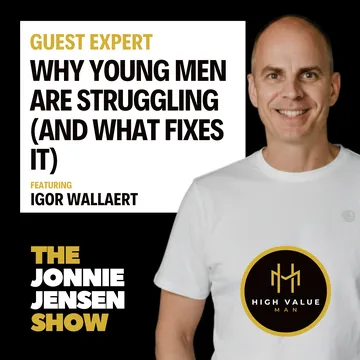
Episode 172 · Monday, 23 February 2026

Why Young Men Are Struggling (And What Actually Fixes It)

A deep dive into the biological and psychological factors stalling young men today and the specific dietary and lifestyle shifts required to reclaim internal agency.

Gen Z MasculinityGAPS DietTestosterone OptimizationDigital DopamineDating MarketIgor Wallaert
By The Jonnie Jensen Show | 55m listen | 17 chapters
Why Young Men Are Struggling (And What Actually Fixes It) cover
The Jonnie Jensen Show · No. 172

About this episode

Igor Wallaert and Johnny Jensen confront the rising tide of hopelessness among Gen Z men as digital dopamine systems and sedentary lifestyles collapse modern masculinity. The Belgian coach details how the polarizing influence of Andrew Tate and the media's reaction to him mirror the cultural disruption of the Sex Pistols, often masking the deeper biological crisis of a generation raised on instant gratification. Wallaert argues that the current epidemic of male isolation stems from a fundamental hijacking of the brain's reward circuitry by high-sensory digital platforms.

Specific dietary shifts are identified as the primary lever for recovery, with Wallaert advocating for the GAPS protocol to repair the gut-brain axis where serotonin and dopamine are produced. The discussion highlights the necessity of animal fats and cholesterol as precursors for testosterone, challenging the demonization of butter and eggs in favor of nutrient-dense satiety. Beyond nutrition, the conversation addresses the 'Nice Guy Syndrome' popularized by Dr. Robert Glover, the neurological impact of rapid-fire children's media like Cocomelon, and the decline of real-world dating confidence due to the fear of social media 'outing' and digital surveillance.

Johnny Jensen reflects on the physical intensity of 1990s rave culture as a healthier alternative to the isolated screen addiction facing today's youth. The segment concludes with a roadmap for transitioning from a victim mindset to internal agency, emphasizing that physical breakthroughs in the gym or kitchen are the essential precursors to navigating the modern dating market and reclaiming social status. Igor Wallaert provides a final call to action for young men to detox from digital 'crack' and return to single-ingredient real foods to restore their natural drive.


CHAPTER 01 / 17 Discussion

Igor Wallaert, Coaching Young Men Through Hopelessness

Johnny Jensen introduces Igor Wallaert, a coach from Belgium who specializes in helping young single men overcome feelings of hopelessness. Wallaert shares his personal journey, noting a health crisis at age 23 that led him to study physical and mental health, eventually becoming a certified GAPS coach and personal trainer. The discussion sets the stage for exploring the differences in challenges faced by Gen Z men compared to previous generations.

igor wallaert· johnny jensen· coaching· young men· mental health· gaps coach

00:00 If you look externally, we have it better than probably any time throughout history. Like comfort-wise, we have so much opportunity. But the problem is that we are also more easily distracted than ever. And I think a lot of men fall into these traps of literally frying their dopamine systems by just cheap leisure and video games, watching Netflix. And so there's no motivation anymore. And there's this drive just disappears if you fry your dopamine systems with these modern things that distract you all the time. Welcome to the Johnny Jensen Show, where modern dads discover how to create the true riches, relationships, and results they deserve.

00:48 Get your high-value man blueprint and join our community at highvalue manproject.com. Let's go. I'm joined by Igor Wallaert, who works with men much younger than me in their journey, which is why I wanted to have Igor on. Igor is a coach. He's from Belgium. And well, I'll let Igor tell you about his journey into being a coach for young men. Good to have you today, Igor. Hey, Johnny, it's great to be here. Thank you for having me. So, yeah, how did I become a coach? Like 10 years ago, there was like this breaking point for me when I was still very young, right?

01:29 Like I was only 23 back then. I'm 33 years old now. Yeah. In which I realized that like my own health was not good. It was not good at all. And I figured out like this is wait, this is not how I'm supposed to be living. And it kind of shocked me as well, right? Because like you're 23, you've always felt kind of great because when people are young, they can do whatever they want, right? Until you reach this kind of breaking point. And then that sent me down like a massive rabbit hole of everything health related both physically and mentally.

02:06 After that, like I was passionate about that for 10 years now. Then I got my certificate as a gaps coach, which is like something nutrition related that most people don't know about, but I can talk about that if you want. I'm also a personal coach certified. And now recently I created a program to help young men, young single men struggling with like a sense of hopelessness to really give them the tools to learn how to thrive. Awesome. Yeah. And that's that's the magic of you being on here today talking because you know in the high value man project is mainly midlife dads, right?

CHAPTER 02 / 17 Discussion

Andrew Tate, Media Influence on Modern Masculinity

The conversation addresses the polarizing influence of Andrew Tate on young men and the media's role in amplifying his reach. While acknowledging that Tate identifies valid problems regarding men feeling lost, the speakers critique his "caricature" of masculinity and the toxic nature of some of his solutions. They compare his cultural footprint to the Sex Pistols, suggesting that media outrage often drives more traffic to his business ventures and coaching communities.

andrew tate· masculinity· social media· sex pistols· role models· media attention

02:45 So there's kids involved, there's relationship struggles, there's like what we're going to do next in life kind of thing. And you're like at the beginning part of that process, like what are we actually going to do in life? Like who am I going to end up with? And, you know, so, but I talk a lot about what's wrong with men today, right? And I have a, I have a teenage son. I have a teenage daughter. So I have the experience of seeing him as a teenager and the experience of her interacting with teenage lads. So this reality for me of what's going on for young men and as a person who's hired people, like recruiting young people or being in the workplace with younger men and just seeing noticing like what I see as a difference in them compared to what me and my mates were like when we were in our

03:33 20s or even when I was in my 30s and 40s and hiring younger men. There seems to be a massive difference in today. So we're going to dig into that and just like show this, is it different or is it the same? Because, you know, if we get down to the shitty end of the stick, depression, addiction, homelessness, suicide, like it literally affects men across the board. Right. And I see, I see, you've used the word already. I see a lot of hopelessness in young men. And of course, there's the whole, I hate using his full name.

04:12 I prefer just to say AT because, you know, one of the things about him isn't that I'm not even that fussed, right? What annoys me is how much attention the media gives him. Right. And I did a comparison the other week about the sex pistols. People talk about the sex. Everyone knows the sex pistols. Sex pistols, like punk band, like influential, you know, generational impact. They sold about 2 million albums. Tiny, really, in the grand scheme of things. You've got one hit wonders who sold more albums than that. And like Rick Astley, like, I don't know, I don't know who's interview up, right?

04:51 Yeah, everyone's heard of that, right? He sold way more albums than that, okay? So this guy, he gets a lot more attention in the media. like then the media talks about him and everyone goes on and searches him and say, oh, he's been searched for more than any other person. No, you lot talk about him and everyone goes off and looks for him. There are way better influences on Instagram and YouTube, people that are doing, speaking good things about masculinity. And bizarrely, some of the stuff that he says, you know, it has a, has, has some sense in it about, you know, men being lost and men needing to rediscover what masculinity means for them. So really good, really good to unpack all that. So like, let's just, let's start with,

CHAPTER 03 / 17 Discussion

Dopamine Systems, Digital Distractions and Hopelessness

Young men are experiencing a sense of hopelessness despite living in an era of unprecedented physical comfort and opportunity. This paradox is attributed to "frying" dopamine systems through cheap leisure activities like video games, Netflix, and social media scrolling. The discussion highlights how constant digital stimulation from a young age tanks motivation and alters body chemistry, leading to a lack of drive for real-world adventures.

dopamine· video games· netflix· gen z· australia· mobile phones· body chemistry

05:35 I don't know, where do you see the state of younger men, young single men? Yeah. So like, I think what you brought up here is a really good point. Like with AT, I think, can I say the name? Because Andrew Tate, I think everyone knows what we're who we're talking about. And I think this is one of the issues. It's not like the issue, but it's like a lack of positive role models, right? For young men, like these young men that do feel this sense of hopelessness, they want to latch on to something. And Andrew Tate is like, yeah, the solution, right? Because, like you said, he does bring up a lot of valid points. He brings up a lot of valid problems and men can relate to that, especially young men these days.

06:19 But I think we both agree on the fact that the solution he brings is not always the correct solution. Like it is in some ways, like you have to work on yourself, et cetera. But it gets toxic quite fast. And it's kind of like a, for me personally, it feels like kind of a caricature. Sorry, if that's a, is that spelt correctly? Caricature of men. Yeah. Do you know what I mean? I think so. You're talking like a slice. It's like a little slice. Yeah, yeah, yeah. It's not what men are supposed to be. It's like a caricature. Oh, yes. Caricature, right? English is not my main language.

07:00 No, that's fine. Like an exaggerated, extreme, not really real version. Yeah. Yeah, yeah, yeah, yeah. Exactly. Yeah, it is. It is. And the other thing that people don't realize is he's actually a businessman. You know, he sells like training products that, you know, young guys are drawn to how to make money online, how to be attractive, how to have adventure. Like, so the more people talk about him, the more young guys go and buy his stuff. Yeah. There's a whole coaching as a community. So they get, it's not like they like pray to the flipping altar of him. Like they get to be part of a community of other motivated young men trying to make it trying to make something for themselves in the world.

07:44 Yeah. And it's, it's crazy how fast, how big he got so fast. Yeah. Like talk about like how much media attention this really got. And like I, I do understand why. Because like I said, men really need to, they're looking for something, right? They're looking for this role model or this thing to cling on to that gives them this hope of like a better, a better outcome for their life. And what, when you say they're, they're looking for hope, like, why don't they have hope? I've got my idea on this, but why don't they have hope? What's going on for them that they're reaching like their 20s, which should be like, yeah, let's go and have, let's go, let's, let's like go on an adventure.

08:25 Like, let's, let's just enjoy life. Like, why are they feeling hopeless? Well, it's, it's, it's just, it's just an internal thing, right? Because if you look externally, we have it better than probably any time throughout history. Like comfort-wise, we have so much opportunity, so much opportunity. But the problem is that we are also easily distracted, like more easily distracted than ever. And I think a lot of men fall into these traps of like literally frying their dopamine systems by just cheap pleasure and like, oh, just video games, watching Netflix.

09:04 And so there's no motivation anymore. And there's this drive just disappears if you fry your dopamine systems with these modern things that distract you all the time. Do you agree with that? Oh, yeah, 100%. So you're talking about mobile phones, talking about not just the mobile phone, but actually what's going on on the mobile phone. I'm gaming, you know, spending hours playing Xbox or PlayStation. It's not that they are intrinsically bad. And this is the thing that people need to get their head around. They're actually quite cool. Like, if you said to me as a young kid, would you like to play this game? I'd be like, that's awesome.

09:43 Are you kidding me? Of course I would. Yeah. Or would you like to watch this guy fall off his bike and smack his head on the pavement? Like, yeah, that's funny. I'm going to definitely watch that. But what we don't talk about enough is. is what's going on with the body chemistry there that we're getting these little hits of pleasure off this device in our hand which can also be lead to other things can also be porn and and and gambling and and just like it's it's it's body chemistry so when you know i'm sort of doing the doing the talk here for you but yeah i get it like like and and these this generation that we're talking about for you gen is gen z right yeah um they've grown up with this so they've had their dopamine tanked completely

10:27 since they were you know 13. and what's going on with the kids now and interesting that australia have banned it right is that you're seeing people push their babies around in buggies with ipads in their hand and instead of actually talking to them about oh look at that bird or look at the leaves or you know what's let's let's talk about pepper pig yeah it's and so so this body chemistry subject is something that is misunderstood by a lot of young people and a lot of just men in general then we think what's missing in my life oh it must be something external it must be something my job's rubbish or my partner's rubbish or i can't find a partner there's no one i'm attracted to

CHAPTER 04 / 17 Discussion

Pornography Consumption, Neuroscience and Imagination

The evolution of pornography consumption is examined, contrasting the "top shelf" magazines of the past with the instant digital access available to Gen Z and Millennials. The speakers suggest that modern video-based porn acts as a massive, low-effort reward system that hijacks male biology. They argue that older forms of media required more creative energy and imagination, whereas current digital habits contribute to a cycle of easy rewards and subsequent emptiness.

pornography· neuroscience· dopamine· millennials· gen z· addiction

11:07 what is no one attracted to because you think that everyone's flipping you know an eight score uh you know because you've been watching it on porn like yeah porn is a really really big one right because that's basically like the biggest reward system we have as men like watching like the sex with women and then you just get that for for free easily yeah that's that's got to be bad right well it's really interesting to dig into the subject of porn because you know i'm 51 right so porn when we grew up you had to go into a shop and reach up off the top shelf and you know see if see if the guy in the shop was selling to you because you weren't old enough or who was the biggest kid in the group

11:51 but there was a degree there of magazine porn that is imaginous you know is there's imagination going on there there's like when you get into the like sort of the body that's kind of the um neuroscience of it and the and the the chemical reward centers like curiously this is how i see it magazine porn there's still a lot of creative energy that goes into looking at it not a video it's like it's like reading the difference between like watching something online or reading a book right it's yeah or and and yeah and going to a play like the the different different experiences yeah having it watching it reading it yeah yeah totally so it's

12:31 because it's just so easily available to everyone right because i i remember when i like i i don't exactly remember when i started watching porn back in the day like i've i haven't watched porn for i don't even remember how long ago i quit but yeah i started watching very early and i think as you mentioned like a lot of people from my generation and the younger generation even because i'm a millennial uh so like generation z it's it's so easy for them to just access all this stuff and what does you know when you're talking to young men about this subject of responsibility like realizing that the problem and the and the and the hopelessness isn't necessarily external it's starts from inside you what's what's their view on it well it's a lot of a lot of denial at first right and a lot of

CHAPTER 05 / 17 Discussion

Victim Mindset, Instant Gratification and Effort

Overcoming a victim mindset is identified as a critical step for young men to regain internal power and agency. The "reward paradox" is discussed, where easy choices lead to a harder life while difficult choices lead to an easier one. Because many young men are wired for instant gratification through digital platforms, they struggle to see the value in long-term efforts like fitness or career building that do not offer immediate dopamine hits.

victim mindset· instant gratification· discipline· motivation· personal responsibility

13:21 like a lot of victim mindset thinking so like a large part of my program actually is like getting out of those victim mindsets because even if you have like the best solution if you operate true victim mindsets nothing's gonna nothing's gonna work right because you always find an excuse to like not do the work to tell yourself that you don't need to do this or that it's just oh it's not worth it right because this and that external external um and if you get rid of victim mindsets it's put it gives you back the power it gives the power back internally so i think that's a very important one and one that i focus really hard on yeah and is is there a sense

14:01 there about like the whole time it takes to get a like time you know effort versus reward so sitting on your ass and playing Xbox or Fortnite FIFA or Fortnite for half an hour is rewarding yeah going for a run if you're unfit not that rewarding going for a run three times a week for six months then you get the reward but they're so detached from effort to outcome yeah because yeah because they're so used to the instant reward right yeah and like that's that's it's kind of the reward paradox in life right like everything you do that is easy now will make your life harder in the future and everything that you do now that is hard will make your life easier but yeah their brain is just and i i can totally relate to this because i was exactly the same right um your brain is just so wired to this this

14:50 easy now that it is at the start, it is very hard to get out. So yeah, it's definitely good to have like some help from communities, whatever, like resources online to get you started. Yeah, yeah. And what's the, what's the pain that these guys are experiencing? What's like, what's what's the sort of like this the secret upset inside them? It's really just this hopelessness and not like not even seeing why they should be doing the work in the first place. And that's that's like the hardest thing because once you get over that tipping point, it only gets easier from there, right? But like actually getting started and finding like that tiny bit of motivation you have left to get out of that hole.

CHAPTER 06 / 17 Discussion

Gut Health, Psychology and Chemical Motivation

The link between gut health and mental well-being is explored through the lens of Gut and Psychology Syndrome (GAPS). Igor Wallaert explains that a significant portion of neurotransmitters like serotonin and dopamine are produced in the gut, meaning poor nutrition directly causes feelings of depression and low motivation. The speakers emphasize that physical and mental health are inseparable feedback loops driven by internal body chemistry.

gut health· gaps· serotonin· dopamine· testosterone· psychology

15:35 I think, yeah, it's just like the hopelessness and them not really seeing why they should be doing this. Yeah. So do you, I mean, obviously we've talked before and you know, looked at some of your stuff. When you start working with a guy, you look more at the body type of stuff. You get them into action, right? Before you start to talk about the mind. Tell us a little bit about that. Yeah, because I think, and this was also for me personally, from my experience, I think like the physical and the mental, they're kind of inseparable, right? Because it creates like a massive feedback loop. If your physical is all out of whack, you're automatically going to feel a lot worse mentally.

16:16 But then at the same time, obviously, if you have like really toxic mindsets, your fixed physical will also be in a bad shape. But I think it's easier to start with the physical. And as a gaps coach, which means like gut and psychology syndrome, by the way, it's like the connection between your brain and your gut. I know better than anyone else that like if your gut is just in shambles because you feed yourself a bunch of toxic stuff all the time, you are going to feel depressed. You are not going to feel as thriving as you should be thriving because as you talked about, like it's just, it's just chemicals inside of your body. And they will make you feel bad, even though there's nothing to feel bad about, right?

16:58 Well, yeah, because our body is geared towards producing good chemicals for us. Yeah, right. Adrenaline, cortisol, like bad if you have too much of it for too long. Good in terms of an adventure and a burst of it because the feeling afterwards is so rewarding. And those feel-good chemicals afterwards, dopamine, serotonin, like they're where motivation comes from. They're where a sense of belonging comes from, you know, and doorphins and from fitness and exercise and oxytocin from love and connection. It's, it's, it's, it's, it's, it's obvious when you talk about it, but when those relationships have all been digital and it's good now that video, you know, like my kids, when they're, well, they call it, I'm on call, leave me alone, I'm on call.

CHAPTER 07 / 17 Discussion

Cooking Basics, Processed Foods and Nutrition

Despite a general awareness of healthy living, many young people lack basic cooking skills and rely heavily on food delivery services. The discussion advocates for returning to simple, single-ingredient "real foods" like eggs and meat to fix gut issues and stabilize blood sugar. A personal anecdote about avoiding instant noodles due to their negative impact on digestion illustrates the importance of choosing nutrient-dense meals over convenient, processed alternatives.

cooking· nutrition· mcdonalds· gut health· micronutrients· processed food

17:46 And they've got, then I got like six or seven of them on screen. So there's, there's a degree of it like that. You know, people say, oh, kids don't talk anymore. My kids talk all the time. And they're, you know, so I'm happy and proud that my kids are so connected with their friends. But I guess the other version of that is when, is when people end up isolated and not many friends. But listen, I've sort of gone off track a little bit there. This, going back to the gut health, the connection between our gut and mind, there's a degree of awareness for young people around what they put in their body and healthy living. I see that on the one hand, you've got young people that drink less, exercise more.

18:26 But then the flip side of that is they don't know how to cook. Food can be delivered to you in flipping five minutes. I just don't do it. I'm pretty sure everybody that gets it, everyone that gets their food delivered by one of those bikes, it's cold, surely. I don't know. And they charge you five quid or five bucks to have it delivered. What's going on with young people there? This whole kind of like they're really healthy, but also they don't know how to cook or feed themselves properly. In terms of your gap skills, what do you see about that? Yeah, well, the first thing is like cooking a lot of meals is like really easy, right? To cook. I think people make it out way harder than it should be. I'm personally someone that like everything I cook is like really, really simple because I don't really mind.

19:12 I enjoy this stuff and I teach people how to enjoy this stuff, by the way, because like you can't, most people don't have the time to cook these amazing meals every day, right? Like, let's be honest. Yeah, yeah, yeah. So, yeah, that's, that's a really big one, like, that they make it out harder than it is. Just teach them like certain, some principles, some easy principles to use to cook all their meals that will make them way healthier and fix the vast majority of their gut issues, basically. So that's like the core of what I do.

19:50 We're building up the basics here of putting these young men back together, right? But there's value here for men of all ages, okay? So eating right is, it sounds like it's bloody obvious, but there's a body chemistry element that goes into eating right as well, yeah? Yeah, yeah, because a lot of the like the dopamine, the serotonin, et cetera, all of this stuff gets created in the gut for a large part. Like all the signals in your body are just completely out of whack if your gut is out of whack because there's a bunch of toxic stuff in your bloodstream that isn't supposed to be there, in your brain that isn't supposed to be there, and it's just causing, well, to put it simply, just a lot of chaos everywhere.

20:33 And so it's really that simple that it's going to make you feel a lot worse. So fixing the guts is probably, for me personally, it's one of the first steps. And cooking those easy meals, just real food, single ingredient foods, doesn't have to be fancy, is one of the first steps. And a lot of the stuff is, you can have like very easy meals that make it taste good. Like no, no more McDonald's burgers every day, etc. Although it's so simple to do, right? Cooking some eggs is just as simple. It takes just as much time as you driving to McDonald's or whatever, or even, yeah, it takes no time at all.

21:14 So that's, that's definitely one of the first things people should be focusing on. Yeah, yeah. Well, I grew up cooking, you know, it was my mum died when I was nine and to whatever degree that played a part in my dad cooking more at the house. We were always involved. My other family, like my aunt, who's now my mum figure, like food's always been a big part of our family. When I went to university, I'd see people eating pot noodles and stuff. And I go, I've never even eaten one of those in my whole life. Like, let's just make a, let's just make a casserole. Let's make a shepherd's pie. And then we'd have like 10, 15 people in our room, like in our, in our apartment thing. Like, can we come up here and eat? Have you at least tried it now, though? I have it. I have it. It gives me heartburn.

CHAPTER 08 / 17 Discussion

Raving Culture, Social Connection and Dopamine

Johnny Jensen reflects on the "work hard, play hard" culture of the 1990s and early 2000s, characterized by raves, physical activity, and intense social interaction. He contrasts this with modern youth who may avoid substances but still feel poorly due to digital dopamine hijacking. The segment suggests that the "carnage" and adventure of physical social gatherings provided a more fulfilling reward than the isolated, screen-based entertainment of today.

raving· clubbing· social connection· dopamine· 1990s· nightlife

22:01 I can go to a Thai place and eat noodles, of course, but those instant noodle things, they just don't work in my gut. And we're not talking about you can't drink beer, you can't party, are we? We're not saying that. Yeah, no. Well, it depends on the person, right? Like if, like with all addictions, it's best to just have like a period where you just go clean. I know, but this is the difference between us lot and you lot. Like we flipping partied hard, you know? We were raving like, you know, 1990. I've got to be honest, till about 2005, right?

22:44 Raving, clubbing, taking pills, smoking weed, drinking beer, drinking vodka, like, like, and as I've just said, for me, as it was, I was cooking. I was always fit. I played rugby. I ran. I entered triathlons. But just the idea of work hard, play hard was just, well, yeah, that's, and we were squeezing joy and fun out of life. I mean, it fascinates me now that kids, you can't get into a pub until you're whatever age. You can't get into a club. Like you go to clubs now and they just sort of half, they half dance.

23:24 Like we would like flipping, be covered in sweat, tops off. Girls just, you know, the only makeup they might have had a lipstick in their pocket, but that was it. Like they didn't worry about what they really looked like. We just had a laugh. I think a lot of that, that stuff gets replaced with like the online world now for a lot of younger people. Obviously, young people still party, still drink. But as you mentioned, I do see that there's a lot of young men, especially that like they don't drink, don't smoke. They don't do any of this stuff, but they still feel really bad. And I think a large part of that is because it's the dopamine, right?

24:06 The online world, everything that is just hijacking your dopamine system, really. Right. So do you think they go and work out and live this healthy lifestyle with the idea that it's going to give them the thing that they're looking for? But it's a bit of a false dream. They look good. Yeah. They just don't feel good. I think they want some certain outcome, right? Instead of just learning to enjoy the process of working out. And I think with it goes back to the dopamine again. Like if your dopamine systems are so fried, it's hard to really enjoy anything because you're always. always looking for that bigger hit and nothing, no normal things like working out or just talking to some friends gives you enough dopamine to have this feeling of like reward.

24:52 Do you agree with that? Well, yeah. And when I relate that back to what we were up to, going to a club, going to a rave, even just going to a house party that was like, you know, you couldn't get to flipping, make everybody move so you could open the front door and let some more people in, you know, like the carnage. So there was that dopamine, that like, whoa, we are like, we are flipping crazy. We would just make like things would be an adventure. Just the very art act of all being somewhere or jumping in the car and driving four hours, five hours to go to a party in a field or to go to a club that was blowing up.

CHAPTER 09 / 17 Discussion

Screen Addiction, Social Fear and Cocomelon

The fear of being "outed" or roasted on social media is cited as a deterrent for young people taking risks in the real world. The speakers also discuss the dangers of "digital crack" for toddlers, specifically mentioning the show Cocomelon for its rapid scene changes and high-sensory input designed to hook developing brains. They argue that these early habits set a baseline for dopamine addiction that persists into adulthood.

screen addiction· cocomelon· social media· parenting· dopamine· toddlers

25:35 Like I think that the excitement of that, let alone meeting new people and chit-chatting, of course, there was no fear either that someone was going to take your picture and boom, send it around the world. So I've talked to a number of other people, obviously, and there's this fear that young people have that they're going to be outed, that they're going to get roasted somehow, that there's an ever-present danger if they step out of line. Right. Yeah, well, first of all, I think a lot of the adventure now is like on the just on the screen, right? Like it's in the video game and it gives you kind of, it's, it's the same dopamine, but it, it, it always leaves you with this emptiness because it's not real, right?

26:19 And deep down inside, you know, it's not real. So like going to the rave, doing this crazy stuff, it's, it still feels a lot better because you're actually living. But people don't even take the action to do these things anymore because they already have the rewards. They already have the dopamine. So they're just stuck. Yeah, I can see that. And even just the whole process. If you think you very rarely do you wake up in the morning and think that game of Fortnite last night was incredible. Do you know what I mean? But in the moment, you're getting the dopamine. Yeah. But there's not the long tail. There's not the long tail of the memory, the connection, the experience, the drive to go.

27:00 But the drive to go and do it again is still there. This is where, this is where gaming and porn and gambling has messed. They've kind of like got the dopamine flipping hack baked into their products. And but, you know, everybody, not just young people, but so many people are now messed up. So when people talk about, oh, we're going to ban mobile phones, you know, like, that's ridiculous. Why would we do that? But this conversation is about the body biochemistry effect of it. And I'm like, to be honest, I'm usually not a fan of like government banning all sorts of stuff.

27:38 But like, I definitely see the value in this because people, it does appear that most, a lot of people don't have like the, I'm not sure if discipline is the right words, but like they don't have the discipline to not give their kids the iPad or just take the easy way and let them watch TV the entire day while they're doing whatever they're doing. In the past, people didn't have that option, right? But now we do. Like I'm a I'm a dad of a three-year-old and it's it's something I take really good care for. Like she doesn't have all this stuff like phone or an iPad. She rarely watches TV. And I think a large part is that we as parents of my generation and younger, we kind of screw it up ourselves because we take the easy route because I haven't done this now.

28:25 And like her baseline, if she can choose, she would rather not watch TV and she would want to do something real, like want to, she want to paint or play or whatever. But I think once you get them into this, like this, this hole, like you give them the iPad, you let them watch TV, then it's going to be harder for them to, and it's just bad habits, right? It's going to be harder for them to get out of these habits. Yeah. That's the reward mechanism kicking in. And people don't understand it. So it just seems like, oh, it's a bit of fun. They're watching a cartoon. Like, let them enjoy it. No, no, you're actually screwing with their mind and their body. They're not screwing with their mind. It's just a cartoon. No, I didn't mean like you're making them mental.

29:10 You're messing with their body chemistry. Right. Plus, also, like, this is also a big thing. Like the cartoons of 20 years ago are not the cartoons of today. Like, if you compare the cartoons of 20 years ago, it was a lot slower. There's a lot less dopamine that you get from watching them as compared to like the biggest one out there is like coco melon. I think everyone, I think everyone knows about cocoa melon. melon that has a toddler from my age. So, and it's it's crazy, right? Like it's a flat every second, there's like a new screen and a new flash of colors and constant sounds, and it just bombards your brain with this

29:50 rewards. And it's it's crazy, it's it's like crack for toddlers, I call it. Yeah, so they're they're abusing it as well. Yeah, these creators are abusing it as well. It's it's twisted, yeah, it's it gigs, it gets them hooked so young, and then like we've talked about, you just fall into this trap and it's so hard to get out on your own if it's all you've ever known, right? Like the easy reward. So, putting this episode together, right? We're now, let's just that piece about adventure and challenges, going out and finding fun.

CHAPTER 10 / 17 Discussion

Testosterone Building, Cholesterol and Animal Fats

The conversation shifts to the natural building blocks of testosterone, identifying cholesterol as a vital component often unfairly demonized by modern dietary trends. Igor Wallaert recommends consuming high-fat meats, butter, and eggs to provide the body with the necessary precursors for hormone production. They argue that micronutrient deficiencies in modern diets lead to constant hunger and tanking testosterone levels in young men.

testosterone· cholesterol· animal fats· micronutrients· gaps· butter

30:29 Is it is that part of what young people should do more? If you were putting a person back together in your coaching, you're talking about their habits, you're talking about what they eat, and we're now talking about like fun and adventure, connection with others. Right. Is that something that you speak into? Is it something that they struggle with? Yeah. And I think like if you start with the basics, like getting the gut health right, uh, detoxing from like the dopamine overdrive, then this drive to do these things starts coming back naturally quite fast, actually, because like a lot of men nowadays, for example, they have really low testosterone because they don't even get the right building

31:08 blocks in their diet to make this testosterone. And for us, as men, like testosterone is our lifeblood, right? Like if you have, if your testosterone tanks, you're going to have way less motivation, way less passion. So getting that better is like also very important. And if that actually improves, then I see like in a lot of young men, they start looking for this adventure a lot more. They start thinking like, oh, I want to do this. But yeah, if you don't have even like the basic chemistry in your body, as we've been talking about this entire episode, it's just so hard to get out of this and start doing these things. But I think it's very important, as you mentioned, because it's the real world.

31:49 It's just real. All the other stuff is fake. It's just a screen. And you don't want to live your entire life having lived just through screen. Yeah. Yeah. And people are increasingly talking about tostone replacement therapy. And young men are talking about it as well. 20 years old sometimes. And it's insane. It's crazy. It's crazy. So just to read, probably you've mentioned some of these things already, but what are the natural building blocks of testosterone? So one of the things that they have been making us very fearful of the last few decades is like cholesterol, for example. But cholesterol is the biggest building block of testosterone. And it's one of the things I've learned through like the GAPS philosophy is that cholesterol is not a bad thing.

32:35 It's not only a good thing, it's really important to get through butter, high-fat meat, etc. Like just real foods. Because if you don't even have the building block, and our bodies make testosterone, sorry, cholesterol, like a large part of our cholesterol is made in the body because it is that important. But it has been proven that if you don't get cholesterol in, you're not going to have enough over the long run. So your testosterone will start tanking. Just the fat-soluble vitamins. Like in the modern diet, there are almost no fat-soluble vitamins. So we like, it's just very micronutrient deficient in general, like no minerals, no vitamins. And a lot of people lack those. And that's also one of the reasons why a lot of people are like overweight because they're constantly hungry.

CHAPTER 11 / 17 Discussion

Satiety, Weight Loss and Dietary Fats

The speakers advocate for replacing processed carbohydrates and seed-based spreads like margarine with natural animal fats to achieve satiety and weight loss. They challenge the conventional wisdom that eating fat makes a person fat, suggesting instead that fat is essential for feeling full and maintaining energy. The segment encourages men to embrace traditional foods like steak and ground beef as the foundation of a healthy diet.

weight loss· dietary fat· margarine· butter· steak· carbohydrates

33:20 Their body is craving these micronutrients, but they always satiate it like for just a short term by having calories with no micronutrients. So that's also junky, which makes them feel full up for a little bit, but it doesn't sustain them until what will be the next natural meal. So where does someone find some of those micronutrients? What's you know, what should people be? Sorry, by the way, I totally under, I learned that about the whole no-fat thing. Like we, I think it was Marcus Aubrey, he's got a good book and he talks about like, yeah, don't pick the no-fat option, you idiot. Yeah. And also like margarine. Margarine is just all those spreads are disgusting. Just button butter.

34:01 It's not like eating like eating a spoonful of it. Throw it all out. It's all this modern processed stuff that is so easy and convenient and that we just kind of learn because my parents, they were, they already did all these things. Like our bread was spread with margarine, et cetera. We were baking with like these synthetic butters, whatever they put into that stuff. Just go back to real foods, like butter, for example, very high cholesterol. It's very important. Personally, I eat a lot of butter. If I do eat bread, which I don't eat often, I just put like a thick layer of butter on the bread.

34:39 That's like that's what bread was for, right? You put a thick layer of butter on it, maybe some raw ground beef. That's the stuff you got to put on your bed. But people, like a lot of my people just eat bread with some chocolate or whatever. They don't get anything from that stuff. So, yeah, what you need to focus on is just mostly animal products, which is also kind of contrary to popular belief. Like a lot of people still think that if you want to be healthy, you got to go for the salads. That's not true. Just go for the steak or the ground beef. That's the cheaper option. But the bulk of our micronutrients that we need is actually in animal products, especially fat.

35:21 So, so meat, dairy. Yes. Yes, eggs, meat, dairy. Okay. As fat as you can get. Like, people are so afraid of eating fat, but you can't have enough fat. And it will also make you feel satiated. So, like, people who are overweight, for example, I always tell them, like, just eat less of the processed carbs, eat more fat. But it's so hard for them because they've been conditioned for so long to fear this fat. And I know it's going to make me fat. But bro, brother, you're already fat. At least just give it a try, right? And it's crazy how fast you can actually drop weight by just focusing on eating more fat instead of like carbohydrates.

CHAPTER 12 / 17 Discussion

Protein Intake, Gym Habits and Simple Principles

Practical advice on protein intake and exercise emphasizes simplicity over complex macro-tracking. While 1.2 grams of protein per kilogram of body weight is mentioned as a general guideline, the focus remains on eating high-quality meat and eggs. The speakers encourage any form of exercise that induces sweating and heavy breathing, noting that physical changes often lead to the mental shifts required for broader life improvements.

protein· gym· muscle building· nutrition· whey protein· fitness

36:06 Yeah. And is there, I'd imagine there's a sense of freedom. I know there is when talking to older men, right? But for younger people to remove some of these societal fears about what they can and can't, you can't eat this, you can't do that. You can't like, I don't know where to turn. But then you say, no, eat the good stuff, get fit and healthy, have some fun. Yeah, yeah, because it doesn't have to be boring like eating salads every day, right? Like who, what, what kind of, what man doesn't want to cook a steak? Like, what man doesn't enjoy a good steak? Let's be honest here. And you know what? My boy, he watches YouTube a lot.

36:45 A different, like good stuff. Thankfully, some good stuff. He can cook an amazing steak now because he watches this American guy talk about cooking good steaks. Yeah. That's a flipping, just one of the magic things about good content online. Yeah. Okay, look, I'm conscious about moving into these different sections. Okay. So now we're hopefully eating a bit right. Is there any other any other macronutrients you want to add to that list before we move to the next bit? Well, well, protein is obviously very important. Just protein. Good. Well, just meat. Meat, really. You can, like, some protein powders are okay. You have, I, I've, you have like these protein powders now that are almost 100% whey.

37:30 That's fine. Um, but the thing is, you don't really need them. Like, I tell, I tell people, if, if you, if, if, if it's easier for you to start like this, that's no problem. But you, you don't need this stuff in the long run. If you, if you eat the meat, if you eat the real, the real food, you get more than enough protein. Um, even if you go to the gym, which I also recommend to everyone, or like at least do some sport that makes you get your blood going, right? No, I what I say is sweating your tits off and blowing out your ass. Sweating your tits. That's that's a good one. That's that's like, and you can do that in 10 minutes or you can do it in an hour.

38:11 That sounds very British. Yeah, okay, yeah. I wouldn't see you sweating your tits off and blowing out your ass. And just for the, just for the, the, the, to help you qualify this, is it like 1.2 grams of protein per one kilogram of weight? Is that an accurate thing that you hear about? Yeah, that's, that's fine. Like, like I said, I don't focus on all this. Um, like, you know, you need to count your macros, your calories. You need to track all this stuff. Um, if you actually enjoy doing that, that's fine. Like, it's not a bad thing to do. But if you just adhere to the very easy principles, like eating real food, get it from a high-quality source if you can.

38:52 If you can't, don't stress too much about it. Just get whatever the best thing is for you, like your budget or your situation. Um, if you adhere to these principles, you don't need to track all this stuff. It's not hard. Your body will change, your mindset will change, everything will get better. Just start making these small steps, right? Just start doing. But there is a slight. I got one of my clients, he says to me, I eat chicken. And I go to him, you're not getting enough protein each day by just telling me, yes, I eat chicken, right? Like, no. So you're going to say, Are you having porridge for breakfast? Are you having butter or with eggs? Are you having a piece of cheese on the side? Like, that's now we're getting towards a protein breakfast and then lunch.

39:35 Is it a bit of meat with a sweet potato next to it and like, you know, and some butter again on it? Like, now we're getting to what? And some nuts on the side, like, like, not like salted peanuts, like some actual almonds or some walnuts and like decent nuts. And then you get into dinner as well and sort of start talking about, you know, again, eat cooking fresh and eating right. Yeah, yeah. Okay, good. So, relationships, young men and relationships. There's what's some of the stresses and strains around that. I've I see men, young men, my boy at school, they're constantly being told you can't do this and you can't touch women, you can't do that, and you can't like all, and then you've got to look out for LGBTQ, and you've got to look out for the, and there's a, there's a, actually, still a large

CHAPTER 13 / 17 Discussion

Dating Market, Social Anxiety and Confidence

Young men are increasingly checking out of the dating market due to social anxiety and a lack of real-world interaction with women. The discussion touches on the fear of being labeled a "predator" and the general lack of confidence required to initiate conversation. Many men now form their perceptions of women based on sensationalized online content rather than personal experience, leading to a disenfranchised view of relationships.

dating· social anxiety· confidence· gen z· predator fear· relationships

40:21 percentage of just straight depending, who cares what color you are, right? But you know, you're just just straight young men who are like, What about me? Yeah, and so then they're what I see is my kids and the lads around him, they seem far less interested in girlfriends. And I think there's quite a lot of associated risk with and trouble with picking the wrong one or getting mucked about or the, you know, it being put on social media if it doesn't go well. What do you see as some of the concerns and constraints that young men are feeling and experiencing about relationships?

40:59 Yeah, I agree with the things you said here. Like for a lot of the men that are that are feeling kind of hopeless, they have kind of checked out for like the dating markets because like they tell themselves like because of all the stuff online, right? They rarely even interact with real women anymore. So what they think a woman is, is just some thing they made up in their mind from bits and pieces they found online, which is mostly just sensationalism to get views. So they kind of checked out and they tell themselves like, ah, it's my life will just be better without a woman. Or it's the other way around where like all they really care about is getting this, getting a girlfriend.

41:39 And they're so desperate for that that they're never going to get a girlfriend, obviously, because it's not the right mindset that attracts a girlfriend if that's all you care about. So yeah, it's like a double-edged sword, or I'm not sure if that's the right term to use, but no, it is, yeah, it is. They want one, but they don't know how to get one. Yeah, yeah. A lot of this stuff just goes back to the social media and like the online. And because if you go outside now, like at a bus stop, if I pass by a bus stop, for example, like all the kids, they're just on their phone, right? Yeah. Instead of talking. So they just get kind of disenfranchised from each other.

42:20 And all they really know is just this online world where everything is like put to the extremes just for sensationalism, right? And just views and clicks. Do you think they have? I always struggle with chatting up girls, right? I've had lots of female mates, lots of girlfriends. Just was like, there was a like a, and it goes back to my mum dying and just stuff like sort of emotional stuff around around that. Now I've discovered and worked it all out. But do young men feel that they like they're able to walk up to a woman and strike up a conversation? Or is there a fear about that they're going to get called a predator or something like that?

42:58 Yeah, I think there's definitely this fear, but there's also just most men lack the confidence in the first place to do something that is perceived as risky for them because like in our brains, although like talking to a woman isn't risk very risky, it is perceived like a threat, right? Because I can relate to you. I was not the best with women when I was younger. I was very scared to talk to women because you think it could potentially be the end of the world, right? And you do need this like this certain confidence to actually get over that fear. And I think a lot of young men these days lack that confidence. I'm not sure if you agree with that. Yes. I think what I see is

CHAPTER 14 / 17 Discussion

Relationship Dynamics, Female Empowerment and Dating Apps

The speakers discuss the shifting power dynamics in modern dating, where women often "call the shots" in the early stages of attraction. They explore how female empowerment and the visual nature of social media have changed the "jeopardy" involved in pursuing relationships. Dating apps are criticized for complicating these dynamics, making it harder for men to find genuine connection and fun without the pressure of long-term expectations.

dating apps· female empowerment· relationship dynamics· masculinity· social media

43:42 younger women, not necessarily that they're aware of this, but call in the shots quite a lot. And this again is a caricature of what previously existed. When in terms of dating and initiating a relationship, women do call the shots. Because if she doesn't say yes to the guy, she doesn't want agree to go out. The guy's just left still, oh, nobody wants me, right? So in that part of it, they get to call the shots. But then, crudely speaking, just like in terms of the experience of mankind, men get to call the shots when creating. the long-term security. Like, will you marry me? Shall we create a family?

44:25 Like, and again, if you want to take it this far, men need to be involved to actually create the family. So, women get to do the choosing. Men get to create the long-term security, which to a degree is what actually women crave: that support and security and safety. So, but in this early stage thing, girls now can basically say, Yes, no, they can pick you up, drop you down. And then, because there's this female empowerment, which rightly so, I have no problems with women having an equal say or an equal voice in any part of life or the world.

45:05 But social media, and you know, if there's an accidental version of this more broadly rather than one individual, women are now very empowered, they look amazing from such a young age, and they do get to call the shots over these young lads who are just like, Oh, hello, can I have a kiss? Can I have a can I so? There's there's so much more concern and jeopardy, and you know, even at a basic level, we me and my mates on me and my girlfriend joke about this. When we were teenagers, you could go to the school disco and snog, kiss, you know, three or four people. That was like that was like a successful night out. Do you know what I mean? Or, you know, go to a club when you were 18, 19.

45:48 It wasn't that you would needed to have sex, it wasn't that you were looking for a long-term partner, you were just having a good time. Yeah, so there was a degree of just fun and connection and sexual energy without it being sex. And I, and what I see is now that this now becomes so conditioned, and there's so much risk with social media that, and, and, and also, dating apps are just a mess for for relationships, and in particular, men's attitudes to how you find people. Yeah, I think the dating apps though definitely don't make the situation any better because it's definitely like better for women to be on that just due to how the dynamics work between like trying to find a mate.

46:28 But yeah, like I think what you mentioned still happens. Um, like people still go out, but I think it's it's a lot less. Um, like what you mentioned, I like getting with the girls. Um, I did those things when I was like 15 to 20, whatever, as well. That was still going on, um, and I think it's it's still going on now, but it's probably a lot less due to how much everything is online now, as I've already mentioned. Yeah, it's interesting. And what there's a book that I, you know, it's in terms of men's coaching, there's a book that everybody sort of shares, which is Dr.

CHAPTER 15 / 17 Discussion

Robert Glover, Nice Guy Syndrome and Masculinity

The book "No More Mr. Nice Guy" by Dr. Robert Glover is recommended as a foundational text for men struggling with passive-aggressive behaviors and a lack of fulfillment in relationships. The discussion centers on the "nice guy" trap—the belief that being overly patient and accommodating will result in love and sex. The hosts argue that men must own their individual version of masculinity to create a healthy balance in their lives and partnerships.

robert glover· no more mr nice guy· masculinity· relationship balance· nice guy syndrome

47:09 Robert Glover's No More Mr. Nice Guy. Have you heard of that book? I've heard of it, but I haven't read it. Igor, you must read this book. Every man must read this book. There's lots of books, obviously, right? But it's about this nice guy mentality of men thinking that if I do enough, if I'm nice enough, if I look after enough, if I'm patient enough, then I'll get what I want. As in, she'll love me, she'll have sex with me, we'll have a good time, like life will be good. So you just go around being as nice as you possibly can in your relationship. And then she's like, Well, this is boring. Yeah. You've allowed the relationship, the balance in the relationship to shift. Whether she thinks she's walking all over you or not, you're letting her walk all over you.

47:53 And I see in, you know, assholes don't come and ask me, don't come and work, want to work with me, like bad guys. They don't want to find out how to be a high-value man. They don't want to, they don't really care about how their relationships are going or how the world sees them, right? But men that do care about that want to have a happy family, want to be successful at both home and work, they're saying to me, what's going on? How can I fix this? How can I create this life that I thought I was working towards? And No Woman Mr. Nice Guy is a real foundational piece in that, that there has to be a masculine energy, however, the individual defines their own masculinity, right? But you have to own your masculinity. It's not about Andrew Tate masculinity, but it is about masculinity.

48:37 Every man should have his own version of his masculinity so that he can show up and be like, yeah, I'm fucking Johnny Jensen. Or yeah, I'm fucking Igor Walla. You know what I mean? You can't be at the back of the room going, well, I don't really know who I am, really. Yeah. I think the most important word you mentioned there is like balance, right? And I think that gets lost a lot in today's world. And I also kind of fell into that trap personally because I think I was kind of a nice guy as well. Like most guys start out like that. And then you find out that, yeah, that's not going to work. So then you go to the other extreme, and then, well, you get some success with that, but long term, that doesn't work as well.

49:21 So I think with everything in life, just finding that balance is like really important. But it's hard in these social media times because everything gets put into like one of the extremes. I think it's hard for young men to navigate this stuff. And then we go back to like the Andrew Tate stuff, right? Like a lot of men are looking for this solution and then Andrew Tate is there. And but that's just one of the extremes again. So you need, yeah, you need to find that balance. But I think it's hard to find like these balanced resources. At least for me, it doesn't appear like there's a lot of this stuff out there. And then I think again, it's just because it's not as sensational as one of the extremes.

50:05 Yeah, absolutely. So what do you tell the young men you work with about relationships and intimacy? So I don't, I personally don't go deep into relationships because it's mostly about like the physical and mental health. I think a lot of that stuff follows if you fix like your internal mindsets. Like if you actually source your happiness and your drive from within and you stop looking for all the external stuff to give you that happiness or sense of fulfillment or whatever, you automatically attract better relationships. Yeah, that's what I believe. Yeah, 100%. I totally with that.

CHAPTER 16 / 17 Discussion

Community, Internal Drive and Real-World Breakthroughs

The final stage of "putting a man back together" involves transitioning from internal health to external action and community. Breakthroughs for clients often involve simple real-world successes, such as having a meaningful conversation or picking up a new hobby. The speakers emphasize that once the body's chemistry is balanced through diet and detoxing from digital dopamine, the natural drive for social connection and adventure returns.

community· oxytocin· motivation· social skills· breakthroughs· hobbies

50:45 Okay, so bringing this full circle, right? Because we've talked, we pretty much started about hopelessness. Then we talked about health and fitness. Then we talked about gut and eating and nutrition. We've had an element in here across the board of the body and the chemicals that go into this. Bringing relationship into it is also about our connection with others, but there's oxytocin that comes along with that. Again, we talk about another body chemical there. Where are young men finding their drive and excitement for life? This is perhaps like what I'm just in my mind as I picture this episode. There's now like this piece here, which is like, okay, right. So where do I go out and find the drive and excitement for life that some the guys are missing?

51:29 Like, you mean, where do I find this in a sense of like an external place? Or I think both. Yeah. You start working with these guys who are experiencing hopelessness, right? And hopefully at the end of it, they're ready to go out and swap that for the excitement and joy in life. Tell me, both from an internal and external point of view, where do you like to see men headed towards? So, yeah, like I like I said, everything starts from the internal, right? But I do think like community is a very important thing that a lot of people are lacking. Probably not only men, but I think men, I don't want to say men value this a lot.

52:08 Maybe women too. But I think men always needed like this sort of community. But you just got to start with the internal. And if you start taking care of yourself, you start doing the work, you will have the drive to actually do things that make you uncomfortable, that seem a bit scary. You may go approach that girl that you see on the street and just talk to her, right? But if you're just stuck in this dopamine hole, low testosterone, low drive, you're never going to do any of these things. So I personally think there's no specific external place where you can start living this life. It just starts from within and then you will find your way. You will find these things.

52:51 Your outcomes will get better. And what are some of the, I don't know, if you think about some of your clients and stuff, what are some of the breakthroughs you've seen with guys you've worked with? So mostly it's like men that are very stuck in the online world. And a lot of the breakthroughs are that they actually start really, really enjoying like the doing the stuff, like going to the gym. They start enjoying conversations. Like they tell me like, I had this conversation with this person today, which is like very basic, simple stuff, right? But for them, it's really a big difference because they didn't have any of this stuff before because even they didn't even have the motivation to do the most basic stuff because everything was already given to them through their screens.

53:37 Yeah, it's mostly like people that are just stuck in the online world that I get. I'm not sure if that's for all the men that feel hopeless, but that's mostly what I'm seeing. So a lot of the breakthroughs really is just getting back to that basic stuff that you talk about, like going to a party or whatever, or just going out with your friends, doing something real, picking up that new hobby. Beautiful. Yeah, absolutely. Awesome. Tell me and tell the listeners basically the kind of men you work with, where they can find you. and really just to remind them what it is you can do for them. Yeah, so I work with young single men that

CHAPTER 17 / 17 Discussion

Igor Wallaert Coaching Services and Outro

Igor Wallaert provides his contact information, including his website and Instagram handle, for young men seeking coaching to overcome hopelessness. Johnny Jensen concludes the episode by encouraging listeners to join the High Value Man Project community and download the "high-value man blueprint." The show ends with a call to action for dads to take responsibility for creating the relationships and results they deserve.

igor wallaert· johnny jensen· high value man project· coaching· belgium

54:18 feel hopeless. They don't really see a point in doing the work or whatever. So it's hard to let them get the first step. But I know from my own personal journey, there is always a breaking point in your life where you are going to feel like, okay, I have to do something about this. And if this is you, that you're the man I work with, because obviously you're going to have to do the work. I help you, but you're going to have to do the work. And you can just find me on my website, which is ihorwalartcoach.com. I have an Instagram, which is just Igor Walla, but it's probably going to be hard to.

54:57 I'll just put a link or whatever. It's Igor, I-G-O-R, and then Walchacht. W-A-L-L-A-E-R-T. Yeah, exactly. There you go. We'll put it in the show notes anyway. Igor, great to connect. I really appreciate your time today. I'll hit the goodbye and see you on the other side. So hold tight. Cheers out. I had an amazing time. Johnny, thank you very much for having me. You're welcome. Thanks for tuning in to the Johnny Jensen show. Be sure to subscribe, leave a review, and share it with fellow dads.

55:35 Creating the life you deserve starts with you. Get your high value man blueprint and join our community of motivated modern dads at highvalumanproject.com. Let's go.