

Can Google index your podcast website? We checked the major podcast hosts
A podcast can be available in every major listening app and still have a weak presence in Google. Distribution and web search are separate systems. An RSS feed sends episodes to podcast apps. Google discovers web pages that its crawlers can fetch, understand and index. A podcaster's report that Riverside was preventing Google from indexing a hosted website prompted us to test the claim across the market.[1] We audited representative public pages from major podcast hosting and publishing services on 12 November 2026. The results were more mixed than the common claim that podcast hosts hide every episode from Google. Riverside was the clearest case of a host explicitly preventing its generated podcast websites from being indexed. Spotify for Creators used a different mechanism that blocked crawlers from fetching its public podcast profile and episode paths. Most of the other services we checked allowed their sampled pages to be crawled and indexed, although many had weaker search setups such as missing sitemaps or thin page content. Getting a website from a podcast host is only the first check. Search engines must also be able to fetch the pages, index them and find enough useful material to match a search.
What we tested
The audit covered 28 representative host, website, player, directory and sharing surfaces. One bCast URL could not be reached during the test. A Blubrry directory URL redirected to the publisher's external website, so it was not comparable with a platform-hosted episode page. For each reachable sample, we checked:
- the HTTP response
- page-level meta robots instructions
- the
X-Robots-Tagresponse header - the applicable
robots.txtrules - canonical URLs
- whether
/sitemap.xmlreturned a usable sitemap - whether episode text appeared in the page
- rendered metadata when JavaScript could change the result This was a point-in-time technical audit, not a ranking study. We checked one representative surface per service in most cases. Platform templates, account settings and generated sites can change. A page that permits indexing is also not guaranteed to appear or rank in Google.
The main findings
Riverside explicitly prevents indexing
Riverside's own help documentation says, "Your website is not indexed by search engines. It is for direct linking only."[2] The live Riverside-hosted site we tested returned this page-level directive:
<meta name="robots" content="noindex, nofollow">
Its robots.txt file allowed crawling, while /sitemap.xml returned a 404 response.[3]
The important part is the noindex instruction. A crawler can fetch the page, but the page tells the search engine not to include it in the index. The missing sitemap may make discovery harder, but it is not the direct cause of exclusion.
Riverside remains useful for recording and editing. Its generated website should not be treated as the show's Google search archive. A separate, indexable website or archive is needed if web search is part of the show's growth plan.
Spotify for Creators blocks public podcast paths from crawling
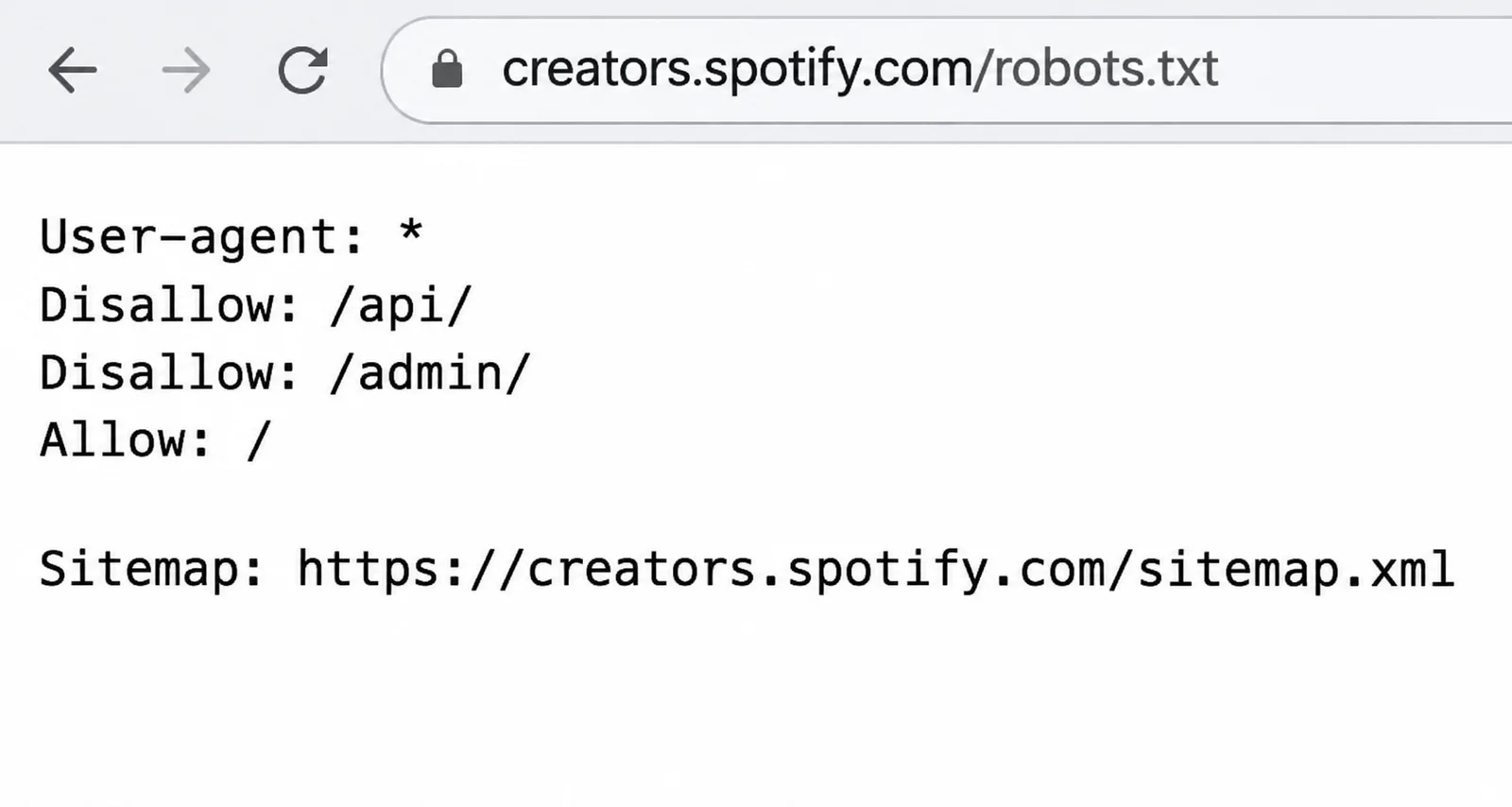
Spotify for Creators uses a different mechanism. The sampled episode had no page-level noindex instruction, but the current robots.txt file allows a small set of marketing paths and blocks everything else:[4]
User-agent: *
Allow: /$
Allow: /features
Allow: /resources
Allow: /switch$
Disallow: /
Public podcast profiles and episodes sit beneath paths such as /pod/profile/.../episodes/..., which fall under that blanket block.[5]
Spotify for Creators blocks compliant crawlers from fetching those hosted podcast pages. It does not add a meta noindex tag to every episode.
Some blocked URLs may still appear in search results. Google can sometimes show a URL it learned about elsewhere, or retain an older result from before a rule changed. That does not make the page a dependable search surface. If Google cannot recrawl the content, it cannot reliably process page changes or use the full page text.
Appearing inside Spotify and owning a crawlable web archive solve different problems. Spotify helps people listen within Spotify. An indexable archive gives the open web a stable set of pages for episodes, topics, guests and transcript sections.
Transistor shows why the exact surface matters
A quick check of share.transistor.fm could produce the wrong conclusion about Transistor as a whole.
The sharing and transcript domain blocks Googlebot from /, and its root sitemap URL returned 404 during our test.[6] The customer podcast website we checked at a show-specific transistor.fm subdomain behaved differently. Its episode page allowed crawling, displayed episode text and was findable in Google.[7]
Transistor should therefore not be described as blocking all customer podcast websites. The narrower finding is that one sharing and transcript surface is blocked while the generated customer site we tested is indexable.
This is why host-level SEO claims need URL-level evidence. A player, transcript viewer, sharing page and customer website can use different domains and different rules.
Most sampled host pages were technically indexable
The majority of reachable pages in the audit did not carry a page-level noindex instruction and were not covered by a relevant crawl block.
Buzzsprout, Podbean, RSS.com, Spreaker, Pinecast, Podpage, Fireside, Audioboom, Podomatic, Podhome and several others returned indexable samples. Simplecast's sampled hosted episodes surface was also indexable.[8]
RedCircle needed a rendered-browser check. Its initial HTML appeared to point the episode canonical at the show page, but the rendered page updated to a self-referencing episode canonical.[9] A static request alone would have produced a false positive.
Technical permission is only the first test. An indexable page can still offer little search value if it contains only a player, a title and a short feed description.
Results by platform
"Indexable" in this table means that our sample returned a usable page, did not tell search engines to exclude it and was not covered by an applicable crawler block. It does not mean that Google has indexed the page or that the page will rank.
| Service or surface | Audit result | Sitemap at tested origin | Assessment |
|---|---|---|---|
| Riverside hosted site | noindex, nofollow |
404 | Blocked from indexing |
| Spotify for Creators public pages | Public podcast paths blocked in robots.txt |
Marketing-only sitemap | Blocked from crawling |
| Simplecast hosted sites | index, follow; episode links rendered |
Not retested | Indexable |
| Transistor customer site | No noindex; episode text rendered |
Customer-site dependent | Indexable |
| Transistor share and transcript domain | Googlebot disallowed from / |
404 | Blocked surface, not the whole host |
| Buzzsprout | No noindex; canonical resolved to episode slug |
Available | Indexable |
| Podbean | robots=all; self-referencing canonical |
Available | Indexable |
| Captivate | No noindex |
404 | Indexable; no sitemap observed |
| Castos | No noindex |
404 | Indexable; no sitemap observed |
| RSS.com | No noindex; self-referencing canonical |
Available | Indexable |
| Acast | No noindex; self-referencing canonical |
404 | Indexable; no sitemap observed |
| Spreaker | No noindex; self-referencing canonical |
Available | Indexable |
| RedCircle | No noindex; rendered self-referencing canonical |
Available | Indexable |
| Omny Studio | No noindex |
404 | Indexable; no sitemap observed |
| Libsyn hosted sites | No noindex |
404 | Indexable; no sitemap observed |
| Pinecast | No noindex; self-referencing canonical |
Available | Indexable |
| Ausha smartlink and episode page | No noindex |
404 | Indexable; no sitemap observed |
| Podpage | No noindex; self-referencing canonical |
Available | Indexable |
| Fireside | No noindex; self-referencing canonical |
Available | Indexable |
| Audioboom | No noindex; self-referencing canonical |
Available | Indexable |
| ART19 | No noindex |
404 | Indexable; no sitemap observed |
| Podomatic | No noindex; self-referencing canonical |
Available | Indexable |
| Megaphone CMS channel | /channel explicitly allowed |
404 | Channel page indexable; not a full podcast website |
| Podcast.co | No noindex on sampled episode |
404 | Indexable; no sitemap observed |
| Podhome | No noindex; self-referencing canonical |
Available | Indexable |
Zencastr public /z/ episode |
No noindex; path not blocked |
Available | Indexable |
| Blubrry directory URL | Redirected to the publisher's external site | External site | Not comparable |
| bCast | DNS lookup failed during the audit | Unavailable | Inconclusive |
noindex, robots.txt and sitemaps do different jobs
These checks are often grouped together as "SEO," but they control different parts of discovery and indexing.
A meta robots noindex instruction
A noindex instruction tells a search engine not to include a page in its index. The crawler may still fetch the page and read the instruction. Riverside's hosted site used this mechanism.
A robots.txt crawl block
A robots.txt rule tells compliant crawlers which URLs they may fetch. Spotify for Creators used this mechanism for its podcast profile and episode paths.
A blocked URL can occasionally appear as a bare or stale result because Google discovered the address through another page. The blocked content is still a poor foundation for search visibility because Google cannot depend on fetching and processing it.
A missing XML sitemap
A sitemap lists URLs that a site wants search engines to discover. It can help with large archives, new pages and pages that have few incoming links.
A missing sitemap does not make a page unindexable. Search engines can discover pages through links. Several services in the audit had indexable samples even though /sitemap.xml returned 404.
A canonical URL
A canonical tag tells search engines which URL represents the preferred version of similar or duplicate content. If an episode page points its canonical at a show homepage, the episode may struggle to become a separate search result. JavaScript can update a canonical after the initial HTML loads. RedCircle's page showed why a rendered check is needed before reporting a canonical problem.
Thin or hidden page content
A page can pass every technical check and still give Google little useful material. A player and two sentences do not expose the depth of a one-hour conversation. Transcript text also needs to be part of a crawlable page. Text trapped in a blocked viewer, an iframe or a client-only interface may not provide the same dependable search surface as structured content in the page.
How to check your own podcast website
Start with one recent episode and one older episode. Use the public URLs that a listener would open, not the private dashboard.
- Open the page in a private browser window and confirm that it loads without a login.
- View the page source and search for
noindex. - Check the response headers for
X-Robots-Tag. - Open the site's
/robots.txtfile and confirm that the episode path is allowed. - Check the canonical tag after the page has rendered.
- Look for a sitemap and confirm that it contains public episode URLs.
- Read the page without relying on the player. Check whether the title, summary, guest, topics, chapters and transcript text are present.
- Use Google Search Console's URL Inspection tool if you control the domain.
- Search Google for the exact episode title and run a
site:search as a rough secondary check. Do not treat asite:search as a complete index report. Search Console is the better source for a site you control.
What podcasters should ask before choosing a host website
A hosting website can be perfectly adequate for playback while doing little for archive discovery. Ask the provider:
- Can Google crawl and index every public episode page?
- Does each episode have a stable, self-referencing canonical URL?
- Are episode pages included in an XML sitemap?
- Is the transcript present in crawlable HTML?
- Can related episodes, guests and topics link to one another?
- Can the archive use your subdomain or custom domain?
- Can you verify the archive in Google Search Console?
- What happens to the URLs if you leave the service? The last question matters because search value attaches to URLs over time. A host migration is harder when every old episode link disappears.
Indexable does not mean useful or guaranteed to rank
The audit found fewer platform-wide blocks than expected. That does not remove the wider podcast SEO problem. A useful search archive needs more than permission to be indexed. It needs stable episode pages, text that reflects what was said, clear titles, crawlable transcripts, internal links and a structure that helps people move between related material. Rankings still depend on relevance, page quality, authority, links, competition and search intent. No transcript product or podcast website can guarantee them. The practical distinction is:
- Distribution gets the episode into listening apps.
- Indexability allows a search engine to consider a web page.
- Useful page content gives the search engine material to understand.
- Relevance and authority affect whether the page ranks for a query. Skipping the second step makes the rest impossible on that URL. Passing it only means the page can compete.
Where PodHerd fits
PodHerd works alongside an existing podcast host. It connects to the show's RSS feed and publishes a searchable archive with structured episode pages, chapters, topics, transcript content and links to exact moments. This gives the show a separate web search surface without asking the owner to replace the service used for recording, distribution or analytics. Grow the Herd can place the archive on the show's subdomain and includes Google Search Console integration. Lead the Herd supports a custom domain and branding. PodHerd makes the archive crawlable, structured and measurable. Google still decides what to index and rank.
The conclusion from this audit
The broad claim that most podcast hosts add noindex to every episode did not survive testing.
The narrower result is more useful. Riverside explicitly prevents its hosted websites from being indexed. Spotify for Creators blocks crawlers from its public podcast profile and episode paths. A Transistor sharing surface blocks Googlebot, while the sampled customer podcast site remains indexable. Most other sampled host pages allowed indexing, but their sitemap coverage and page usefulness varied.
Podcasters should judge a host website as a search surface, not only as a player. Check the exact public URLs, the rules that apply to them and the content that a crawler can read.
If your current host handles distribution well but leaves the back catalogue difficult to search, PodHerd can add an indexable archive without changing where the podcast is hosted.
Start a seven-day PodHerd trial or see a searchable archive in action.
Sources and pages tested
We ran this audit on 12 November 2026. Hosting platforms can change their templates and crawler rules, so check the linked pages for their current configuration.
[1] Reddit report that prompted the audit
[2] Riverside website indexing policy
[3] Riverside sample site
[4] Spotify for Creators robots.txt
[5] Spotify for Creators sample episode
[6] Transistor share-domain robots.txt
[7] Transistor sample episode
[8] Simplecast sample episodes page
[9] RedCircle sample episode